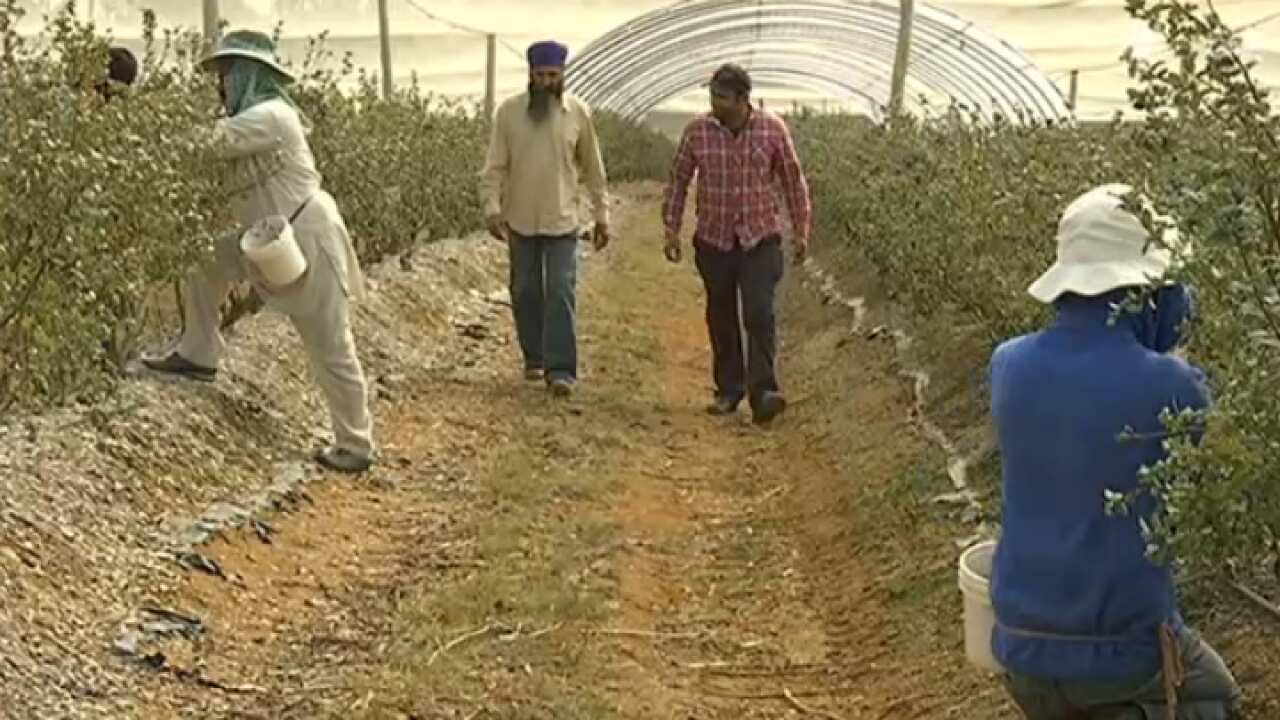
Blueberry production has more than doubled across Australia in the past three years, much of it driven by a small community of former fruit pickers in New South Wales.
Coffs Harbour on the NSW mid-north coast has long been known as banana country, with green plantations hugging the slopes that stretch towards the ocean.
In recent years, a new crop has appeared on the horizon as blueberries are proving to be a big hit with consumers and producers.
Phillip Wilk, from the New South Wales Department of Primary Industries, said the industry is worth $120 million.
"There's a lot of doom and gloom in horticulture with a lot of industries declining, but this one is really growing," he said.
Fourth generation Australian Satpal Singh was among the first in the region to realise the fruit's potential.
"Our family moved here in about the 1950s, in Woolgoolga, and that was predominantly to work as labourers in the banana industry,” he said.
“As we settled here, we were able to buy the banana farms because they were a smaller plot of land. Basically we worked, toiled for a long time."
Woolgoolga, just north of Coffs Harbour, is home to a flourishing Indian Sikh community.
Many are descendants of migrants who travelled to the region to work as farm labourers from the late 1800s.
A century later, Satpal Singh's family found the banana industry they'd invested in had begun to decline as the pace picked up for growers in northern Queensland.
"We weren't making enough living to get food onto the table," he said.
"It wasn't mainly just [something we wanted to do], it was more that we were pressured to try something new."
OzGroup began in 2001 as a stand-alone company. Back then, there were only around four local growers but that number has since blossomed to around 120.
The group now acts as a co-op, providing storage and packing facilities for growers in region.
Co-op director Gurmesh Singh, Satpal's cousin, said business is booming.
"It was an easy change for people to make, and a lot of people have made that change,” he said.
“They've bought new farms and converted them into blueberries as well. You need relatively sandy, well-draining soils, frost-free would be ideal, and relatively flat, although some of the hills around here are pretty steep."
Phillip Wilk said the growers themselves are partly responsible for the industry's success.
"They're really enthusiastic growers," he said.
"They're willing to trial all sorts of things, and look they've shown their faith in the industry because there's huge investment in infrastructure involved in setting up here."
He believes demand is driven by the fruit’s healthy image, and that the creation of new export markets will help Australia's blueberry industry to keep growing.
"I'd say within the next two to four years we'll see another 50 per cent jump in the industry but you are always looking at external markets as well, to try and relieve some of that pressure on domestic markets, because it's very much a local market at the moment."
For growers, it’s a labour-intensive business, and the small berries can be high maintenance.
Farmer Paul Shoker is among those with no plans himself to swap his crop.
"I think it's kept people on the land," he said.
"It's been good in that sense and it is contributing to the local economy, but I think a lot of it has been what you'd almost call herd mentality, you know, following each other. I guess they will reach a point in the next couple of years of oversupply."
For Satpal Singh, the success of the industry means he can continue working the land as his ancestors did.
"We are lucky that we're still doing the same work they were doing, providing food for people,” he said.
“That's actually always a really satisfying way to get to bed at night, to say that you're putting food on the table for people to eat."
Share


