
They're simple but wreak havoc: oil drums packed with hundreds of kilograms of explosives and metal fragments, which are then rolled out of a helicopter.
They have reduced buildings to rubble and claimed hundreds of innocent human lives.
And their complete and utter devastation continues to be played out in endless videos uploaded to YouTube.
A sharp increase in the use of barrel bombs by the Syrian government against rebel-held areas of Aleppo, in the country’s north, has claimed hundreds of lives in the two weeks since the Geneva peace talks began, according to the British-based Syrian Observatory for Human Rights.
News that makes sense
Your trusted source for staying up-to-date with the world around you. Get free daily news updates and analysis, straight to your inbox.
The organisation said at least 246 people, including 73 children, had been killed in just the last five days.
The escalation in violence, in a bid to recapture territory and drive residents out of rebel-held areas, has diminished hope among Syrians that the peace talks, which are due to resume February 10, will force an end to the three-year conflict.
'I think the regime will retake all the rebel areas,' a Syrian refugee living in Beirut, who wanted to remain anonymous for fear of his family’s safety in Aleppo, said.
'The regime’s plan is to destroy the road between Aleppo and Turkey. My brother who is still in Aleppo and cannot leave said the regime would not stop. They have helicopters; the regime will not give up.'
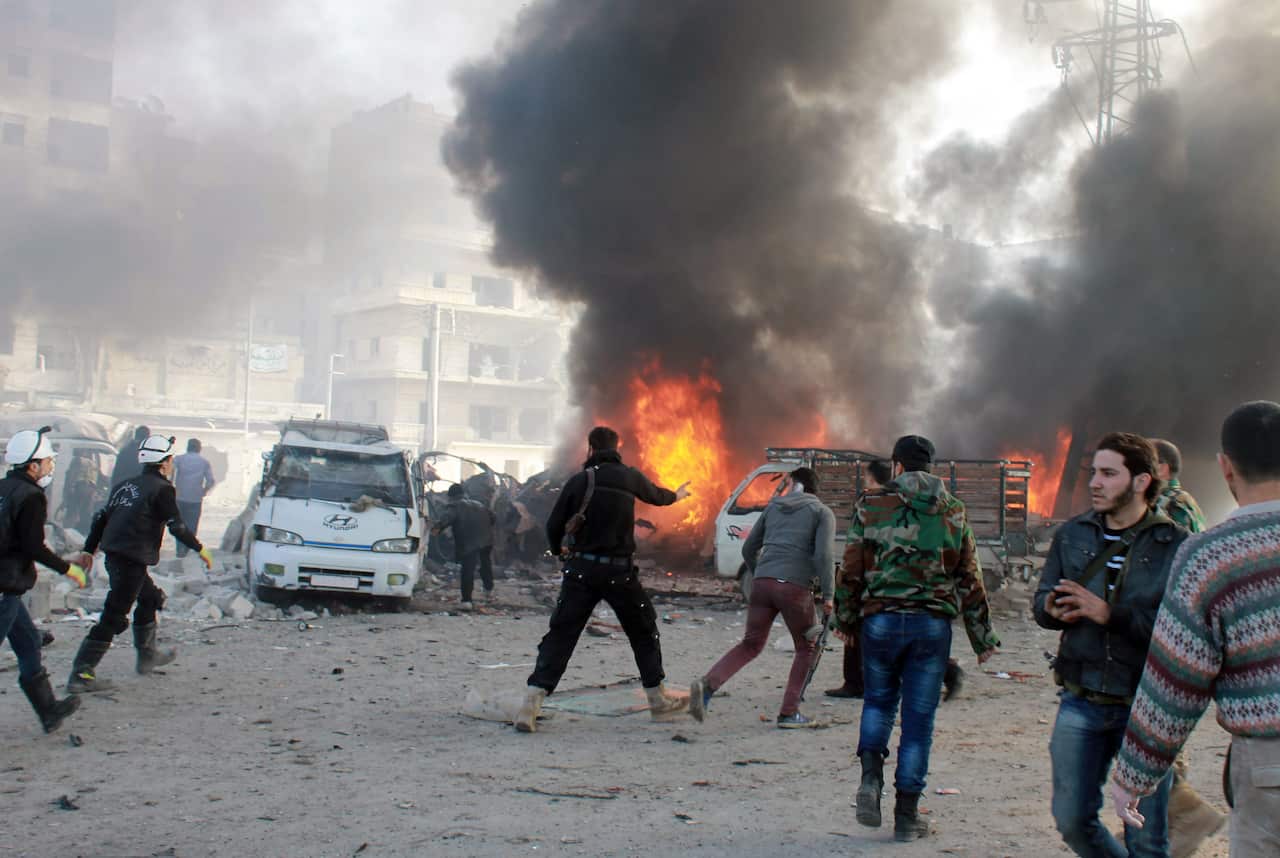
Experts said the use and efficiency of DIY barrel bombs had changed drastically since they were first used in Aleppo in August 2012.
'Earlier types were pretty much any container filled with explosives and pieces of scrap metal, and lit with a wick fuse,' British blogger Eliot Higgins, who monitors and investigates the use of weapons in Syria, said.
'The problem with the wick fuse is if it was too short it would detonate mid-air, and if it was too long the barrel bomb would hit the ground and possibly shatter, separating the fuse from the bomb.'
Nowadays increasingly more effective barrel bombs had been designed, he added.
'It is much larger, with an estimated weight of up to 2000lbs (907 kilograms), has a DIY impact fuse, so it's more reliable, and has fins welded on it so as it falls out the helicopter it points downwards, ensuring the impact fuse hits the ground first.
'This is far more effective than earlier versions, and the same design has been adopted across the country, which itself is unusual, as the earlier wick fuse barrel bombs varied in their design depending on where they were being made.'
US secretary of state John Kerry has described the Syrian regime's relentless use of so called barrel bombs as barbaric. The bombs have killed more than 150 in rebel held areas of Aleppo in the last 4 days alone. According to activists, 5 children were among the latest casualties when a mosque which was doubling as a school took a direct hit.
The weapons have been captured on video both in storage and physically rolled out of government helicopters.
They have reduced apartment buildings to rubble and left crowds searching for loved ones amid the debris, more videos on YouTube showed.
Since government forces unleashed the barrel-bombing campaign on rebel-held areas of Aleppo last week, almost 10,000 Syrians have fled to the Turkish border.
But the country, which hosts about 700,000 refugees, is only accepting the small number of Syrians who have passports as refugee camps swelter to the brink.
US sectary of state John Kerry slammed the attacks, saying: 'It is the latest barbaric act of regime that has committed organised, wholesale torture, used chemical weapons, and is starving whole communities by blocking delivery of food to Syrian civilians in urgent need.'
Last December Western powers proposed a UN Security Council resolution to condemn the use of barrel bombs but Russia, a staunch ally of Syria’s President, Bashar al-Assad, has repeatedly blocked such efforts.
Sophie Cousins is an Australian journalist based in Beirut and Delhi.







