
Iraqi Prime Minister Haider al-Abadi announced the launching of an offensive to retake the Islamic State stronghold of Fallujah after the military told residents on Sunday to get ready to leave before fighting started.
"Zero hour for the liberation of Fallujah has arrived. The moment of great victory has drawn near and Daesh has no choice but to flee," Abadi said on his official Twitter feed, using an Arabic acronym for the jihadist group.
He said the offensive would be conducted by the army, police, counterterrorism forces, local tribal fighters and a coalition of mostly Shi'ite Muslim militias. A U.S.-led coalition that has bombed Islamic State in Iraq and neighboring Syria for nearly two years was expected to provide air support.
Fallujah, a longtime bastion of Sunni Muslim jihadists, 50 km (30 miles) west of Baghdad, was the first city to fall to the jihadists, in January 2014, six months before the group declared a caliphate spanning large parts of Iraq and Syria.
News that makes sense
Your trusted source for staying up-to-date with the world around you. Get free daily news updates and analysis, straight to your inbox.
Iraqi officials said Shi'ite militias, including ones backed by neighboring Iran, may be restricted to operating outside the city proper, as they were largely in the battle for Ramadi, to avoid aggravating sectarian tensions with Sunni residents.
The Iraqi army, police and the militias, backed by coalition air strikes, have surrounded Fallujah since late last year, while the jihadists have been preventing residents from leaving for months.
Families who cannot flee should raise white flags to mark their location in the city, the military's media unit said in a statement on state television, a tactic employed with some success in other recent offensives.
Deputy District Council Chairman Falih al-Essawi said three corridors would be opened for civilians to camps west, southwest and southeast of the city, and a subsequent military statement said some residents had begun to flee.
"Our goal is to liberate civilians from Daesh's repression and terrorism," Abadi said in a televised speech.
Trapped civilians
Residents told Reuters about 20 families set out from a southern front-line neighborhood late on Saturday but that only half of them made it out. Some were intercepted by Islamic State, while others were killed by explosives planted along the road by the jihadists, the residents said.
The United Nations and Human Rights Watch said last month that residents were facing acute shortages of food and medicine during a siege by government forces. Aid has not reached the city since the Iraqi military recaptured nearby Ramadi, the Anbar provincial capital, in December.
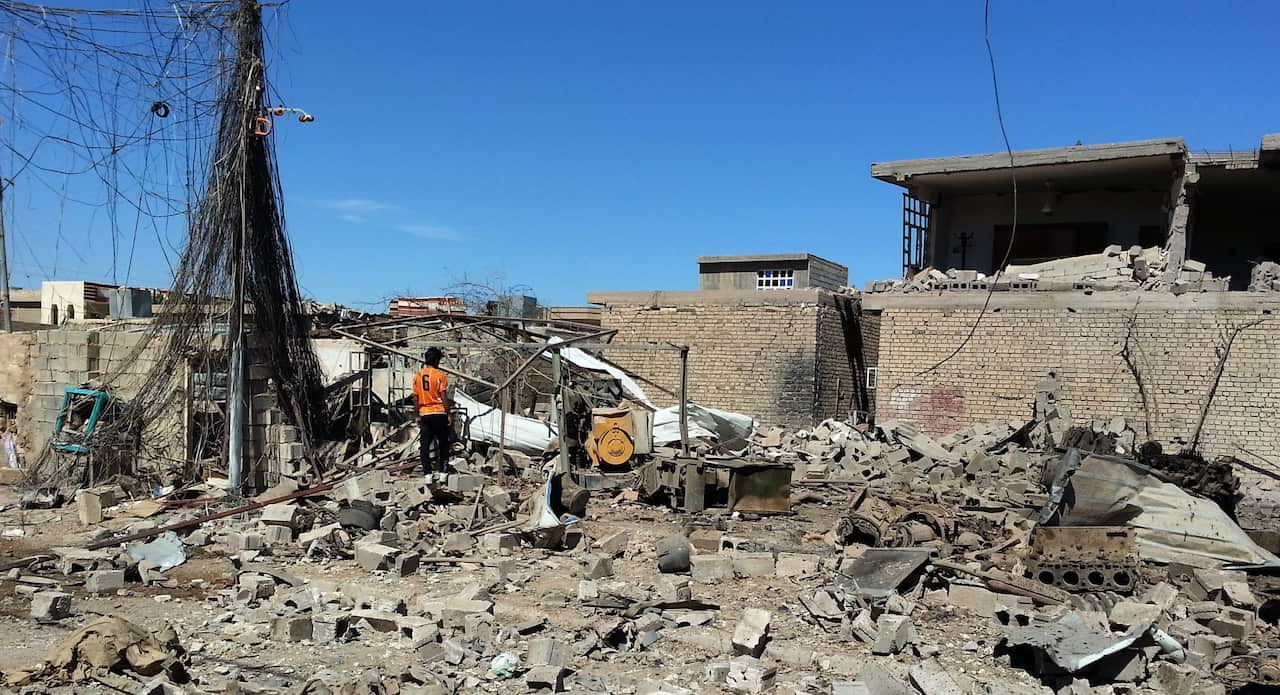
Essawi told a local television channel on Sunday that more than 75,000 civilians remained in Fallujah, in keeping with a recent U.S. military estimate of 60,000 to 90,000. About 300,000 people lived in the Euphrates River city before the war.
Known as the "City of Minarets and Mother of Mosques", Fallujah is a focus for Sunni Muslim faith and identity in Iraq. It was badly damaged in two offensives by U.S. forces against al Qaeda insurgents in 2004.
Saad al-Hadithi, a spokesman for Abadi, said the city's "liberation" would help restore normal life to Anbar province, over which Islamic State took nearly complete control in 2014.
Following recent government offensives in Rutba and Hit, control of Fallujah would secure the road more than 500 km (300 miles) from Baghdad to the Jordanian border and northwards to Haditha, 190 km (115 miles) northwest of the capital.
But Islamic State still controls vast swathes of territory and major cities such as Mosul in the north. Iraqi authorities have pledged to retake Mosul this year, although some officials question in private whether the army will be ready in time.







