

How do you tag a swarm of angry honey bees?
You create a hive of activity in a refrigerator so they can chill out.
Once the buzz dies down, you know the cold air has taken the sting out of the insects so tiny sensors can safely be attached to their backs.
Thousands of bees are being tagged this way in a world first research program that aims to improve bee pollination and productivity.
The CSIRO led "swarm sensing" project also aims to better understand what's causing Colony Collapse Disorder (CCD), a condition decimating honey bee populations worldwide.
"Internationally it's important because the world is worried about bees disappearing," CSIRO science leader Dr Paulo de Souza told AAP.
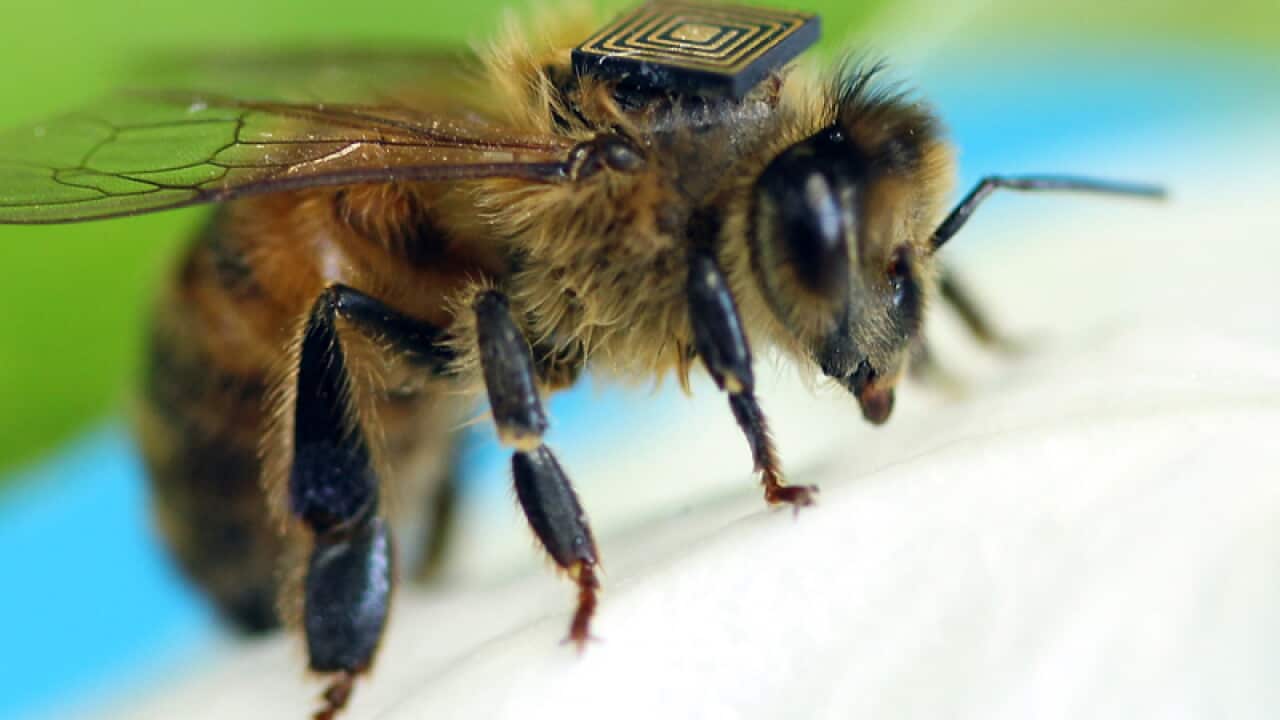
Up to 5000 sensors, measuring 2.5mm x 2.5mm, are being fitted to the backs of bees in Hobart, Tasmania, before being released into the wild.
Each day, bees are captured from hives and taken to the lab where they are refrigerated for a short time so they fall into a state of rest.
The radio frequency identification sensors are then strapped to their backs with adhesive and, after a few minutes, they fly away back to their hives.
The sensors record the bees passing particular checkpoints, allowing researchers to use signals to construct a comprehensive 3D model and visualise how the insects move through the landscape.
Some bees will feed at sites with trace amounts of commonly used chemicals, allowing researchers to assess how pesticides, believed to be a cause of CCD, affect bee movement.
As honey bees are creatures of habit, any change in behaviour indicates a change in their environment.
Better understanding bee behaviour, Dr de Souza says, will allow farmers and fruit growers to maximise the potential for pollination, boosting productivity and helping in monitoring biosecurity risks.
While Australia is free from the threat of CCD and the destructive varroa mite, farmers are becoming worried about declining pollination.
Some Tasmanian apple growers had reported pollination rates had significantly dropped last season with production falling about 30 per cent, Dr de Souza said.
About one third of the food we heat relies on pollination, he said.
The CSIRO is working with the University of Tasmania, beekeepers and fruit growers to trial the "swarm sensing" technology.
The next stage of the study is to reduce the size of the sensors to a mere 1mm so they can be attached to smaller insects, including fruit flies and mosquitoes.
"It (swarm sensing) is likely to be used for a lot of the creatures we haven't been able to track so far," Dr de Souza said.
"It's a new tool to understand ecology and the relationship among the species ... how bees, wasps, misquotes interact and how they work."
SWARM SENSING RESEARCH:
*Radio frequency identification sensors measuring 2.5mm x 2.5mm
*Attached to the backs of bees to monitor movement
*Work like a vehicle's e-tag, recording when the insect passes a particular checkpoint
*Information sent remotely to a central location where researchers use signals from sensors to build a comprehensive 3D model and visualise how the bees move through the landscape
*Bees are taken from hives and put in a lab refrigerator so they fall into a rest state, allowing researchers to attach the sensors
*The sensors appear to have no effect on the bee's ability to fly
*Researchers will reduce the size of the sensors to 1mm so they can be attached to smaller insects such as mosquitoes and fruit flies