

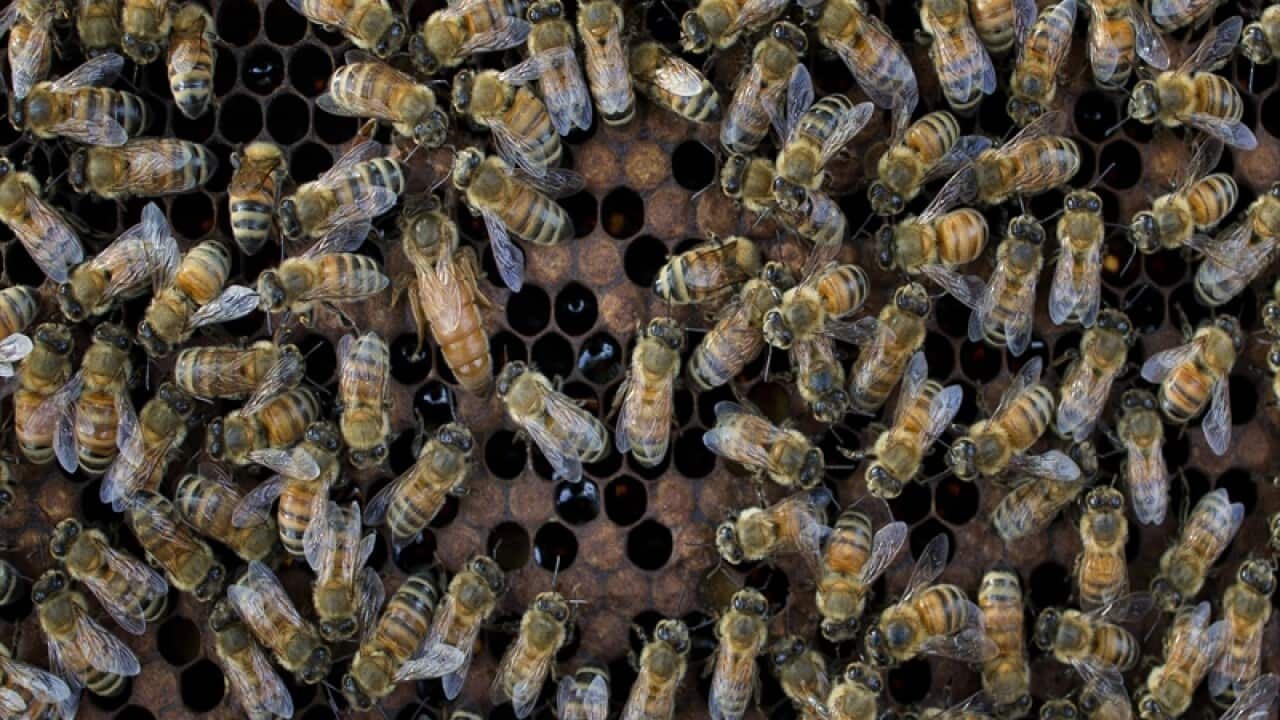
A bee's "alarm clock" has been documented for the first time by researchers.
Scientists have recorded the honeycomb vibration of the honeybee which prompts others in the hive to start getting busy.
The signal, known as the Dorso-Ventral Abdominal Vibration, alerts other bees to start foraging for food or become more active when the insects drum on the comb.
It had previously only been visible to the naked eye by opening up the hive and had only ever been measured during the day for very short periods.
A team of researchers from Nottingham Trent University monitored the signal for over a year and said the vibration reduces during the winter months.
They used simultaneous video and accelerometers embedded into the honeycomb of a number of hives which meant they did not disturb the colony.
Dr Martin Bencsik, lead researcher and a scientist at the university's School of Science and Technology, said: "Bees rest to conserve energy when they don't need to be active, and some will wake the others up when it is time to start work.
"We now have proof that honeybees induce specific vibrational waveforms into the honeycomb.
"Now that we have thorough measurements of these, we could artificially drive them into the comb to further challenge our understanding of its functions."
He added: "There are numerous exciting new pathways to explore, as a result of this work."
One of the study paper's authors, Michael Ramsey, said: "It is amazing how we can tap into the world of bees' vibrations using this technology.
"It allows us to experience a honeybee hive as if we were a bee stood on the comb.
"The further application of novel methods such as this for studying animal behaviour will enable scientists to create a more comprehensive understanding of the natural world."