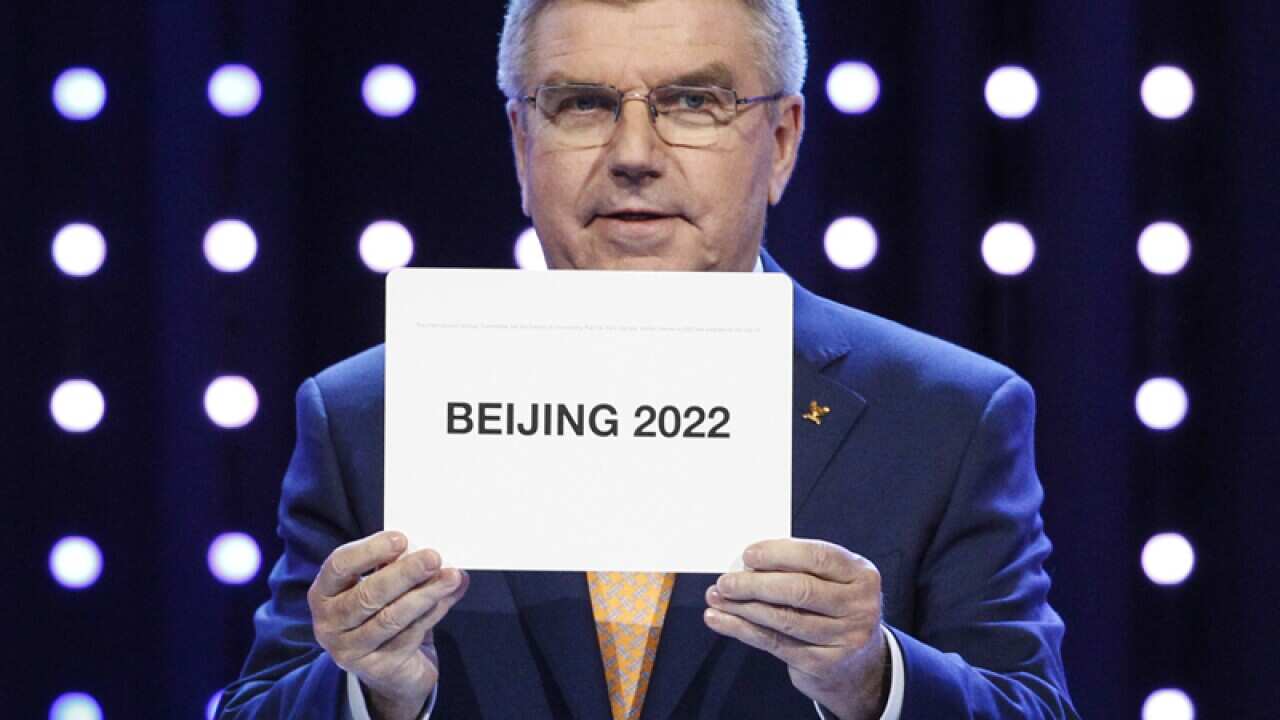
Australia's International Olympic Committee vice president John Coates says the chance to get the people of China into winter sports was the reason Beijing was selected to host the 2022 Winter Olympics.
The Chinese capital beat out a bid from the Kazakhstan Almaty in a surprisingly close vote to become the first city awarded both the winter and summer Games.
Beijing won the secret vote of the IOC by 44 votes to 40, with one abstention.
The vote was eventually conducted by paper ballot, after the first electronic vote experienced technical faults with the voting tablets.
"Gee, you wouldn't have picked that close result a few months ago," Coates said.
"That address by the prime minister (of Kazakhstan) was brilliantly crafted. I think that's why it got close.
"But the size of China, the number of people that are going to be introduced to winter sport now, those were all factors."
Kazakh Prime Minister Karim Massimov made a last-minute impassioned plea for the IOC to be "brave" and give the games to his country, but it wasn't quite enough.
The Chinese capital, which hosted the 2008 Summer Olympics, came in to the vote as the strong favourite, despite its lack of natural snow.
Beijing was seen by IOC members as a safe, reliable choice that also offered vast commercial opportunities in a new winter sports market of more than 300 million people in northern China.
Almaty had hoped to bring the games to Central Asia for the first time, but was a lesser-known quantity and viewed as a riskier choice by IOC members.
"Just as with the Beijing 2008 Summer Games, the Olympic Family has put its faith in Beijing again," the bid committee said.
"This will be a memorable event at the foot of the Great Wall ... that will further enhance the tremendous potential to grow winter sports in our country, in Asia and around the world."
Almaty bid vice chairman Andrey Kryukov said the city would consider bidding again.
"One thing I can say is Almaty was ready to host the 2022 Winter Games," he said.
In Beijing, the news was greeted with lion dancers and confetti canons at a staged government pep rally at the Bird's Nest stadium attended by about 500 preselected participants.
In Almaty, about 1,000 people gathered on a square to hear the result, including many students and government employees who said they had been ordered to attend by officials.
When it was announced that Beijing had won, the crowd scattered almost immediately and the event came to a close with no speeches from officials.
But no sooner had IOC president Thomas Bach read out Beijing's name as the successful bidder, than human rights groups began protesting against what they say is China's poor record.
"The IOC has sent the wrong message to the wrong people at the wrong time," the International Tibet Network said in a statement.
"China wants the world to ignore its deteriorating human rights and be impressed by Chinese can-do pragmatism instead.
"The honour of a second Olympic Games is a propaganda gift to China when what it needs is a slap in the face."
Share


