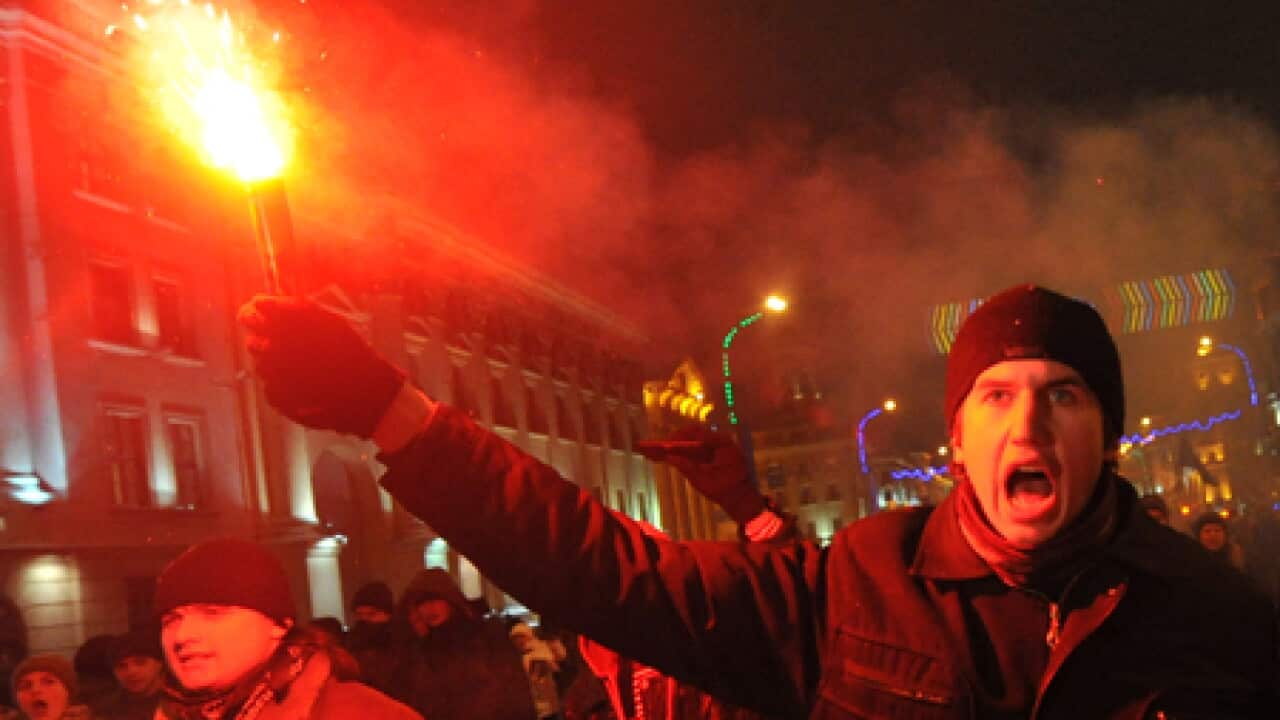
The United States and European Union led a storm of international condemnation of Belarus on Monday following a crackdown on protesters against the re-election of President Alexander Lukashenko.
Hundreds of people were arrested in the early hours of Monday after riot police broke up the demonstrations in Minsk in the immediate aftermath of Lukashenko's landslide victory in Sunday's election.
Among those arrested were seven of his nine election opponents.
The United States said it did not consider the results of the election legitimate and warned that the treatment of protesters by the authorities was "disproportionate".
"The United States concurs with the assessment of the OSCE (Organisation for Security and Co-operation in Europe). We cannot consider the election results yesterday as legitimate," State Department spokesman Philip Crowley said.
News that makes sense
Your trusted source for staying up-to-date with the world around you. Get free daily news updates and analysis, straight to your inbox.
At the White House, President Barack Obama's spokesman Robert Gibbs also said the results could not be seen as legitimate or free and fair.
"The United States strongly condemns the actions that the government of Belarus has taken to undermine the democratic process and (the use of) disproportionate force against political activists, civil society representatives and journalists," said Gibbs in a written statement.
"We call for the immediate release of all presidential candidates and the hundreds of protesters who were detained on December 19 and 20."
He noted that in a December 1 joint statement it was made clear that the development of US-Belarus relations was contingent on the Belarus government's respect for human rights and democracy.
"The actions taken over the last 24 hours, however, are a clear step backwards on issues central to our relationship with Belarus," Gibbs said.
The European Union's top diplomat Catherine Ashton called on Belarus to "immediately release" the opposition leaders and condemned the use of violence.
However, Belarus' most powerful neighbour Russia steered clear of condemning the brutal crackdown.
"What happens there, in the long run, is the internal affair of our neighbouring state," Russian President Dmitry Medvedev told a joint press conference with visiting Latvian counterpart Valdis Zatlers.
"I hope that these elections will result in Belarus being a modern state that continues on the path of creating a modern state based on democracy and friendship with its neighbours," added Medvedev.
In contrast, neighbouring Poland condemned the violence, the foreign ministry saying it was "particularly worrying to see the beating and arrest of opposition candidates in the presidential election".
Fellow ex-Soviet republics Lithuania and Latvia, which have close economic links with Belarus, also blasted Minsk over the use of force.
"Belarussian authorities failed to grant the freedom of assembly to Belarussian citizens and used force against demonstrators," Lithuania's foreign ministry said in a statement.
Latvia's foreign ministry said the crackdown would "certainly not facilitate either the processes of democratisation and reforms in Belarus or a further dialogue and the development of relations between the EU and Belarus".
"We call for the immediate release of the participants of the protest rally and for a further implementation of responsible policies that would both ensure the freedom of speech and assembly, and allow confrontation and violence to be avoided," it added.
Lukashenko won Sunday's polls outright with nearly 80 per cent of the vote after a huge turnout of over 90 per cent, the central election commission said.
However, election monitors from the pan-European security body OSCE said the presidential polls indicated that Belarus "still has a considerable way to go" in meeting its commitments for free and fair elections.
It said that while the overall voting process was assessed as good, the process deteriorated significantly during the vote count itself.







