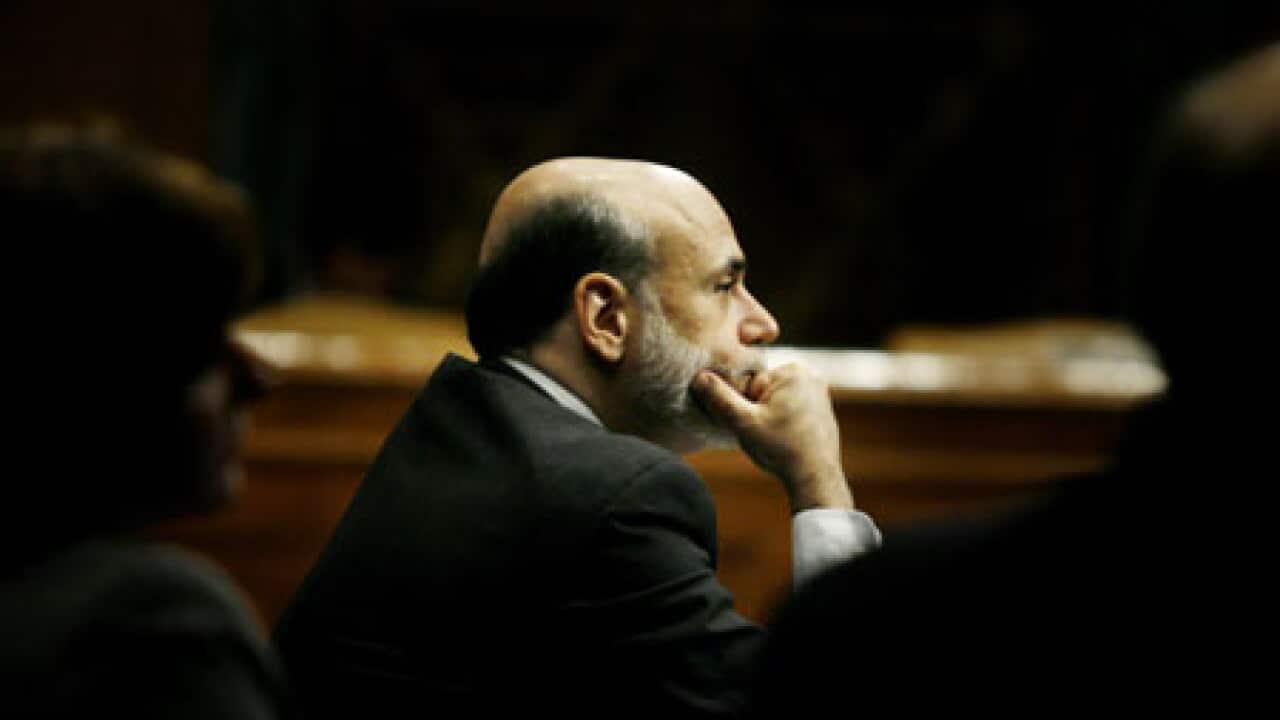
US Federal Reserve chief Ben Bernanke offered hints of higher interest rates as the central bank ends its massive stimulus effort but argued that an "accommodative" monetary stand is still needed to sustain a recovery.
Bernanke's comments, released for a House of Representatives hearing canceled due to a major snowstorm pounding Washington, were aimed at clarifying the so-called exit strategy from an unprecedented effort to revive the economy.
Analysts say the Fed faces a delicate task as it tries to keep stimulating growth with record-low rates and the injection of more than one trillion dollars into the financial system but also seeks to guard against a surge in inflation as the recovery gathers steam.
News that makes sense
Your trusted source for staying up-to-date with the world around you. Get free daily news updates and analysis, straight to your inbox.
Bernanke sought to reassure lawmakers and financial markets that the Fed has an exit strategy but is not yet ready to shift its course for an economy growing again despite 9.7 percent unemployment and difficult credit conditions.
"The economy continues to require the support of accommodative monetary policies," Bernanke said, using the Fed code for exceptionally low interest rates.
"However, we have been working to ensure that we have the tools to reverse, at the appropriate time, the currently very high degree of monetary stimulus. We have full confidence that, when the time comes, we will be ready to do so."
Bernanke's comments offered no specific timeline for the Fed to move away from its massive stimulus that has included a cut in the federal funds rate to a range of zero to 0.25 percent and an array of liquidity programs.
He repeated that this effort is likely to remain in place "for an extended period," the same phrasing used by the Federal Open Market Committee, the central bank's policy-setting panel.
"In due course, however, as the expansion matures the Federal Reserve will need to begin to tighten monetary conditions to prevent the development of inflationary pressures," he said.
Bernanke did evoke mixed comments with a statement about the discount rate, which is one way the Fed can lend directly to commercial banks.
"Before long, we expect to consider a modest increase in the spread between the discount rate and the target federal funds rate," he said.
Financial markets were rattled by the remarks, and analysts said that any hint at any rate hike could be significant even if the discount rate is less important that other Fed tools.
"Bernanke's rate hike talk pressured US equities and supported the dollar," said Michael Malpede at Easy Forex.
"It now appears the Federal Reserve may raise its discount rate sooner than previously anticipated, possibly as soon as spring," said Ryan Sweet at Moody's Economy.com.
Ian Shepherdson at High Frequency Economics dismissed the notion that the Fed was shifting policy.
"None of this will happen soon, though, and the likely near-term hike in the discount rate should not be interpreted as a policy signal," he said.
Bernanke said the federal funds rate, which is the rate charged on interbank loans, may be a less reliable barometer of overall conditions and that the Fed may start using a new benchmark target.
He said the rate paid on commercial bank reserves kept at the Fed may be a better tool, since it establishes a floor for lending.
"It is possible that the Federal Reserve could for a time use the interest rate paid on reserves, in combination with targets for reserve quantities, as a guide to its policy stance, while simultaneously monitoring a range of market rates," he said.
Bernanke reaffirmed the Fed's intent to conclude its program of major asset purchases -- sometimes called quantitative easing, to pump money into the financial system -- by the end of March. He said this would entail the purchase of 300 billion dollars of Treasury securities and 1.25 trillion dollars of government agency mortgage-backed securities (MBS).
But he said the Fed would probably hold these assets until market conditions improve.
"I currently do not anticipate that the Federal Reserve will sell any of its security holdings in the near term, at least until after policy tightening has gotten under way and the economy is clearly in a sustainable recovery," he said.







