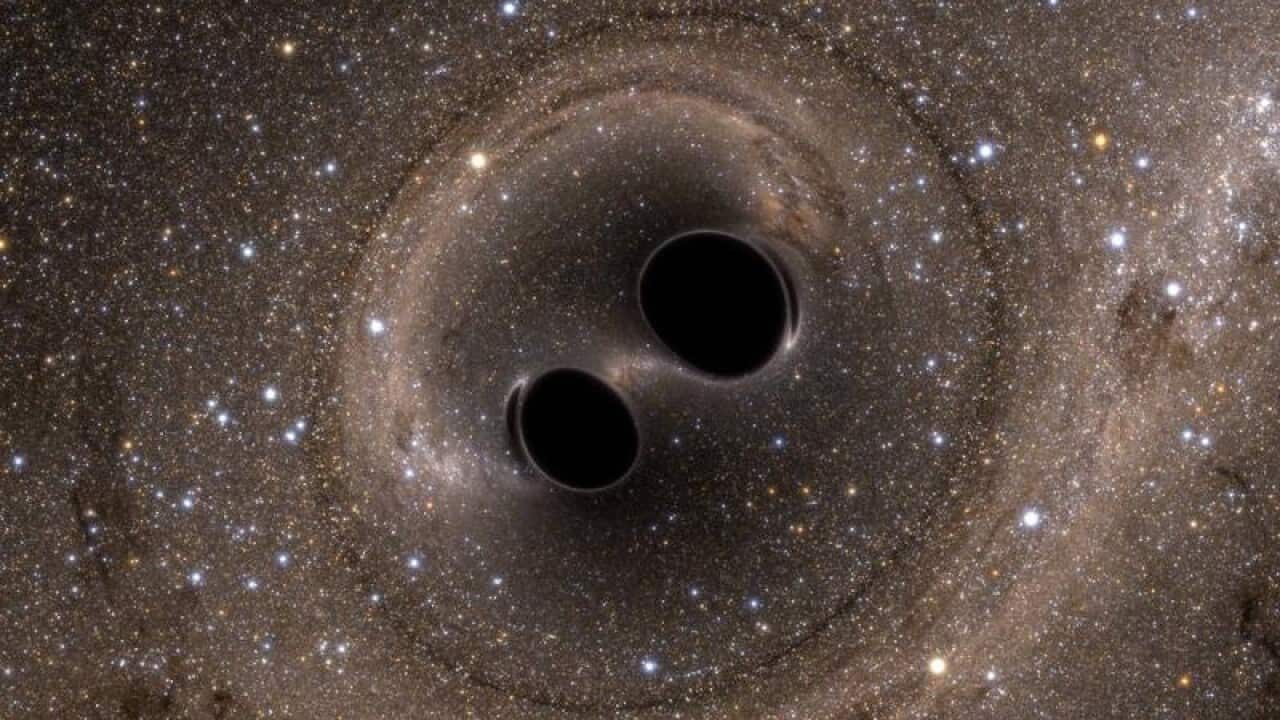
One of the most cataclysmic events in the universe has been detected despite taking nine billion years to reach Earth.
An international team, including Australian scientists, have discovered wrinkles in space and time, known as gravitational waves, from the biggest known collision of binary black holes that formed a new black-hole about 80 times larger than the sun.
Although the collision happened nine billion years ago the ripples only made it to Earth last year, and it wasn't discovered until this year.
The discovery announced on Tuesday is the latest success, and one of the biggest, for the Advanced Laser Interferometer Gravitational-Wave Observatory (LIGO).
The team detected the collision's gravitational waves passed through Earth on July 29, 2017, followed by three other small black hole mergers in August, 2017, by reanalysing data previously captured by Advanced LIGO.
News that makes sense
Your trusted source for staying up-to-date with the world around you. Get free daily news updates and analysis, straight to your inbox.
The discovery brings the total number of black hole merger detections to 10, along with a neutron star collision, during the past three years.
Australian team's Professor Susan Scott says she has spent most of her career hoping to detect gravitational waves and technology advancements were finally giving scientists answers.
This event also had black holes spinning the fastest of all mergers observed so far and it is the most distant merger in the universe ever observed, Prof Scott said.
"We can't see these events any other way except through gravitational waves, as they don't emit light or radio waves ... because they're black holes," she told AAP.
The binary systems, meaning two black holes orbiting each other, eventually smash together and radiate strong gravitational waves which are very faint by the time they reach earth, said Prof Scott, from the Australian Research Council Centre of Excellence for Gravitational Wave Discovery (OzGrav).
The detections will improve scientists' understanding of how many binary black hole systems there are in the universe and the range of their masses and how fast they spin during a merger, she said.
Researchers plan to use LIGO's technology to detect cataclysmic events even further out in space, in the hopes they can reach back to the beginning of time.
The next observation run to collect data will begin early next year, following work to make the gravitational wave detector more sensitive.
Prof Scott will present the recent results at the Australian Institute of Physics Congress in Perth later this month and the discovery will be published in Physical Review X at a later date.
"This should be the biggest announcement at the whole congress ... it's a pinnacle of my career," she said.







