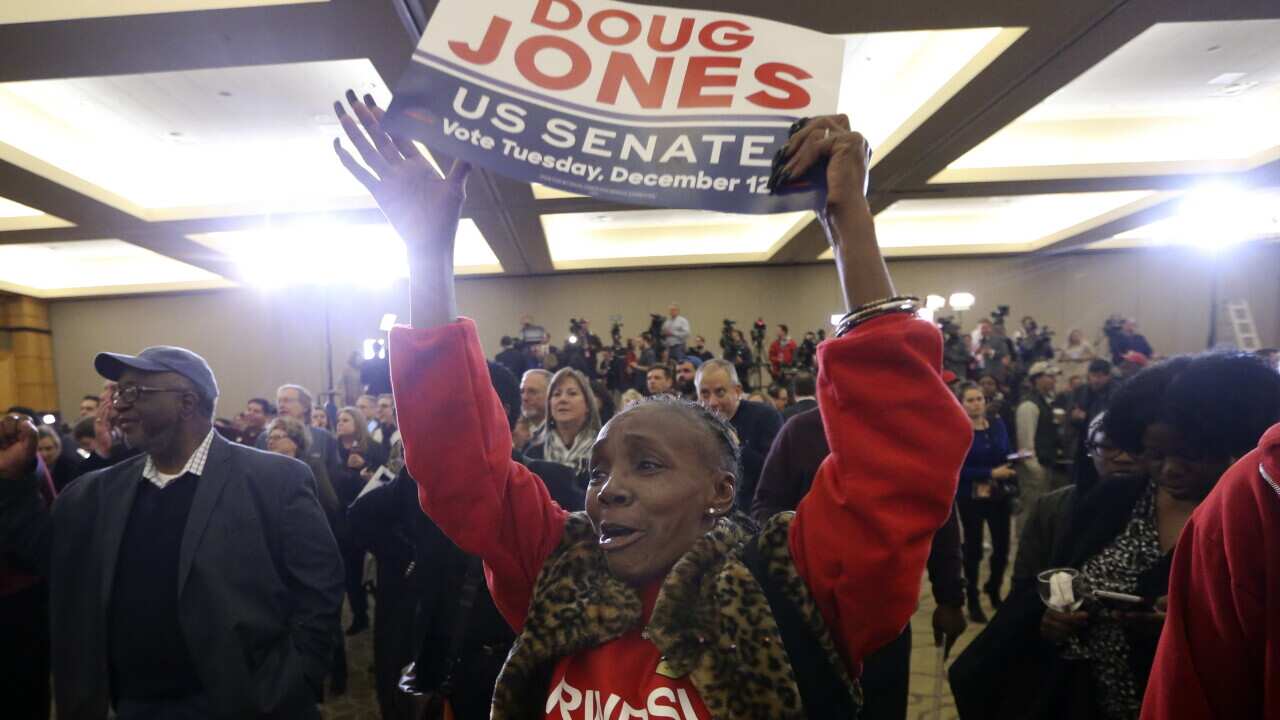
Black voters, particularly women, have been praised by Democrats and progressives across the US for their decisive role in defeating controversial Alabama Republican Senate candidate Roy Moore.
Democratic candidate Doug Jones won with 49.9 per cent of the vote, compared with Republican Mr Moore’s 48.4 per cent.
Exit polls published by the Washington Post on Thursday showed 98 per cent of black women and 93 per cent of black men had voted Democrat in the deeply conservative state, compared with 34 per cent of white women and 26 per cent of white men.
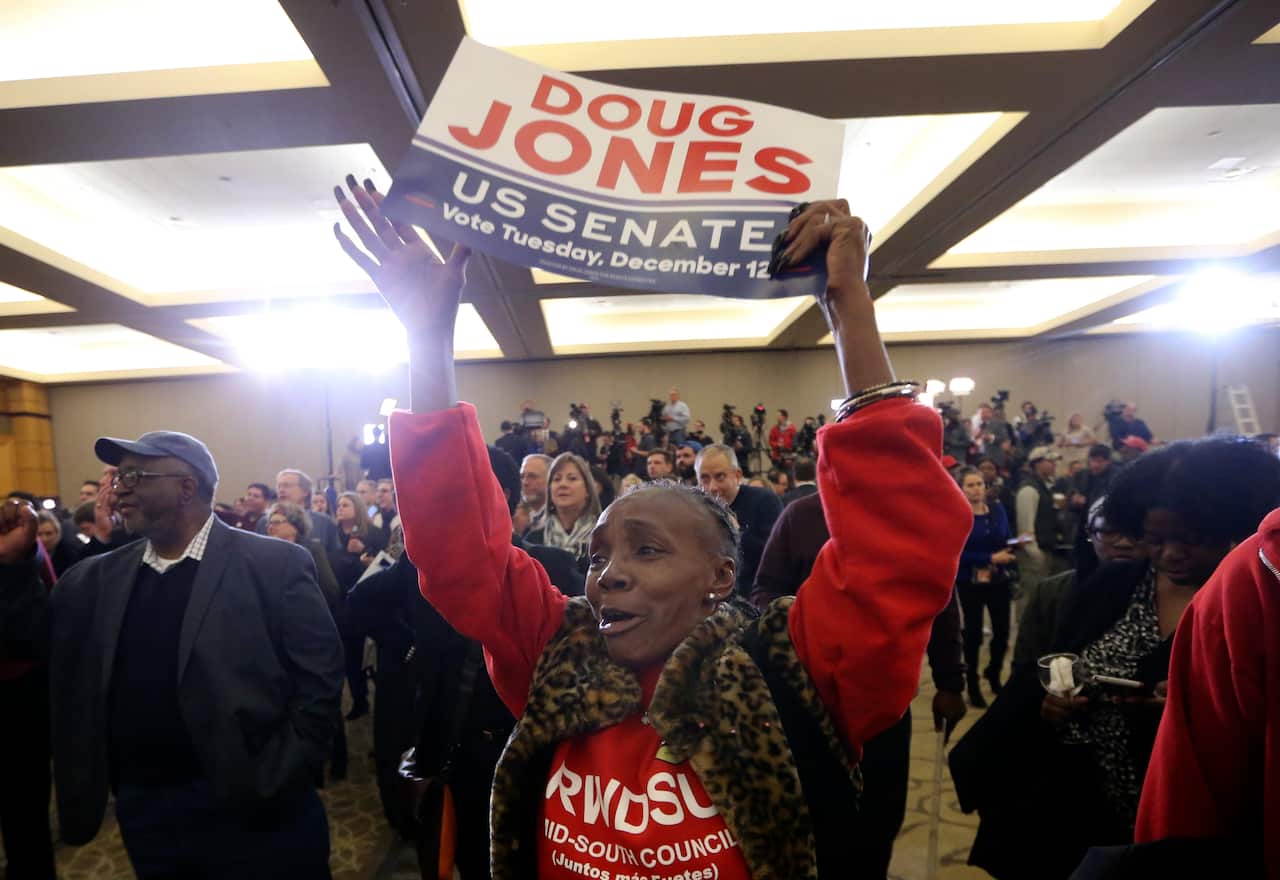
“Let me be clear: We won in Alabama and Virginia because #BlackWomen led us to victory,” Democratic National Committee Chair Tom Perez said on Twitter.
News that makes sense
Your trusted source for staying up-to-date with the world around you. Get free daily news updates and analysis, straight to your inbox.
“Black women are the backbone of the Democratic Party, and we can’t take that for granted. Period.”
The win was significant for Democrats, who have had relatively few victories to celebrate since Hillary Clinton’s shock defeat last year.
Mr Moore - a former Alabama Supreme Court judge who fought for the Ten Commandments to be displayed in his courtroom - had been tipped to win the race after winning the Republican primary in September.
That changed in early November when the Washington Post published allegations that the 70-year-old had initiated a sexual encounter with a 14-year-old girl, Leigh Corfman, when he was 32.
Six other women have come forward with historical allegations of sexual misconduct against Mr Moore.
He categorically denies the claims, blaming the media for aiding in a smear campaign.
“The allegations are completely false. They are malicious. Specifically, I do not know any of these women,” Mr Moore told a campaign rally on 27 November.
But despite the controversies, the polls remained neck and neck right up until election day.
Birmingham City Councilwoman Sheila Tyson, who helped coordinate ‘get out the vote’ efforts focused on black female voters, said black women were strongly motivated by the chance to elect the first Senate Democrat for the state in 25 years.
"We knew somebody had to carry him over the line," she told NBC. "And we knew it was going to have to be us."
Darnell Hunt, Director of the African American Studies Centre at UCLA, says Mr Moore appealed to nostalgia among white voters.
“He was definitely trying to represent the ‘Old South,’” he told SBS News.
In one rally Mr Moore appeared to criticise African American voting rights, in another, he romanticised family values in earlier times “even though we had slavery.”
“No self-respecting (person) can hear something like that and not be appalled and question the moral character of that person,” Professor Hunt said.
Professor Hunt says he hopes the win energises African American voters and other marginalised communities going into 2018, a year in which Democrats hope to retake control of the House of Representatives, and potentially the Senate.
“It was amazingly affirming to have the vote turn out that way. I take it as very positive sign,” he said.
“I’m hoping the lesson of Alabama will be the importance of mobilising people and putting up candidates, even if the odds are stacked against you.”
Mr Jones’s strategy relied heavily on making sure black voters turned up at the polls despite the off-cycle election, called to replace former Alabama Senator Jeff Sessions who was appointed as the Trump administration’s Attorney General.
Many in the Republican Party distanced themselves from the embattled candidate following the allegations, though in the final days of the campaign Donald Trump issued a strong endorsement, even recording a robocall for the conservative Republican.
The win comes amid a period of introspection for Democrats, who were criticised in 2016 for running a campaign based on identity politics which failed to embrace the white working class.
Democratic leaders have also been accused of taking the votes of African American women for granted, making little effort to promote and support female African American candidates.
Professor Hunt says he hopes Democrats realise the importance of the minority communities who he hopes will put them over the line in the 2018 midterms.
“I hope that what Democrats represent will reflect their priorities,” he said.
Professor Young said he wasn’t surprised that Moore’s share of the vote still remained so high among white voters in the deeply red state.
“The shadow of the Confederacy is still heavy on the state of Alabama,” he said.
“In time, things will get better, they’re moving in the right direction.
Mr Moore, who once argued that Muslim Americans should not be allowed to serve in Congress, received national media attention for his divisive views.
The controversial candidate has also referred to Native Americans and Asian Americans as “reds and yellows” and has said he had doubts over President Obama being born in the US.
The candidate’s wife, Kayla Moore, drew ridicule the night before the election in arguing that her husband was not anti-Semitic.
“One of our attorneys is a Jew,” she said. “We have close friends that are Jewish.”
Mr Moore also said in a 2005 interview with US TV network C-SPAN that homosexuality should be illegal.
His spokesman Ted Crockett this week said Mr Moore "probably" still held the same view.
“Homosexuality is a sin in the biblical sense, that is where Roy Moore is in the state of Alabama,” Mr Crockett told CNN’s Jake Tapper.







