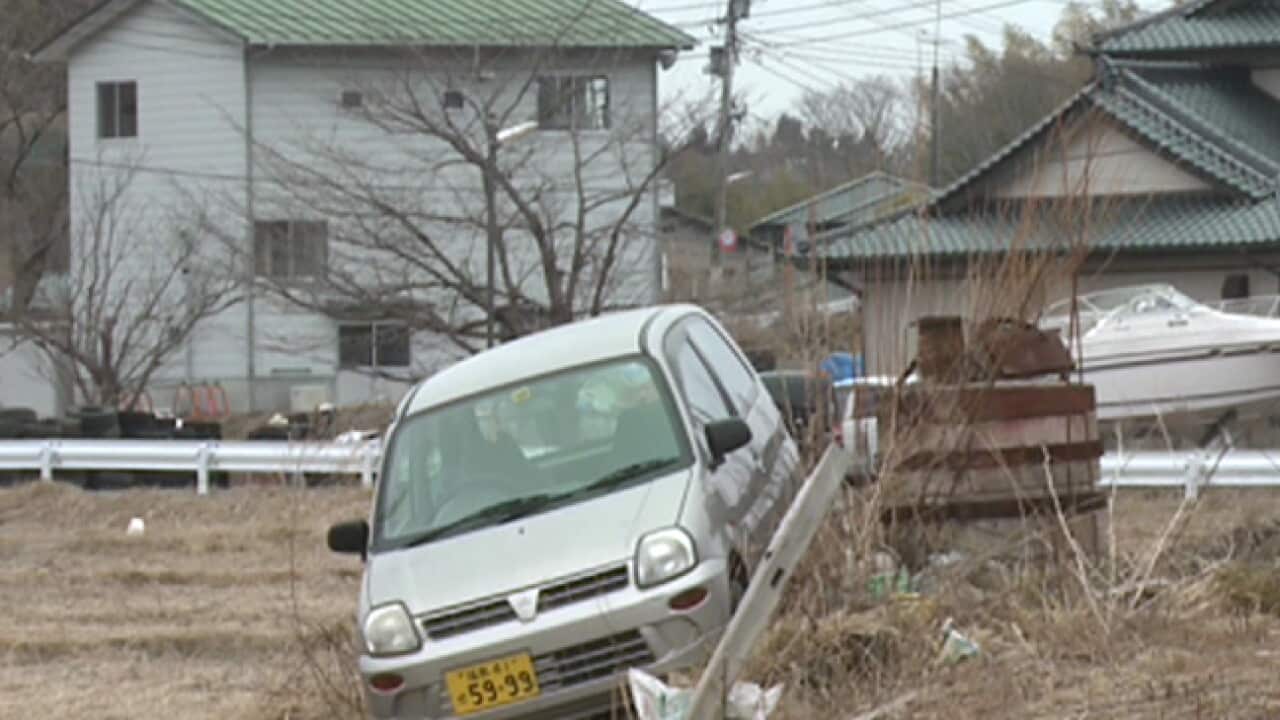
In a Dateline special on The Nuclear Dilemma, reporter Adrian Brown visited Fukushima two years on from the earthquake, tsunami and nuclear disaster. Here, he writes about the eerie experience of visiting the ghost towns inside the exclusion zone…
The Geiger counter on the dashboard of our van is going berserk. In the space of just a few minutes the reading has leapt from 0.23 microsieverts per hour to 19.2 - 0.23 was the pre-disaster Japanese government regulatory limit. It's an unsettling moment.
We are travelling inside the exclusion zone around the crippled Dai-ichi nuclear plant in north east Japan. Almost two years ago, a radioactive cloud blew over this area and the radiation still lingers today.
News that makes sense
Your trusted source for staying up-to-date with the world around you. Get free daily news updates and analysis, straight to your inbox.
It's a landscape denuded of life. Fields where rice and strawberries once grew are now covered in towering weeds. Homes and shops shaken by the disaster lie abandoned. It's a time capsule of the terrifying events of March 11th 2011.
There are few more lonely or desolate places. Outside the town of an Odaka, a surreal moment. The traffic lights are still working. They blink red, so we stop. What you notice more than anything else is the eerie silence.
Not for the first time in my career I realise that what I am doing is all down to a personal perception of what risk is. I am reassured by expert opinion that a brief visit into this no-go zone is not hazardous to health. Prolonged exposure, of course, is why almost no one lives here anymore. But I have already received a few teasing texts from colleagues, including one advising I wear lead pants!
We are on our way to visit one of the few people who have remained on this contaminated land since the disaster.
Masami Yoshizawa can see the towers of the Dai-ichi plant from the hilltop overlooking his farm. It's just 14 kilometres away. He heard the explosions on that fateful day and soon realised the danger he and his 40 cattle were in. He's had regular health checks and so far so good, but he also knows that it could be many years before he knows what effect the radiation exposure will have on his health.
Some of his cattle have started to develop a strange skin condition that he says he didn't see before the disaster. As he contemplates his future, I detect an almost fatalistic acceptance in what may lie ahead.
At the time I was both shocked and mesmerised by the story of the Fukushima 50, the group of workers who went back into the crippled plant to try to cool down the reactors. The operator of the plant, Tepco, rarely grants interviews and those workers who have spoken to the media have only done so on the condition of anonymity.
However, I submitted my request to Tepco and hoped for the best. Then just two days before my assignment ended, the company's PR department contacted me to say one of the Fukushima 50 was prepared to talk to me on camera.
For Atsufumi Yoshizawa it would be his first interview with a foreign television network. He's 54 and married with two adult daughters. But his thoughts, he told me, were not on his family as he prepared to return inside the plant after the first of the explosions. He admitted that it felt like a suicide mission.
“Regardless of dying for somebody or something, it was something that only we could do and no one else could do,” he tells me. “So me and the other workers on the spot were thinking this way. There was a feeling among everybody on the spot that we may have to sacrifice ourselves."
Anywhere else in the world, people like Mr Yoshizawa would have been hailed as heroes, but it hasn't worked out that way. Many Japanese people believe that he and his co-workers perpetrated the accident and then bungled their response. Yet there is no doubt that without their intervention, the disaster could have been a lot worse.
Mr Yoshizawa spent nine months in the plant, braving high levels of radiation. Hearing his calm reflections of that time makes for compelling listening. For the first few weeks he and his co-workers survived on little sleep, living on a diet of water and biscuits. Like others affected by the disaster, he is learning to live after exposure to high levels of radiation.
Japan is the only country in the world to have had a nuclear bomb dropped on it. This disaster though had a much wider destructive range, affecting more than 600 kilometres of coastline. The scale of it is still hard to absorb.
Today more than 340,000 people remain homeless. They've just endured their second winter in temporary shelters. Their initial stoicism has now given way to frustration over the lack of reconstruction.
But Nakamura Hiro is remarkably philosophical about his predicament. His home was destroyed and tells me how he lived in his car for four months. He doesn't have any idea when or if he will ever get a proper home like the one he had before. He says he's satisfied because at least he has a job.
See Adrian's full story and the rest of the program on Dateline's website.
Also in the special The Nuclear Dilemma program, Aaron Thomas reported on the controversy over where to dump Europe's nuclear waste, and Dateline looked at the legacy of nuclear weapons testing on the Pacific islands of French Polynesia – can they ever really be completely decontaminated?







