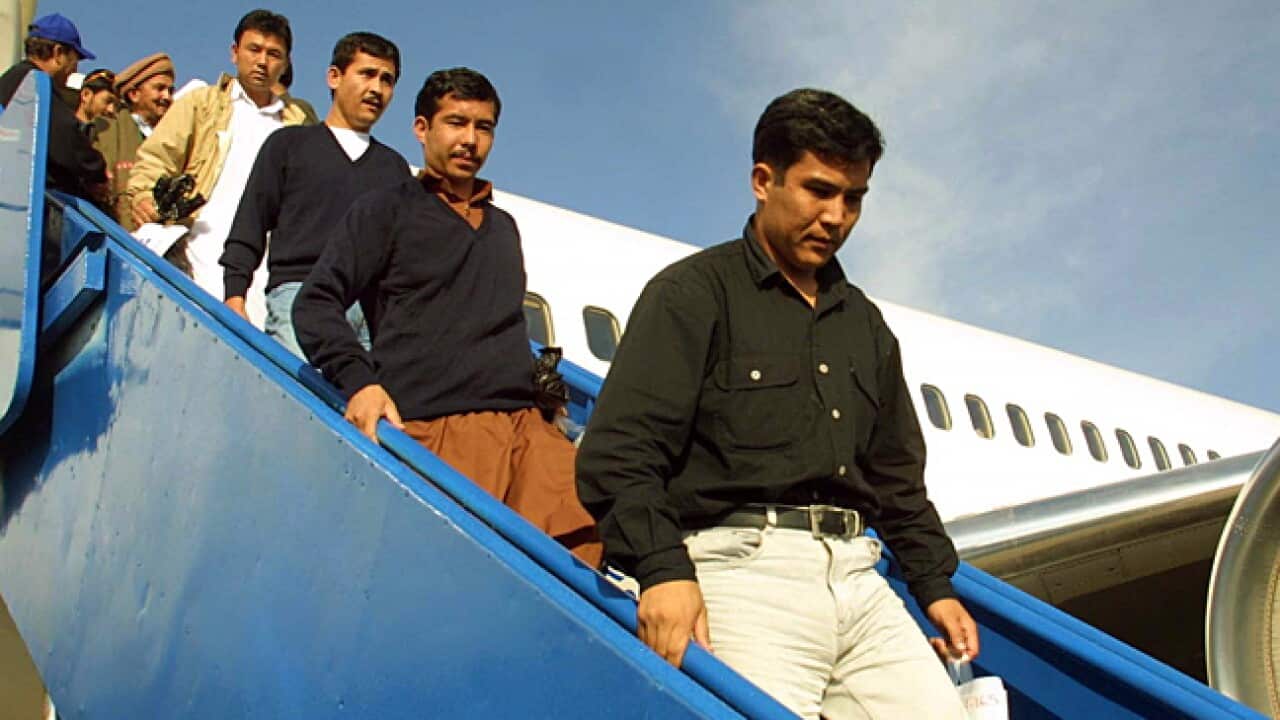
"We are a compressed version of Ellis Island," suggested John Bateman, the man from the United States' government Center for Disease Control, and one of several officials responsible for overseeing the arrival of refugees on American soil.
Bateman was referring to the now-famous island that sits in the shadow of the Statue of Liberty in New York Harbor. For decades, Ellis Island was the first stop for immigrants arriving in America, eloquently paid tribute in a poem by Emma Lazarus that now stands on the pedestal of Lady Liberty: "Give me your tired, your poor, your huddled masses yearning to breathe free."
Newark Liberty International Airport in New Jersey may not inspire the same romanticism as New York's spectacular harbour but as Bateman explained, in 2012, it serves as a point of welcome for people aspiring to some kind of the American dream, whatever that is in the 21st Century.
News that makes sense
Your trusted source for staying up-to-date with the world around you. Get free daily news updates and analysis, straight to your inbox.
Bateman and I were standing by an airbridge gate, waiting to meet a group of 30 or so refugees whose plane had just landed from Paris. Newark was their first stop in the US, an almost end point to a journey that had begun in the Bhutanese refugee camps of Nepal and taken them to Kathmandu and Bahrain before eventually ending with a new life in Atlanta, Cincinnati, Akron, or Burlington in Vermont (which is at least kind of like Nepal - it at least has more mountains than freeways).
The US takes, by far, more refugees for resettlement than any other country in the world. Since 1975, the US has taken over 3 million refugees but - still - that number is tiny when compared with the 15 million people worldwide currently living with refugee status. For 2012, the US government will take a maximum 80,000 people for resettlement. Currently, the main intake originate from Bhutan, Burma, and Iraq.
A refugee is broadly defined as a person unable to return to his or her country of origin because of a "well-founded fear of persecution based on race, religion, nationality, political opinion, or membership in a particular social group". Refugees are a different kind of immigrants. Most didn't want to leave the home country and most want to eventually return.
"It was not safe," explained Ali, a former translator for the US Army in Baghdad who now lives in Portland, Maine. We were speaking on the phone about his experience leaving Iraq for the US Working for Americans in Iraq could provide serious repercussions.
"I had to live away from my family in Baghdad and they had to move twice. Some people accept it but others take it in a very religious way," Ali explained.
“Religious” translates - pun intended - as you will probably be killed.
But when you arrive in a new country, sometimes life takes over and going home is no longer an option. At least, the best option. Kids get born, they go to school. Those with school-age children have an anchor. Even with its faults, the U.S. school system offers greater benefits than, say, Iraq right now. But there's a flipside to that, too.







