

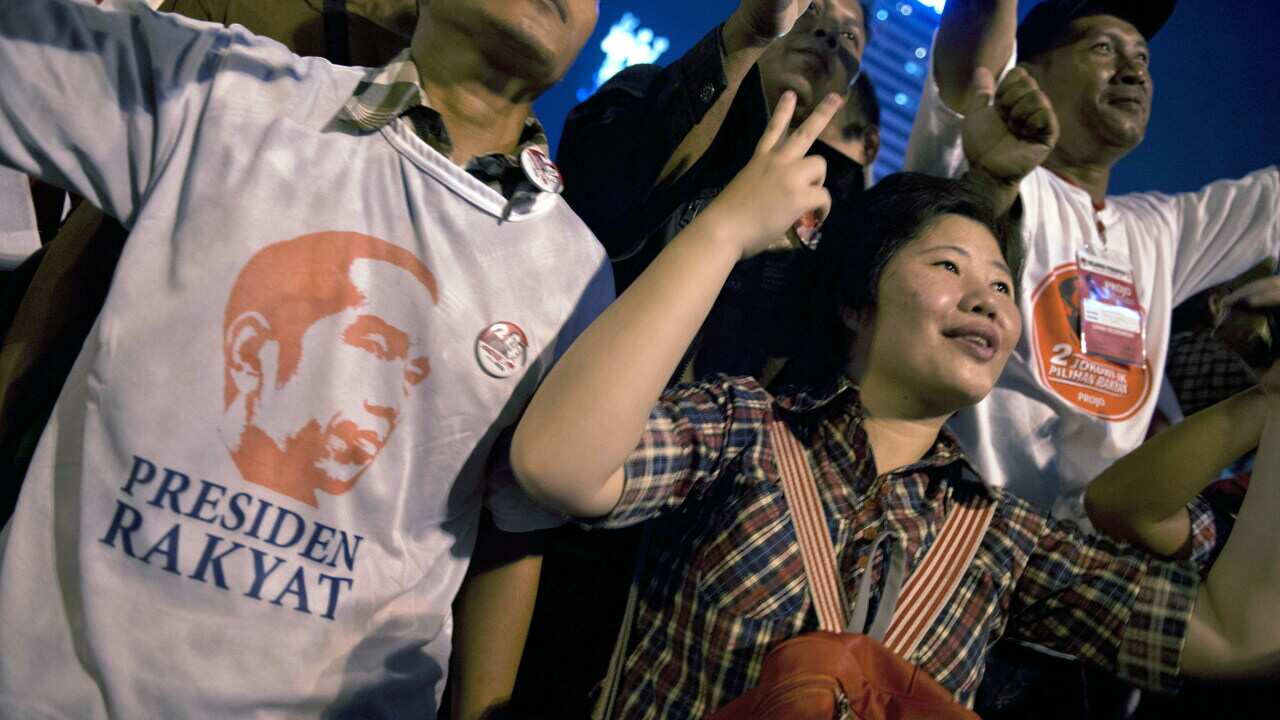
One of Australia's leading scholars on Indonesia says he's confident Joko Widodo will be the next Indonesian president.
The man known as 'Jokowi' and his rival, Prabowo Subianto have both claimed victory following yesterday's poll but the official result won't be declared for another two weeks.
But Professor Greg Barton from Monash University says the current Governor of Jakarta, Joko Widodo, will be the victor.
He's basing his prediction on the results of what are known as quick counts which are projections of the final result based on exit polling.
"With a margin of between 4 and 6 per cent reported in the quick count - and this quick count using local polling station data, the most extensive one uses 4,000 polling stations and that one had a gap of over 5 per cent - we can be pretty confident that Jokowi has won this."
News that makes sense
Your trusted source for staying up-to-date with the world around you. Get free daily news updates and analysis, straight to your inbox.
And one of the unofficial quick counts put Jakarta's governor Joko Widodo ahead with 53 per cent of the vote, compared with Prabowo Subianto on 47 per cent.
But Mr Prabowo's campaign team says its preferred polling shows he is ahead.
So with both candidates claiming victory, the incumbent president called both men in for talks on how best to proceed until the official election declaration on July the 22nd.
The Indonesian election is a huge logistical execise with 470,000 polling stations catering to almost 190 million registered voters.
Indonesia's Centre for Strategic and International Studies says Prabowo Subianto managed to make up plenty of ground on his opponent in the last few weeks of the election, thanks to a well-funded campaign employing all the resources of his political machinery.
But the centre's Tobias Basuki has told Al Jazeera the likely victory by Jokowi represents all power to the people.
"What's interesting here is eventually we see that organic voluntary politics by the people won over political machinery in this Indonesian election."
Greg Barton, from Monash University, says the election provides the Australian government with a chance to recalibrate the relationship with Indonesia and address perennial problems such as the ongoing disputes between the two nations over the Abbott government's 'turn back the asylum boats' policy.
He also says Australia needs to wake up to the fact that Indonesia has changed dramatically since the end of the Suharto regime.
He says what hasn't changed is the way Australia thinks about its neighbour.
"We live with an image, a mental image, of Indonesia in the Suharto era. We think about the military, we think about authoritarianism, we just don't understand the way this democracy has come so far in the last 15 years and so we need to start to reflect in our language and our engagement more of a meeting of equals and less of a sort of a negotiation over individual transactional matters and in a way that suggests that somehow Australia might be superior to Indonesia."







