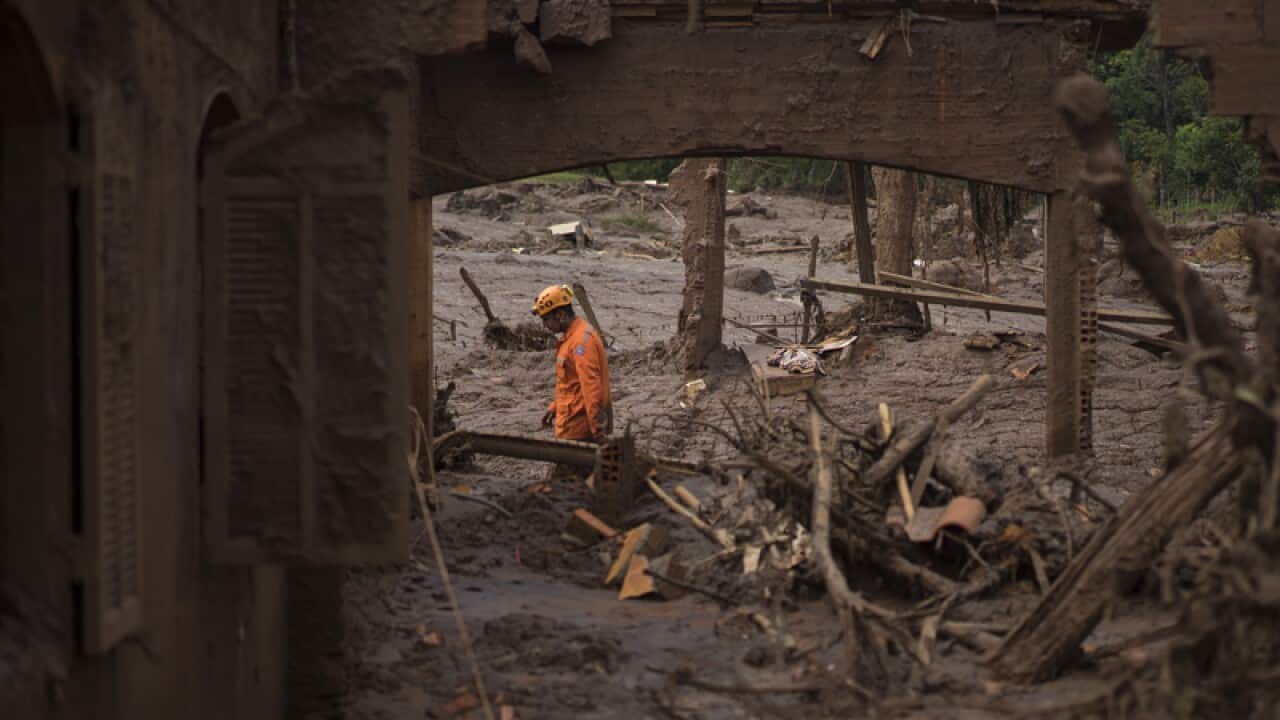
Brazil's government says it will sue mining giants BHP Billiton and Vale for $US5.2 billion ($A7.19 billion) after the deadly collapse of a wastewater dam at an iron-ore mine.
Environment Minister Izabella Teixeira says a lawsuit would be filed demanding that the companies and mine operator Samarco, which they co-own, create a fund of 20 billion reais.
The money would go to environmental recovery and compensation for victims.
"There was a huge impact from an environmental point of view," Teixeira said at a press conference in the capital Brasilia.
"It is not a natural disaster. It is a disaster prompted by economic activity, but of a magnitude equivalent to those disasters created by forces of nature."
News that makes sense
Your trusted source for staying up-to-date with the world around you. Get free daily news updates and analysis, straight to your inbox.
The suit would be filed on Monday, Attorney General Luis Inacio Adams said.
At least 13 people died and some 11 remain missing from the flood of mud and wastewater triggered by the breaking dam at the Samarco iron ore mine near Mariana in southeastern Brazil on November 5.
The deluge swept down the River Doce to the Atlantic, sparking claims of major contamination, although the mining companies insist there is no serious pollution.
The fund being demanded by the government would dwarf initial estimates by Deutsche Bank that a clean-up could cost about $1 billion.
Adams said that the companies would be asked to pay the amount out gradually, as a percentage of their profits.
"The measure should guarantee long-term financing for actions to revitalise the (river) basin," Adams' office said.
Adams said he hoped the corporations - BHP Billiton is the world's biggest miner and Vale is the world's biggest iron ore specialist - would co-operate with the government.
Both have said they want to meet their obligations.
"The scale of the damage is very big but the companies have announced measures that show they are interested in repairing their image," Adams said.
Teixeira described the environmental impact as devastating and difficult to repair.
Earlier on Friday Vale announced a compensation fund, but did not give figures.
Executives also sounded a defiant note, rejecting allegations that the River Doce had been badly polluted.
Vania Somaville, director of human resources, health and safety at Vale, told a press conference that lead, arsenic, nickel and chrome had been detected at some points along the river.
However, Somaville argued that the potentially dangerous contaminants were not carried there by the wastewater from the mine.
That was in stark contrast to a report by two UN experts, which accused the corporations and the Brazilian government of failing to respond to a toxic disaster.
The UN's special rapporteur on human rights and the environment, John Knox, said the equivalent of "20,000 Olympic swimming pools of toxic mud" spewed into the River Doce.







