IN BRIEF
- Trump announces two-week ceasefire with Iran after threats over Hormuz; talks set to begin on Friday in Islamabad.
- Iran warns ceasefire does not mean end of war and says US must agree to its peace plan.
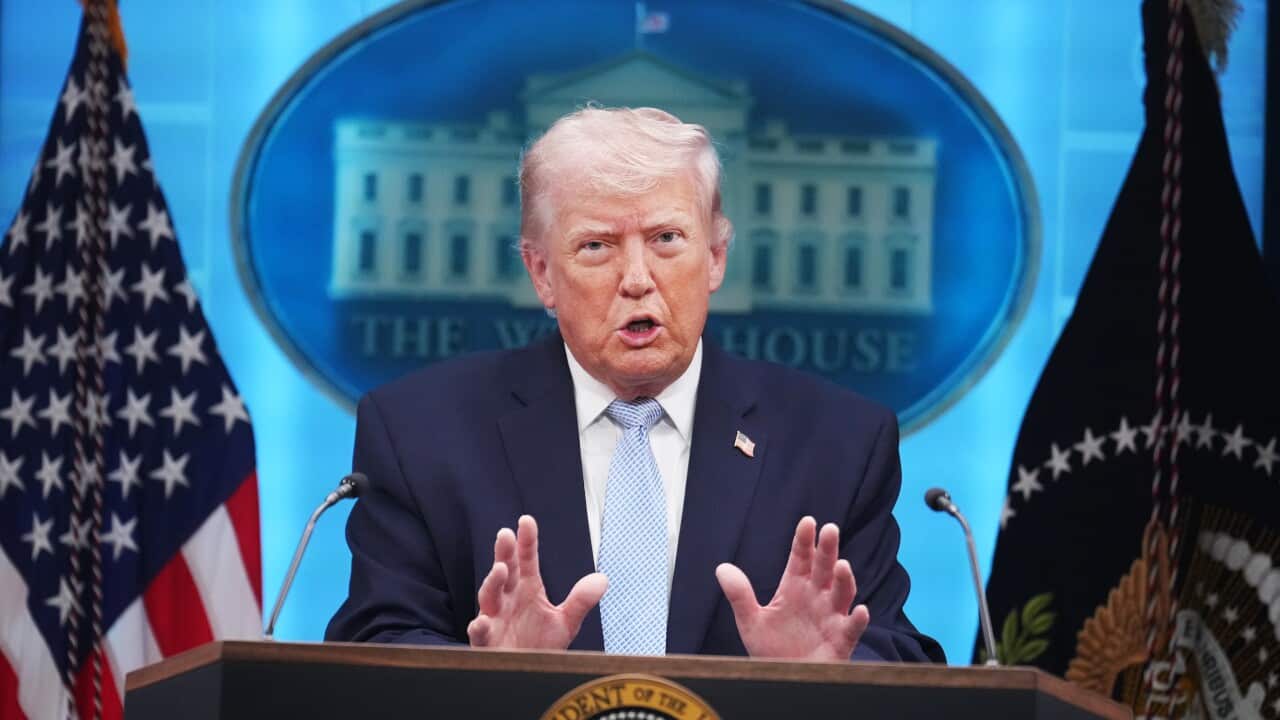
President Donald Trump has announced a two-week suspension of United States military attacks on Iran, backing down from his own 8pm ET (10am AEST) deadline under which he had threatened to destroy Iranian power plants and bridges if Iran did not reopen the Strait of Hormuz.
Iran has since accepted the ceasefire, with both sides set to begin talks on Friday.
Trump announced the "double-sided ceasefire" on his Truth Social platform, saying the pause came after conversations with Pakistani Prime Minister Shehbaz Sharif and army chief Field Marshal Asim Munir, and was conditional on Iran immediately opening the strait.
"I agree to suspend the bombing and attack of Iran for a period of two weeks," Trump wrote. "This will be a double sided CEASEFIRE!"
"The reason for doing so is that we have already met and exceeded all military objectives, and are very far along with a definitive Agreement concerning Longterm PEACE with Iran, and PEACE in the Middle East."
News that makes sense
Your trusted source for staying up-to-date with the world around you. Get free daily news updates and analysis, straight to your inbox.
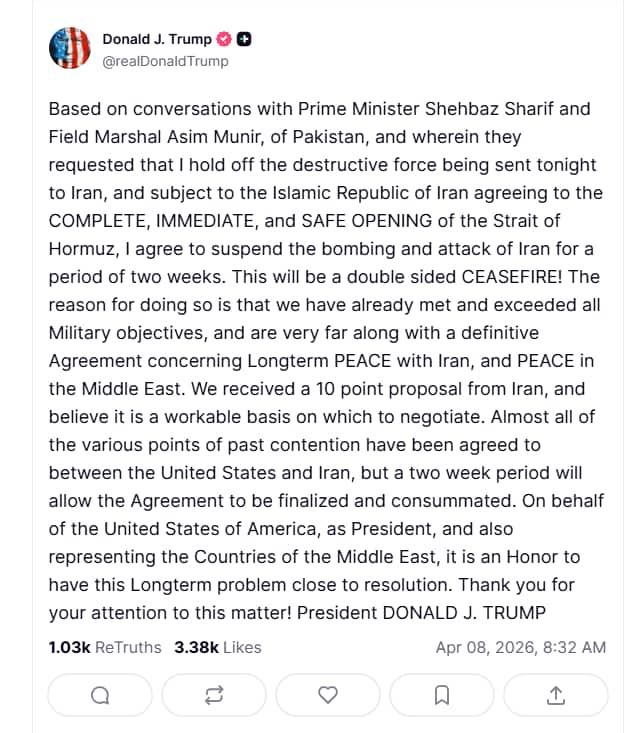
"We received a 10 point proposal from Iran, and believe it is a workable basis on which to negotiate. Almost all of the various points of past contention have been agreed to between the United States and Iran, but a two week period will allow the Agreement to be finalized and consummated.
"On behalf of the United States of America, as President, and also representing the Countries of the Middle East, it is an Honor to have this Longterm problem close to resolution."
Two White House officials confirmed that Israel has also agreed to the two-week ceasefire and to suspend its bombing campaign on Iran, the Reuters news agency reported.
The agreement includes a cessation of Israel's campaign in Lebanon, said Sharif, who helped mediate the ceasefire.
What could happen in the Strait of Hormuz?
Iran has since accepted the ceasefire, with Iranian state media reporting that talks between the two countries would begin on Friday in Pakistan's capital, Islamabad.
Iranian state TV declared Trump had accepted Iran's terms for ending the war, framing it as a "humiliating retreat" by the US president.
White House press secretary Karoline Leavitt said: "The truth is that President Trump and our powerful military got Iran to agree to reopening the Strait of Hormuz, and negotiations will continue."
A statement from Iran's Supreme National Security Council said it had won a major victory by forcing the US to accept its 10-point plan.
However, Iranian state media cautioned that the talks "do not mean end of war", with Iran insisting it will only accept a permanent end to hostilities on the terms of its peace plan.
Iran also said it would guarantee passage for maritime traffic through the vital Strait of Hormuz for two weeks, but with conditions.
It said that the pause would be used for talks with the United States on ending the war.
"For a period of two weeks, safe passage through the Strait of Hormuz will be possible via coordination with Iran's Armed Forces and with due consideration of technical limitations," Iranian Foreign Minister Abbas Araghchi posted on social media.
The Islamic republic's Supreme National Security Council said in a separate statement the negotiations were set to last two weeks but could be "extended by mutual agreement of the parties."
Despite the announcement, Israel's military said Iran had fired missiles towards Israel moments after Trump declared the pause — with blasts heard in Jerusalem and Jericho in the occupied West Bank, according to Agence France-Presse correspondents on the ground.
Former US ambassador to Israel Dan Shapiro said Trump's move was the "only plausible way to avoid an escalation that could have unleashed massive destruction of civilian infrastructure in Iran and in the Gulf states, and sent the global economic crisis into long-term overdrive".
— With reporting by the Agence France-Presse and Reuters news agencies.
For the latest from SBS News, download our app and subscribe to our newsletter.







