Britain accused Russia on Wednesday of breaking the two-decade international ban on chemical weapons at emergency talks into last month's poisoning with a nerve agent of a former Russian spy.
The accusations came as diplomats from the Organisation for the Prohibition of Chemical Weapons met behind closed-doors in The Hague to discuss the case.
Experts from the watchdog last week confirmed the British findings that former Russian double agent Sergei Skripal and his daughter had been poisoned with a nerve agent.
"We will continue to call out Russia's reckless and indiscriminate behaviour when it violates the CWC (Chemical Weapons Convention), and when it threatens global security," British ambassador Peter Wilson said.

"Russia has a proven record of conducting state-sponsored assassination," he claimed, according to a tweet from the British delegation to the OPCW.
"It is highly likely that the Russian intelligence services view at least some of its defectors as legitimate targets for assassination," Wilson said.
It was the second meeting of the Hague-based body's executive council in three days, and was called by Britain to discuss the probe into the poisoning of Skripal and his daughter last month in the British town of Salisbury.
Founded in 1997, the OPCW oversees the application of The Chemical Weapons Convention (CWC) aimed at eliminating the world's stockpiles of toxic arms.
After deploying its experts to Salisbury, the OPCW last week confirmed in a report "the findings of the United Kingdom relating to the identity of the toxic chemical".
Russian denials
It did not however publicly name the substance or its origins, which Britain says was a Novichok nerve agent of the sort first developed in the Soviet Union in the 1970s.
Moscow has vehemently denied the allegations, and in a tweet by the Russian embassy to the Netherlands mocked the British statements.
"No plausible alternative, highly likely (twice), it is likely that, strong probability, probably, may have been, may have - that is the wording again used by the delegation at the @OPCW. What a depth of argumentation!," it said.
The Salisbury crisis, coupled with Russian support for its ally Syria after accusations of illicit toxic weapons being used on civilians in its civil war, has sent already-frayed relations between Moscow and the West plummeting to new lows.
On Monday, the OPCW's governing executive council also met in closed-session to discuss a dangerous mission by its inspectors to the Syrian town of Douma to probe allegations of a chemical chlorine and sarin gas attack on April 7.
The mission, due to get underway on Wednesday, has been hit by delays, amid fears from Western powers that crucial evidence has already likely been removed.
Meticulous clean-up
London said meanwhile on Tuesday that the nerve agent substance used in Salisbury had been delivered in "liquid form" and in small quantities.
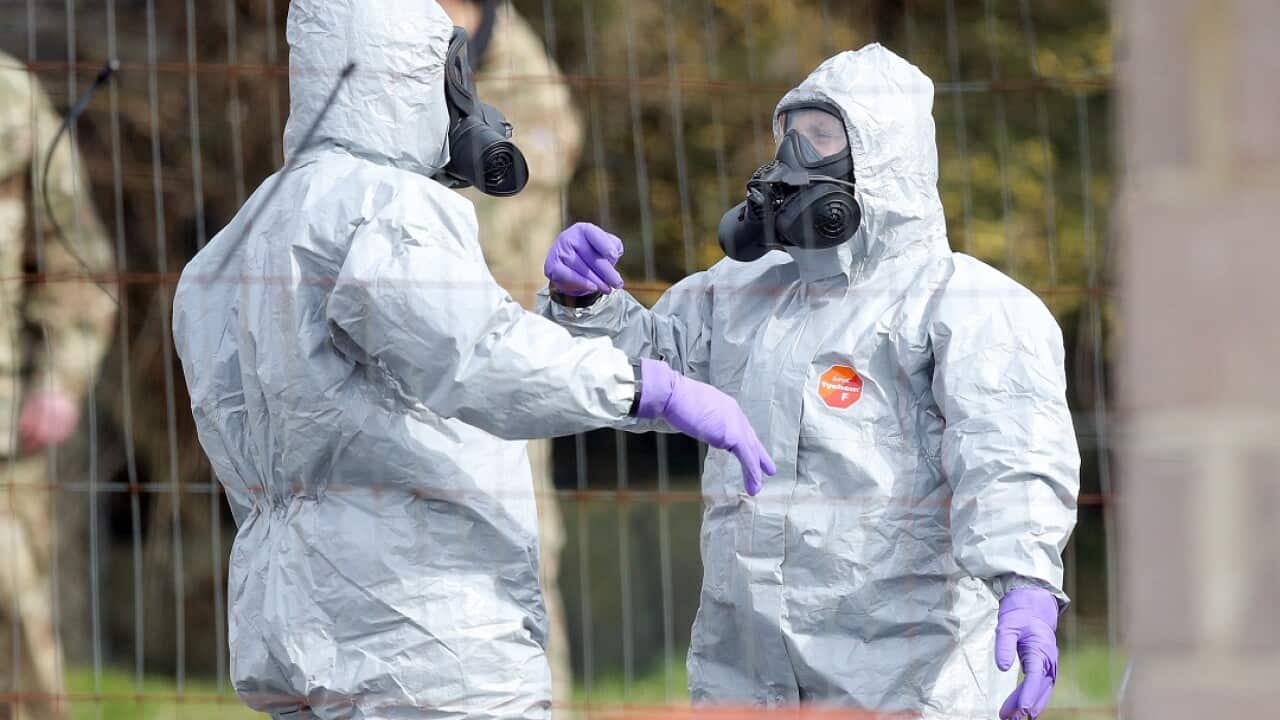
A meticulous clean-up has now begun in Salisbury, and the town's cemetery where Skripal's wife and son are buried was re-opened on Tuesday.
But nine other sites, including a pub and a restaurant the Skripals visited, remain closed off and the work could take several months. The Skripals were found slumped on a bench in Salisbury.
Sergei Skripal, 66, remains in the city's hospital, though he is improving rapidly and no longer in a critical condition, doctors said in their last update on April 6.
Yulia Skripal, 33, who had been visiting her father in England when the attack took place, has been discharged and is continuing her recovery in a safe house.
The Group of Seven industrial powers condemned the attack "in the strongest possible terms" on Tuesday.
They agreed it was "highly likely" that Russia was responsible and there was "no plausible alternative explanation".