
For New Zealanders the Centenary of Anzac burns bright in the national consciousness.
101-year-old New Zealand expatriate Frank Harlow was born almost two years before the landings at Anzac Cove.
Now living in Sydney the World War Two veteran says his most vivid memory as a little boy is the end of the Great War.
"I can remember seeing the soldiers coming home in a truck," he said.
The returned servicemen did not talk about what they had endured, the horrors they had seen. They just wanted to get on with their lives.
Mr Harlow recalls one veteran from his small town in the Bay of Plenty.
"We had an ex-soldier who ran a fruit and vegetable shop. He had one arm. He had a hook on one end," he said.
The Kiwis died in appalling numbers in Gallipoli. Out of the 14,000 New Zealanders who served there, 2,770 were killed and 5,212 were wounded.
The New Zealanders had the highest death toll per head of population of any country that served during the ten-month campaign.
Mr Harlow served in the Battle of Crete when Germany launched the biggest air invasion the world had ever seen. But he says the Anzacs had it much worse.
"We thought we got it bad with the Germans in Crete but it was nothing to what they got," he said.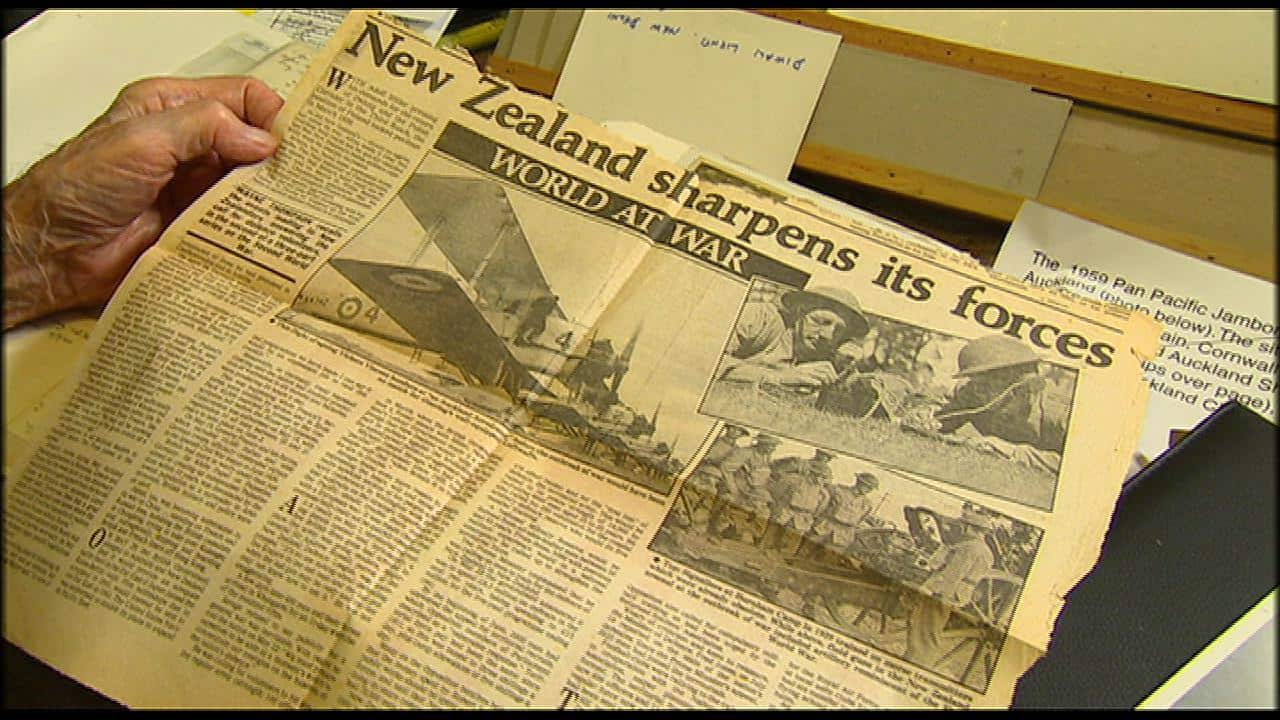 The word, Anzac, is the most evocative in the lexicon of two nations.
It is an acronym for the Australia and New Zealand Army Corps, formed when the Australian Imperial Force (AIF) joined with the New Zealand Expeditionary Force (NZEF).
But the Anzac spirit could also be said to have begun on Australian shores. Four thousand New Zealanders living here at the outbreak of the war volunteered to serve with the AIF.
The history of New Zealand and Australians fighting together goes back to the 1860s, when Australian volunteers crossed the Tasman to fight in the Land Wars.
A bond formed in the Turkey trenches
But a senior historian with New Zealand's Ministry of Culture and Heritage, Dr Monty Soutar, says it was in the trenches of Turkey that a bond was formed that has linked the two countries for 100 years.
"We are from the same part of the world basically and had similar experiences.
When they got to Gallipoli faced with a common enemy they bonded together, I guess, in the same spirit that we do today," he said.
For Australians, Lone Pine conjures up memories of bravery and loss. For New Zealanders it is Chunuk Bair, an 850 metre hilltop occupied by Turkish troops.
It was one of the key objectives in the Sari Bair Offensive as the British sought to drive the Turks from the high ground.
Dr Soutar says among the forces attacking the position was a 500-strong Maori contingent.
Before the attack they performed the Kamate haka. Now known around the world because of performances by the world champion All Blacks, the fearsome spine chilling challenge would have rarely been heard beyond New Zealand shores.
"It was at night so you can probably imagine how fearful it was for the Turkish, and they say the first trenches they went to clear the Turkish were gone, in absolute fear of what was coming, said Dr Soutar.
The battle ultimately ended in failure with the loss of many lives. Counter-attacks forced the allies from the trenches which were reoccupied by the Turks.
Nine Australians were awarded the Victoria Cross during the Gallipoli campaign. Despite many individual acts of courage only one New Zealander was recognised.
23-year-old signaller Corporal Cyril Bassett dodged sniper and machine-gun fire laying and repairing telephone lines during the Battle of Chunuk Bair.
After the war, Corporal Bassett said all his mates got were wooden crosses.
"I think the centenary period is bearing it out that New Zealanders see World War One as a coming of age."
Some historians believe that the reason more New Zealanders did not receive the VC was because often there was no-one to put forward a commendation. The officers lay dead with their men.
In every city, in every town in New Zealand stands a cenotaph engraved with the names of young men cut down in their prime.
A time of quiet reflection
While the numbers of people attending services and marches has soared in recent years, observers would note they rarely feature the flag waving and displays of nationalism seen in Australia commemorations.
Perhaps that is a sign of the more reserved character of the New Zealanders, or it is seen as a time of quiet reflection.
On April 25 New Zealanders will pause to remember the suffering and the hardships endured by so many.
"I think the centenary period is bearing it out that New Zealanders see World War One as a coming of age. Maybe not so for Maori. But certainly for New Zealanders in general," said Dr Soutar.
Frank Harlow loves seeing all the young people attending commemorations, but the centenary will also come with mixed feelings.
It is a reminder of the thousands of men who didn't come back. His uncle, Private John Harlow, was killed on the Western Front just two months before the war was over.
"He always crops up along with a lot of other good blokes. A lot far better men than me," he said.
Share


