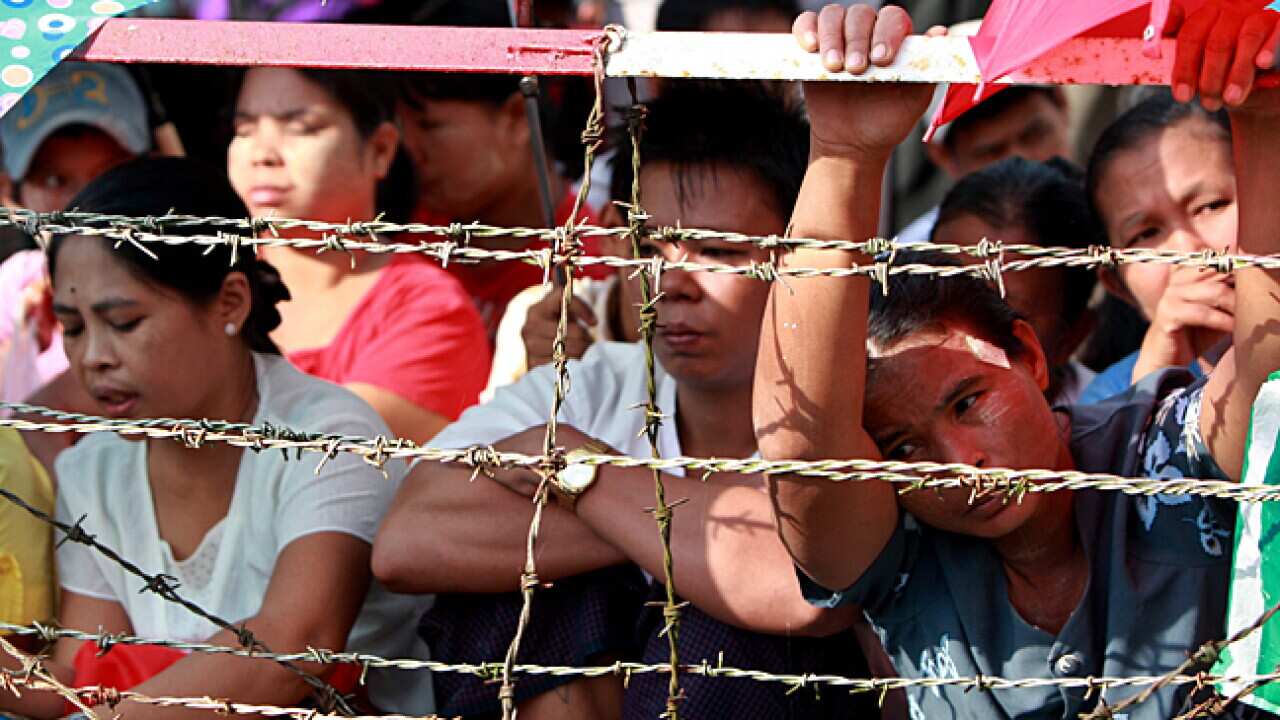
The release of roughly 2,000 political detainees including pro-democracy campaigners, journalists, monks and lawyers, has long been a key demand of Western powers that have imposed sanctions on the country also known as Burma.
Opposition leader Aung San Suu Kyi's National League for Democracy (NLD) party said that about 120 political prisoners had been pardoned, and suggested the figure could still increase.
News that makes sense
Your trusted source for staying up-to-date with the world around you. Get free daily news updates and analysis, straight to your inbox.
"We are still compiling the list," said spokesman Nyan Win.
The prominent satirist and vocal government critic Zarganar, who goes by one name, was among those released as part of a pardon of more than 6,300 prisoners by the new nominally civilian leadership, his sister-in-law told AFP.
The dissident was arrested in 2008 after organising deliveries of aid to victims of Cyclone Nargis -- which left 138,000 people dead or missing -- and sentenced to 59 years' imprisonment, later reduced to 35 years.
Some of Burma's most famous actors and comedians were among the throngs of friends who packed Rangoon airport to greet the performer, who flew home from Myitkyina in the far north of the country.
Asked if he had a message for Burma's leader, Zarganar replied: "I would like to ask him why he is so stingy. There are many people still in prison to be released."
A number of political prisoners were pardoned at Rangoon's notorious Insein Prison, including student activist Aung Kyaw Soe, who was arrested in 1990 and sentenced to death, later reduced to life in prison.
"I was released after serving 21 years and two days. I am glad that I was freed but I am also sorry for the people who are still inside the prison," he told AFP outside the jail gates.
Many of Burma's political prisoners were sentenced to decades in jail and have endured "torture and other forms of cruel, inhuman or degrading treatment", according to rights group Amnesty International.
A mass pardon of dissidents would be arguably the clearest sign yet of change under a new government that has reached out to critics including pro-democracy leader Aung San Suu Kyi, who was freed in November.
State television announced on Tuesday that more than 6,300 elderly, sick, disabled or well-behaved prisoners would be granted an amnesty from Wednesday "on humanitarian grounds".
It said freeing detainees would allow them to "help to build a new nation".
President Thein Sein, a former general and senior junta figure, has surprised critics by signalling a series of political reforms since taking power following a controversial election last November.
He has been applauded by international observers for holding direct talks with Suu Kyi, who spent most of the past two decades locked up by the junta.
But rights group Amnesty International said the release of at least 120 political prisoners was a "minimum first step", calling on the authorities to immediately release all the remaining prisoners of conscience.
In a rare concession to public opinion in the authoritarian nation, the government last month suspended construction of a controversial mega-dam, risking the anger of traditional ally China, which is backing the project.
A top US official, Kurt Campbell, on Monday hailed "dramatic developments" in Burma including what he described as "very consequential dialogue" between the Nobel Peace Prize winner and the leadership.
He hinted that concrete moves towards democracy by Burma could lead to an easing of sanctions. "We will match their steps with comparable steps," he said.
The new regime, which came to power after elections held a few days before Suu Kyi's release, appears keen to improve its image and in August held the first talks between her and Thein Sein.
Suu Kyi, whose party won 1990 elections but was never allowed to take power, has said she believes Thein Sein genuinely wants to carry out reforms, but cautioned it was too soon to say whether he would succeed.







