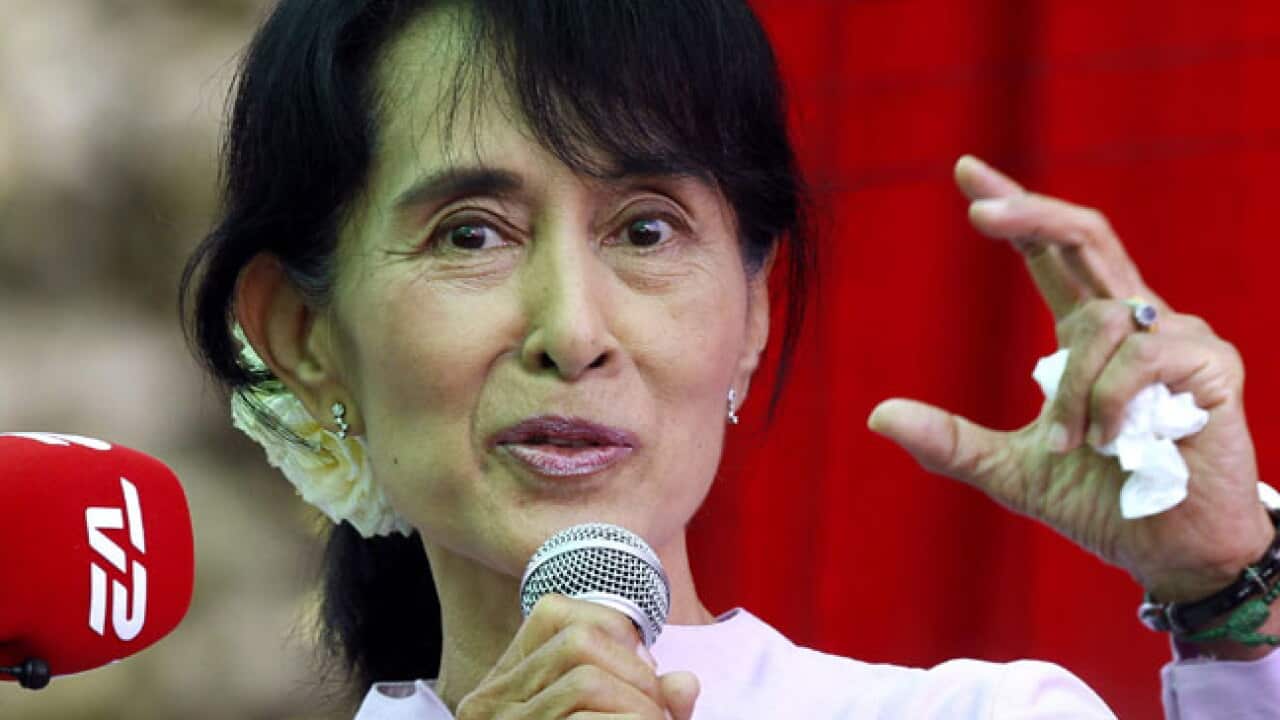
Pro-democracy leader Aung San Suu Kyi has said that elections in Myanmar would not be "genuinely free and fair", sounding a note of caution over her landmark bid for a seat in parliament.
The Nobel laureate, who spent most of the past 22 years as a political prisoner, complained of a series of problems, including "many, many cases of intimidation" as well as the vandalism of signboards.
"I don't think we can consider it a genuinely free and fair election," the democracy icon told a news conference ahead of Sunday's polls, when 45 seats are at stake -- not enough to threaten the ruling party's majority.
News that makes sense
Your trusted source for staying up-to-date with the world around you. Get free daily news updates and analysis, straight to your inbox.
"While we recognise that even in well-established democracies there are irregularities and misdemeanors when elections take place, what has been happening in this country (is) really beyond what is acceptable for a democratic election," she added.
"Still we are determined to go forward because we think that this is what our people want."
The National League for Democracy (NLD) leader said the polls were boosting people's interest in politics in the country formerly known as Burma after decades of outright military rule ended last year.
"It is the rising political awareness of our people that we regard as our greatest triumph," she said. "We don't at all regret having taken part."
The polls mark the first time that Suu Kyi is standing for a seat in parliament, and she has drawn huge crowds on the campaign trail.
Experts believe the regime wants the pro-democracy leader to win a seat in a parliament dominated by the army and its political allies to burnish its reform credentials and encourage an end to Western sanctions.
But Suu Kyi said that she had no plan to accept a position as minister in the army-backed government if offered because under the constitution she would be required to give up her seat in parliament.
"I have no intention of leaving the parliament to which I have tried so hard to get into," she said. But she indicated that she might be willing to take on some kind of non-ministerial role.
The NLD won a landslide election victory in 1990 but was never allowed to take office.
A 2010 election that swept the army's political proxies to power was marred by complaints of cheating and intimidation, as well as the exclusion of Suu Kyi, who was released from years of house arrest just days later.
The NLD has complained that it was not allowed to use suitable venues for campaign rallies, while in the constituency where Suu Kyi is standing, the names of hundreds of dead people were found on the electoral roll.
They also complained that somebody catapulted a betel nut at the car of one of its candidates, although he was not injured.
President Thein Sein acknowledged in a recent speech that there had been "unnecessary errors" in ballot lists, but said the authorities were trying to ensure the by-elections would be free and fair.
Since taking office a year ago, Thein Sein has carried out reforms including releasing hundreds of political prisoners, easing media restrictions and welcoming the opposition back into mainstream politics.
Unlike in 2010, the government has invited foreign observers and journalists to witness a vote seen as a major test of its reform credentials.
Suu Kyi described the vote as "a step towards step one in democracy".
She added: "Our opinion is that once we get into parliament we will be able to work towards genuine democratisation."
A gruelling schedule of rallies and speeches has taken its toll on the health of the opposition leader, who cancelled campaigning this week after she fell ill and was put on a drip during a trip to the south.
"I've not been well recently and I'm feeling a little delicate so any difficult questions and I shall faint straight away," she joked to the hundreds of journalists and diplomats who crammed into the grounds of the crumbling lakeside mansion where she was locked up by the junta until 2010.
US URGES FREE VOTE IN MYANMAR
The United States on Friday urged a free and fair vote in Myanmar, saying that the conduct of closely watched by-elections would affect future relations with the once-isolated nation.
The State Department said it shared concerns about irregularities expressed by democracy icon Aung San Suu Kyi, who is seeking her first seat in parliament, but said it would wait to see the outcome of Sunday's vote.
"We certainly want to see free and fair elections on Sunday. This would certainly propel further momentum in our bilateral relations," State Department spokesman Mark Toner told reporters.
"But we have noted some of these irregularities and... as we move forward through Sunday, we're going to assess," Toner said.
"We're obviously going to be looking to these elections on Sunday as another indication of what direction the country is moving in," he said.
Suu Kyi, a Nobel laureate who spent most of the past 22 years under house arrest, is seeking one of 45 seats in an election that would have been unthinkable before President Thein Sein launched reforms last year.
But Suu Kyi said Friday that the vote would not be "genuinely free and fair" and complained of problems including "many, many cases of intimidation."
President Barack Obama's administration has put a major focus on the country formerly known as Burma and opened dialogue in 2009 in hopes of coaxing the country out of its isolation.
Secretary of State Hillary Clinton paid a landmark visit to Myanmar in December and offered an eventual easing of biting sanctions in return for progress on democracy as well as a resolution of long-running ethnic conflicts.
The United States sent two observers to the election after an invitation by Myanmar, but State Department officials have said that the mission is too small and too late to conduct proper monitoring of the polls.







