(Transcript from World News Radio)
There has been a plea for unity among South Sudanese Australians, amid fears violence in South Sudan could overflow into diaspora communities.
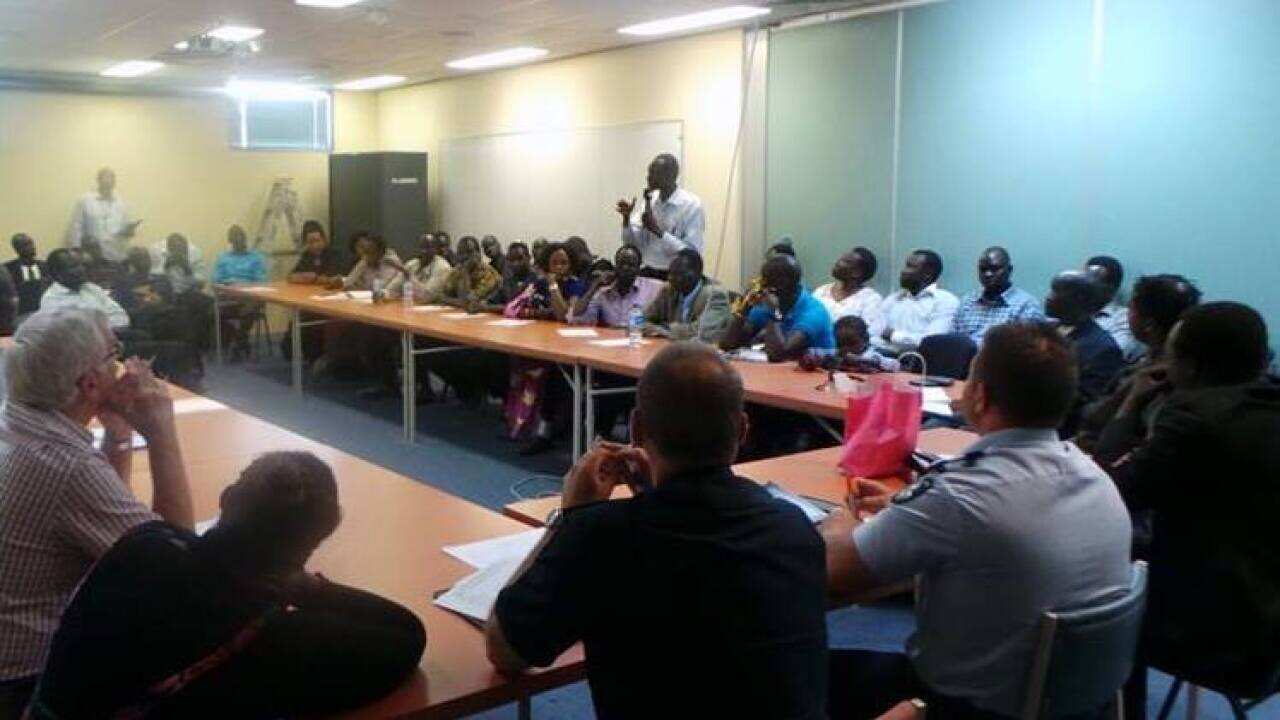
Police and community leaders in Victoria have held a forum in Dandenong, an outer Melbourne suburb with a large South Sudanese population, to address these concerns.
It came amid reports threats of violence are being made within the South Sudanese Australian community on social media.
Ajak Deng Chiengkou has the details.South Sudan gained independence from Sudan in July, 2011, following a referendum, with high hopes that nationhood would bring lasting peace to the region.
The referendum ended the decades long civil war between the government of Sudan in Khartoum and rebels from the south known as the Sudan People's Liberation Army or SPLA.
But political tensions within South Sudan flared last December, and fighting since then has left thousands of people dead, and many more displaced.
Amid signs that the fighting was taking on an ethnic dimension, South Sudanese families in Australia have been traumatised by reports of missing relatives and destruction of villages.
And police in Victoria are concerned that tensions within Australia's South Sudanese Nuer and Dinka communities could ignite violence here.
The forum at Dandenong police complex was attended by around 40 community members and police representatives.
Victoria Police inspector for community engagement Ron Gardner says police are aware of the impact of the recent fighting on the Victorian South Sudanese community.
"We are fully aware of the heartache that's occurring in South Sudan and that people are losing relatives and that the war is having a great impact. Our biggest concern is that it may move from a political issue to one that becomes ethnic-based and we have members of many ethnic groups in the South Sudan community and we became aware that through social media and other forms, there was a lot of consternation, a little bit of hatred being generated."
The conflict in South Sudan is between forces loyal to President Salva Kiir, from the Dinka tribe and rebels led by former vice president, Riek Machar who is from rival Nuer group.
But Chairman of the Nuer community, Garjung Choop, made a plea to his compatriots to remember they are now all Australian.
"What has happened in Sudan is in Sudan, it has not happened in Australia and we are all here (as) Australians. We are under the rule of Australia."
South Sudanese Youth Worker with Victoria Police, Bil Bj, told the forum, community members must not let grief and worry about the troubles in their homeland affect their lives in Australia.
"The problem is not between Nuer and Dinka, the problem is between the SPLM and the opposition and the SPLM and the government, that is the problem. These are the people, South Sudanese they are Nuer and Dinka and other tribes and I believe 95 per cent of them they lost one or two relatives in this war. Including myself, I lost five of my family. So if I attack someone because of my frustration of what happened back home so the law will hold me accountable here."
Christian youth fellowship worker Phil Malvueth Gai also made a plea for unity, saying other Australians should not be pulled into problems from overseas.
"I have visited so many families in the last few days within the last few days, both from the Nuer and from Dinka. I'm personally from Dinka, but my group, the young person's group that I have in the church are from different parts of South Sudan, so I have access to all the communities so I know how much this has affected the community. Having seen that I had the feeling that this could lead to communities fighting at the end of the day, in public places particularly."
Inspector Ron Gardner told community members that a united front is important if they want support from the Australian government.
"We're powerless to change what happens overseas, except through public opinion. As citizens of Australia you have the right to demand that the Australian government exercise your view. But that can only be done if you are a united group. If we have one interest say 'you must do that', another one say 'you must do that', the government will turn around and say, 'well these are various interest groups'. if the government of Australia were to say, 'our citizens. Australians who are of South Sudanese origin all say that this is not acceptable they all say this, without exception'. Then the government would be obliged to act on behalf of its citizens and exert its influence, either through the United Nations or another way."
Endalkatchew Gage is the New and Emerging Communities Liaison Officer for Victoria Police's Southern Metropolitan Region.
He agrees a united community could help to affect change in their homeland.
"We don't have any leverage on what happens there, but we can work together closely, all of us, members of the Southern Sudanese communities, we can work together to address issues that arise here."
Inspector Gardener also warned against allowing heightened emotions to lead to violence, which could in turn create a bad reputation for South Sudanese migrants.
"We understand that grief and emotion leads to the formation of a particular view, the problem then impacts on Victoria police and the community when the emotions overspill and arguments occur and then the community fractures, because then two things happen. One, we don't have the united voice to our government to act on your behalf and make representations. The other thing is that the wider Australian community will become dismissive and say things like, 'well why bring that problem here?' And it will then cause problems with the South Sudan people, part of our community, with potentially the rest of the community."
Inspector Gardener warned that anyone inciting hatred against other community members could be charged under racial villification laws.
"There are laws under racial villification that apply to people that might be of South Sudanese origin, but come from a different part of the diaspora. Racially-vilifying someone, in other words, stirring up hatred with the intent that other people act to their detriment is a criminal offence under Victorian law and we could and would deal with them in the most severe of cases and in fact even if they are not that severe, there is a potential for action. People need to understand that you have the right to have your say. But can not do so to the detriment of others. If you are villifying them in the public arena, that is against the law."
Endalkatchew Gage, who is originally from Ethiopia, believes South Sudanese have a lot to learn from Australian multiculturalism.
"There is a massive diversity where I came from, in Ethiopia there is a diversity as well. Diversity can sometimes (lead to) strains. We can see the multiculturalism in Australia, that can be an example for us. A guiding example."





