
When Clare Lutton tells people she is a sumo wrestler, they usually react in disbelief.
"Most people are surprised when I tell them," she says, "basically because I don't fit the stereotype of a sumo wrestler."
But the 28-year-old, who manages a dental practice in Sydney, is not to be underestimated.
"It's got a bit of an image problem. People don't realise it's a legitimate sport."
A champion rower at school, she was offered lucrative scholarships to study at universities in the US but turned them down after her mother developed early onset Alzheimer's at the age of 49.
Since taking up sumo wrestling in 2010, Clare has represented Australia at competitions around the world and faced some formidable opponents.
She is one of only a few female sumo wrestlers in Australia and says the sport's "intimidating" image might be what's putting more women off.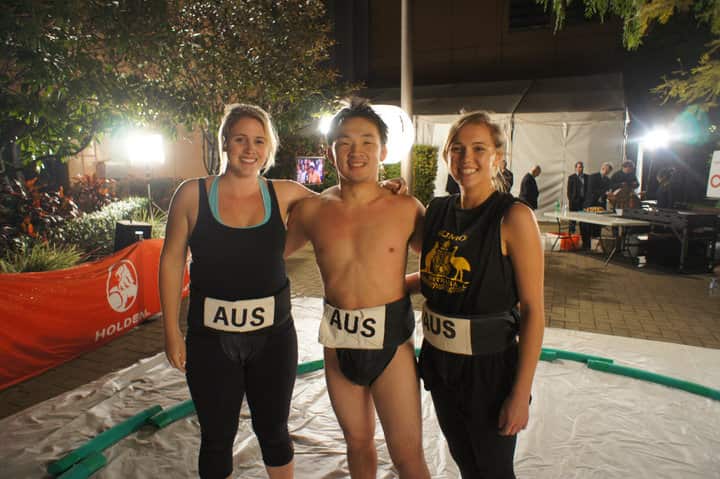
An uphill climb
Clare's coach, John Traill, is one of the sport's strongest advocates in Australia.
A former competitive sumo wrestler and Vice President of the Australian Sumo Federation, he goes by the nickname "Johno Fuji" after sumo champion, Chiyonofuji. "He was 130 kilograms with a washboard stomach and could run 100 metres in about 11 seconds," John says.
John is part of a global drive to get more women involved in the sport but says it's been a challenge here in Australia.
"It's got a bit of an image problem," he says. "And also people don't realise it's a legitimate sport."
"There is a misconception that you have to be fat. It does help — mass times speed equals force, so the heavier you are, the more force you can put behind you — but that's not necessarily the case in amateur sumo, where there are weight divisions."
John estimates there are about 20 women in Australia practising sumo at any one time, many of whom are based in New South Wales.
He attributes the Federation's president, Katrina Watts — a former sumo commentator in Japan — with boosting the sport’s profile in Australia.
"She has been growing women's sumo ever since she got back from Japan," he says. "To have her at the helm has brought a lot of interest in the sport."
Samurai warriors
The sport of sumo wrestling dates back more than 1,500 years and in Japan has strict rules and traditions around it, including a blanket ban on women entering the dohyō (ring).
Athletes are known as 'sumotori' or 'rikishi,' meaning 'strongman' and the top professionals generally weigh in at about 150 kilograms.
The sport pits two rikishi against each other, each wearing only loincloths. One is named the victor after he forces his opponent outside the dohyō or topples him to the ground.
Former rikishi Miniaminoshima Falevai, known as "Minami", was scouted at the age of 16 after being spotted at a junior international competition.
Not long afterwards he moved to Japan from his native Tonga to train full time.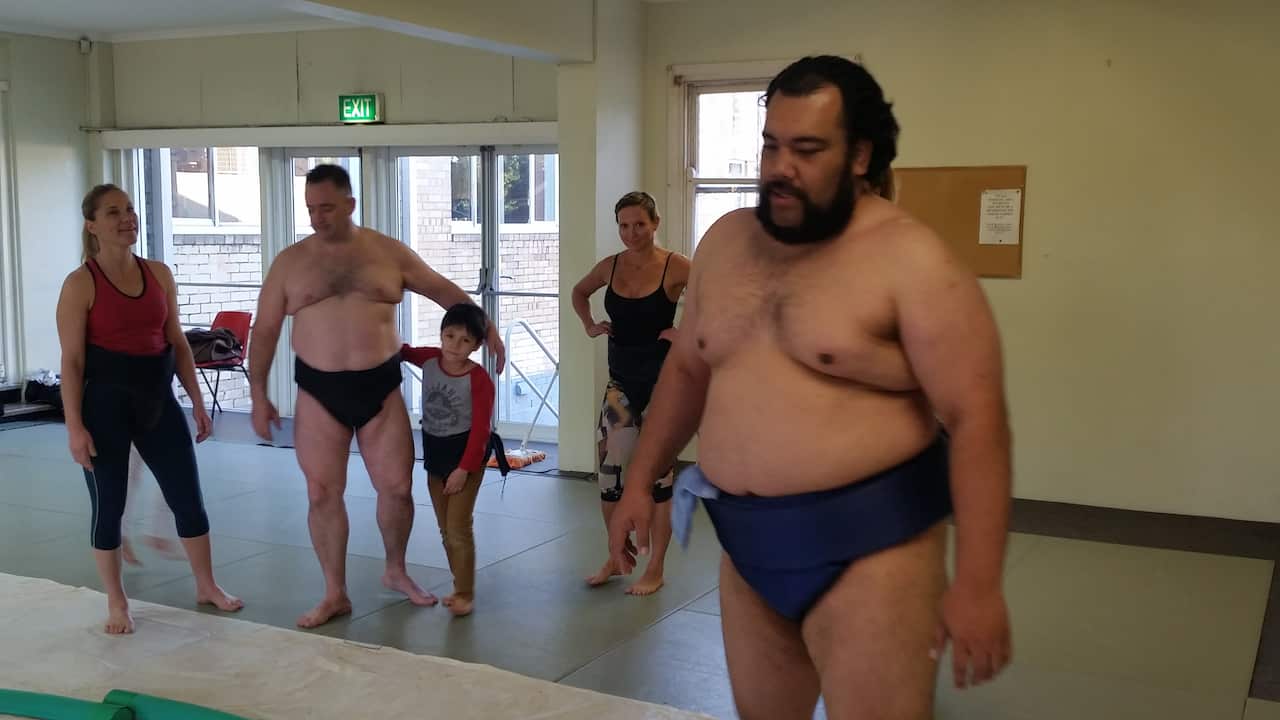 "It's another world out there," he says of the pro circuit. "It's really tough. It's disciplined.
"The only time we had off was a week after each tournament. Besides that, it was all training."
Sumo stars are revered in Japan, with top players earning millions of yen in prize money each year.
They live and train in residences called "stables" and follow rigorous routines including eating large, protein-rich meals each day, often followed by naps, in order to "build up".
Unlike professional sumo, amateur sumo has weight divisions — lightweights under 85kgs, middleweights 85kgs to 115kgs, heavyweight over 115kgs, as well as an "open" category — meaning players aren't under pressure to reach gigantic sizes.
Women's amateur sumo began in 2001 but is still not permitted at Tokyo’s Kokugikan, sumo's national sports hall, or at a professional level.
Entering the ring
Minami says it is a well-established part of sumo tradition that women are banned from pro competition.
"Sumo is a samurai sport," he says. "Women were not samurai and sumo was only for samurai warriors."
But the amateur women's scene has gone beyond Japan and now includes athletes from all over the world.
Rising to the top of that scene are women from Russia, Mongolia and The Netherlands.
Australian student Nadine Lee says she first became interested in the sport when she was living in Japan but didn't consider training until a friend recommended it back in Australia.
She thinks there needs to be more advertising to get the word out to women about the benefits of sumo.
"It's a regime like any other sport so it's got its rules and regulations, and its physicality," she says.
"People may just think it's a bunch of fat guys pushing each other around, but there's more to it than that."
John Traill agrees.
"Women do some of the most poetic sumo because they can get out of the way quickly and they are very flexible."
Angela Keil-Zippermayr, a German IT worker who took up sumo only a few weeks ago, says the sport suits her personality and way of life.
"It's very close to who I am," she says. "I'm very physical and I'm very masculine, and so it fits in very well."
She's happy to be breaking boundaries.
"When I tell people I do sumo they laugh and think it’s hilarious but I think they think it’s really great," she says.
"And they have much more respect for me now than they did before, which is one of the main reasons why I do it."
Olympic dreams
Organisers of the sport have long campaigned to have the sport recognised as an Olympic event.
But with Olympic sports needing strong male and female divisions, sumo's male-dominated image is hindering its chances.
There are hopes that if more women get involved, this could be turned around.
Nadine Lee is optimistic.
"I hope sumo becomes an Olympic sport," she says.
"I mean, if curling can become an Olympic sport, why not sumo?"
And she'll be fighting fit, if that time comes.
Share


