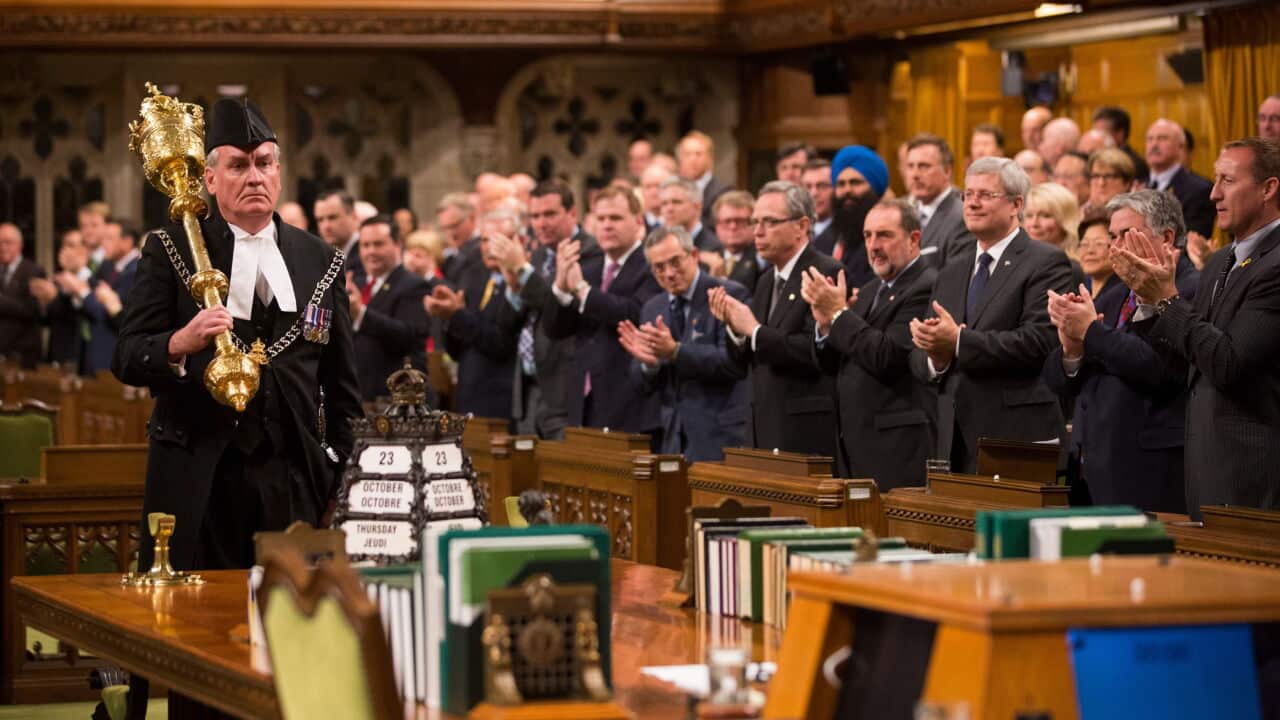
Lawmakers have returned to the bullet-chipped halls of Canada's parliament after two jihadist attacks in three days forced their nation to confront a deadly new home-grown threat.
In the House of Commons on Thursday, members applauded Sergeant-at-Arms Kevin Vickers, who on Wednesday put aside his ceremonial duties to draw a gun and fire the shot that halted one attacker.
Vickers' composed bravery has become an inspiration to Canadians struggling to comprehend how two of their countrymen could turn against their homeland with such reckless brutality.
"The objective of these attacks was to instill fear and panic in our country and to interrupt the business of government," Prime Minister Stephen Harper told the chamber as business resumed.
"Well, members, as I said yesterday, Canadians will not be intimidated. We will be vigilant but we will not run scared.
News that makes sense
Your trusted source for staying up-to-date with the world around you. Get free daily news updates and analysis, straight to your inbox.
"We will be prudent but we will not panic and as for the business of government, well, here we are, in our seats, in our chamber in the very heart of our democracy and our work."
Harper then crossed the floor to shake Vickers' hand, and to hug opposition leaders.
Earlier, the prime minister had lain a bouquet of flowers at the Ottawa war memorial where an unarmed Canadian soldier mounting a ceremonial guard was shot dead on Wednesday.
On Wednesday, Michael Zehaf-Bibeau, a 32-year-old petty criminal from Montreal, had shot dead the soldier, Corporal Nathan Cirillo, before storming the corridors of parliament.
There, officers opened fire, including Vickers, a veteran of the Royal Canadian Mountain Police appointed to lead the parliamentary security team and wield the ceremonial mace.
The attack followed one on Monday, when 25-year-old Martin Couture-Rouleau ran over two soldiers in a Quebec parking lot, killing one of them, before being shot dead by police.
Both assailants were already on a Canadian government watch list of so-called "high-risk travellers" banned from leaving the country for fear they might join Islamist extremists waging war abroad.
Canada has never before been hit by Islamist violence, but it has been threatened in militant broadcasts over its role in the US-led air armada striking the Islamic State group in Iraq.
Some Canadians are thought to have travelled to the Middle East to join the group, and others are thought to have developed radical ideas at home, living among Canada's Muslim minority.
The prospect of more such attacks was at the forefront on many minds on Thursday, as a society proud of its reputation for openness and tolerance grapples with a new menace.
Canada's Muslim community is nervous that the attacks will stir animosity against it, and its leaders were quick to denounce the violence and vow to keep a closer eye on troubled believers.
Imam Sikander Hasni of the Kanata association, who works at the capital's mosque, said he and his colleagues had worked closely with police and had tipped them off to an earlier plot.
"Something needs to be done but at the same time, I think there's a realisation that sometimes there is not very much that can be done," he said.







