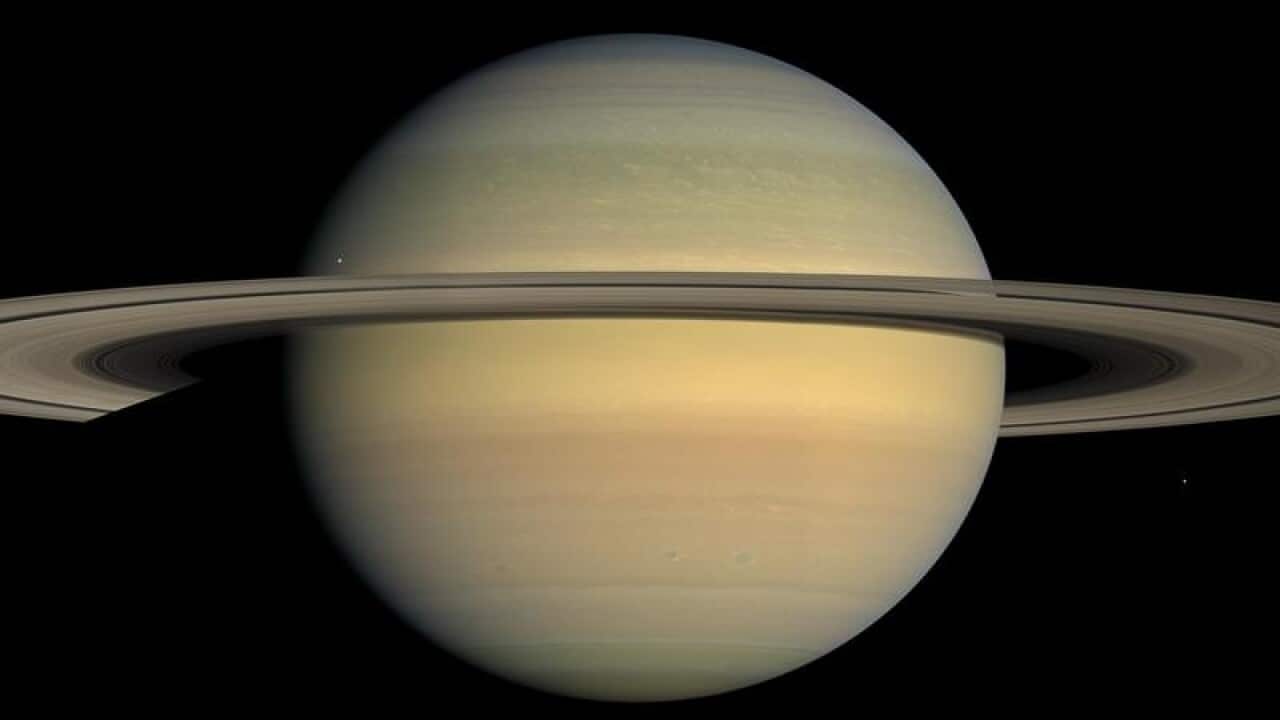
The Cassini space probe is soon to be killed off and sent on a spectacular space dive into Saturn's atmosphere ending a 20-year mission during which it's discovered a wealth of scientific data on the planet and its moons.
NASA scientists have opted to destroy the space robot on Friday as it runs out of fuel and becomes impossible to steer. They say it will break up into fragments and plough into Saturn's cloud tops at a speed of 113,000 kilometres per hour.
As the 6.7-metre probe begins its fall into Saturn's cloud tops it will continue to take images of the ringed planet and its moons which will be radioed to Nasa's Deep Space Network antenna complex in Canberra before being posted on the mission website.
Cassini was launched in 1997 and took seven years to travel the 3.2 billion kilometres to Saturn before embarking on a 13-year journey of discovery. The cost of the mission stands at GBP2.9 billion ($A4.8 billion).
In its time Cassini made 22 daring orbits that allowed the probe to slip between Saturn and its rings.
News that makes sense
Your trusted source for staying up-to-date with the world around you. Get free daily news updates and analysis, straight to your inbox.
Scientists expect to lose contact with the probe at around 12.55pm UK time as Cassini begins to feel the effects of drag from Saturn's atmosphere and starts to tumble, causing its dish antenna to lose sight of Earth.
"The spacecraft's final signal will be like an echo. It will radiate across the solar system for nearly an hour and a half after Cassini itself has gone," Cassini project manager at Nasa's Jet Propulsion Laboratory in Pasadena, California, Earl Maize said.
"Even though we'll know that, at Saturn, Cassini has already met its fate, its mission isn't truly over for us on Earth as long as we're still receiving its signal."







