

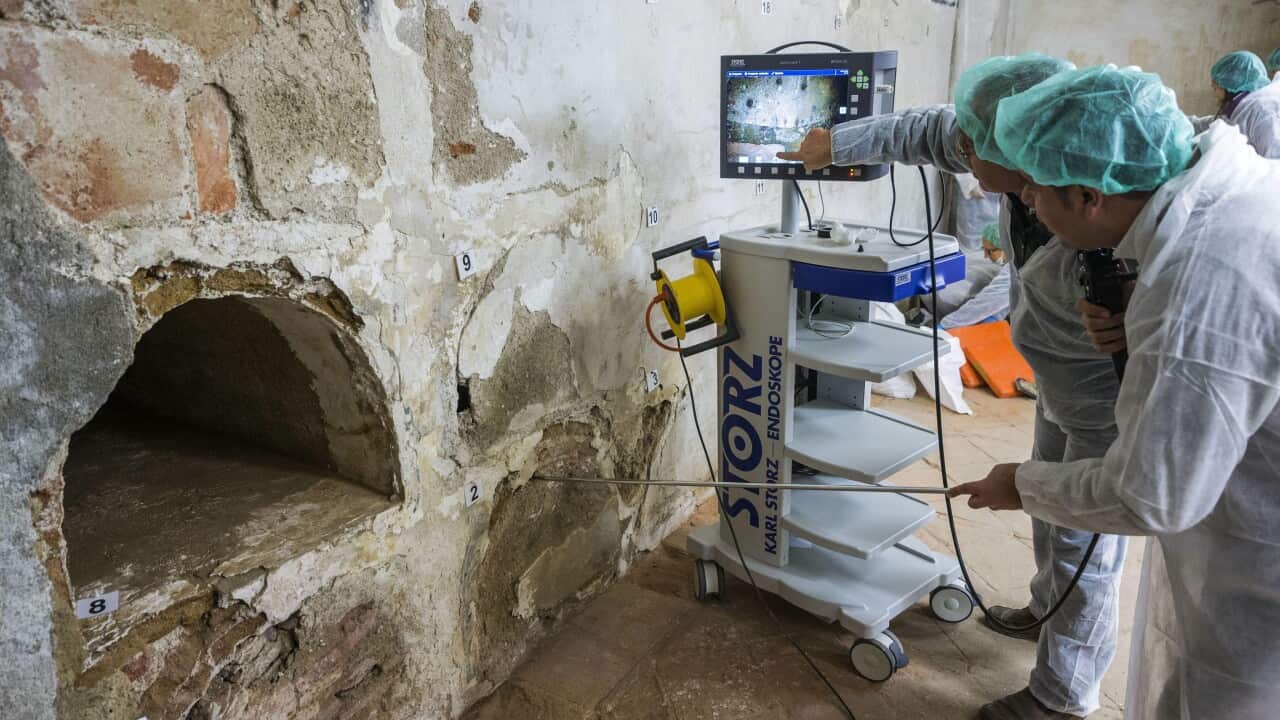
Nearly 400 years after his death, the quest to find Cervantes had led Spanish scientists deep into the sub-soil of a 17th century convent. Some of bones dug up in recent months almost certainly belong to Cervantes, they said.
"Everything coincides to lead us to believe that Cervantes is there," forensics export Francisco Etxeberria told a news conference.
Investigators may never be able to guarantee with absolute certainty that it was his body, Exteberria added, even though DNA tests are to be carried out.
Cervantes - whose masterpiece about an errant, daydreaming knight and his faithful servant Sancho Panza has delighted readers around the world - had requested to be buried in the convent.
The Trinitarian religious order had helped to pay a ransom to release him from slavery after he was captured by Moorish pirates.
News that makes sense
Your trusted source for staying up-to-date with the world around you. Get free daily news updates and analysis, straight to your inbox.
He died in 1616 - the same week as William Shakespeare.
But the exact location of his tomb was lost in a subsequent rebuilding of the convent.
Historians hope to establish a burial site to attract literary pilgrims. Madrid mayor Ana Botella said on Tuesday that authorities were looking into the possibility of opening up the site to visitors.
Investigators began their search almost a year ago in the cloistered convent, still home to a dozen elderly nuns, to visitors. They recently found bone fragments and as well as a dilapidated piece of a wooden coffin with the letters "M" and "C" on it.
None of the bones showed signs of the injuries Cervantes was known to have sustained during his life, including lesions to his left arm when he fought in the Battle of Lepanto in 1571, the experts said.
The Cervantes search yakes place after a similar quest in Britain, where investigators found the remains of medieval monarch King Richard III in 2012 under municipal car park. He will be reburied in a ceremony next week.
Reporting by Raquel Castillo, Writing by Sarah White; Editing by Angus MacSwan.