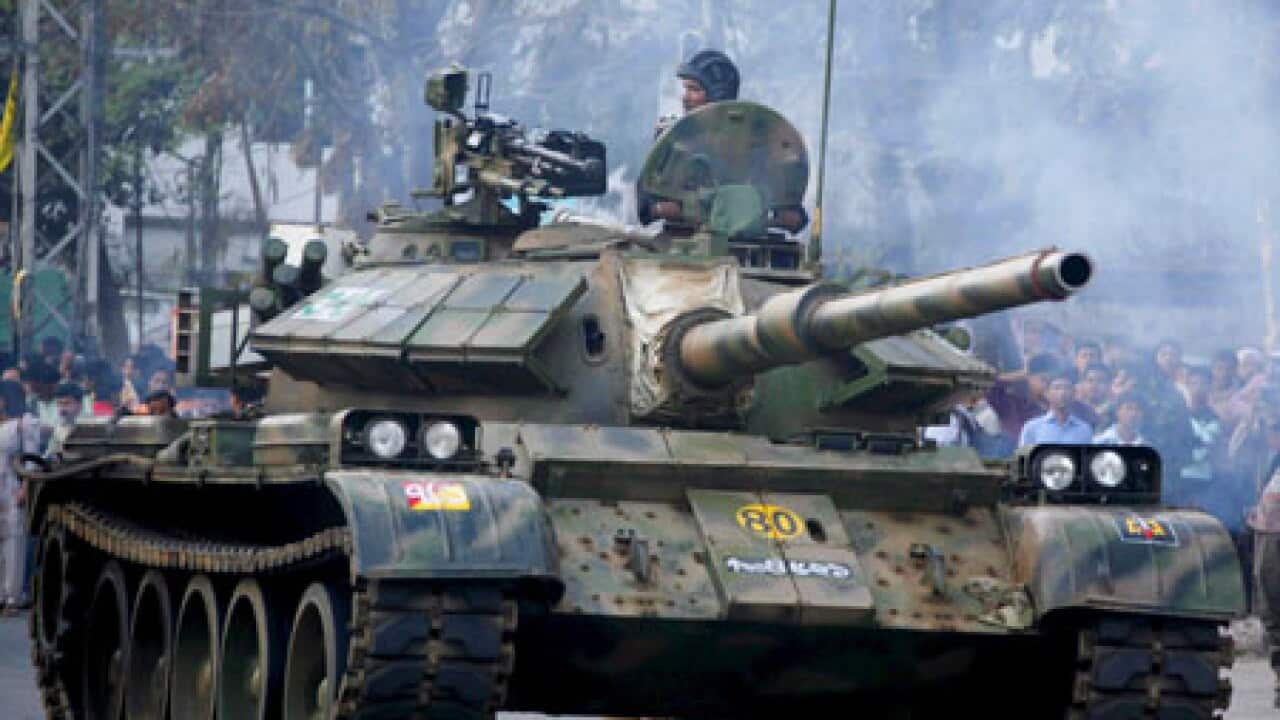
Even at a distance, a tank is hard to miss. Yet if it is a tank with adaptive camouflage you might barely realise you are looking straight at it. At least that's the aim of the "chameleon" system being developed by BAE Systems in Sweden.
The system, which will be tested later this month, is part of a broad push to find ways of making tanks less conspicuous in the battlefield, says Hisham Awad at BAE Systems in Bristol, UK.
Given their large size and relatively slow speed, tanks are often sitting ducks for enemy fire. BAE Systems believes its system can not only make tanks harder to see, but also disguise them thermally, by making the vehicles "sweat", or even look like cows.
News that makes sense
Your trusted source for staying up-to-date with the world around you. Get free daily news updates and analysis, straight to your inbox.
At the moment, the visual camouflage system is the technology that is at the most advanced stage and is being developed to conceal the tank's sides, Awad says. A pair of "bug-eyed" compound video cameras on each side capture the tank's surroundings. Each one contains nine small cameras, giving a wide field of vision. The images from these cameras are then fed to displays built into the outer surface of the armour on the tank's opposite side. The displays use arrays of organic light-emitting diodes (OLEDs) to project the image onto a screen contained within the armour, much like a rear-projection TV, says Awad. The screen will be built in to a layer of a transparent composite armour on the tank's side. How to hide the tank's tracks and roof are challenges that the researchers have yet to overcome.
"There may be discontinuities at the edges," says Alan Johnston, head of the vision lab at University College London. But even so, provided the display refreshes fast enough it should work, he says, adding that just matching the colours to the background could be enough.
BAE Systems would not reveal many of the details but claims that a working version of the system could be available within five years.
While this should make a tank more difficult to see, hiding its thermal appearance is much more challenging. "A lot of heat comes out of the vehicle at any one time," says Awad. This produces a characteristic thermal signature, making tanks easy targets for heat-seeking missiles.
BAE researchers are modelling ways to capture the water component of the engine exhaust and channel it to composite armoured tiles along the tank's sides. The water could then evaporate off, cooling the tank's surface just like sweating.
Rather than just hiding the vehicle's heat signature, though, the researchers want to be able to move water over the tank's body very quickly and create specific shapes. Individual composite tiles could be switched on and off and used like pixels to depict simple shapes, the company claims. "You can make it look like a Ford Focus, or you can have the shape of a cow," says Awad.







