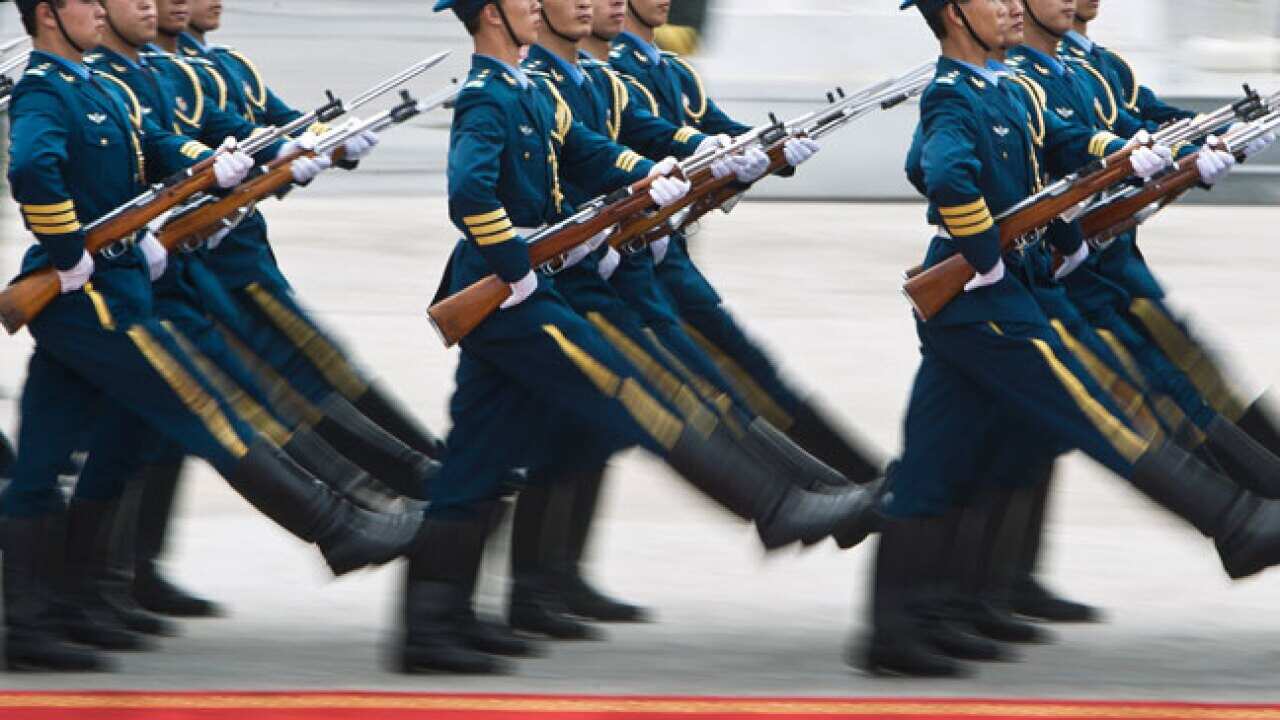
The Pentagon says China's military has made significant steps to modernise but its 'ability to sustain military power" remains limited.
MARITIME POWER EXPANDING, US WARNS.
China's military is increasingly focused on naval power and has invested in high-tech weaponry that will extend its reach in the Pacific and beyond, the Pentagon said Wednesday.
China has ramped up efforts to produce anti-ship missiles that could knock out aircraft carriers, improved targeting radar, expanded its fleet of nuclear-powered submarines and warships and made advances in satellite technology and cyber warfare, the Pentagon wrote in an annual report to Congress.
The weapons buildup comes as the Asian economic giant places a growing priority on securing strategic shipping lanes and mineral-rich areas in the South China Sea.
"The evolution of China's economic and geostrategic interests has fundamentally altered Beijing's view of maritime power," the report said.
While Chinese leaders continue to prepare for a potential conflict with Taiwan, they now see a broader role for the People's Liberation Army, with the navy as a crucial element, it said.
"China's leaders have offered unambiguous guidance that the PLA Navy will play a growing role in protecting China's far-flung interests," the report said.
US commanders worry that China's advances could jeopardize America's longstanding military dominance in the Pacific while US officials have accused Beijing of aggressive tactics against neighboring countries over territorial disputes in the South China Sea.
An expanded Chinese naval presence in the region, including warships, submarines, missiles and possible aircraft carriers, would have "implications for regional rivalries and power dynamics," Michael Schiffer, deputy assistant secretary of secretary of defense, told reporters.
Chinese leaders have insisted its modernization program is aimed solely at "self-defense" and accused US officials of trying to portray the armed forces as a threat.
The report said China had sought to strengthen its nuclear forces by adding more "road-mobile" ballistic missiles and by stressing "camouflage" tactics to ensure the atomic arsenal could better survive a potential attack, the report said.
The Chinese buildup includes a new aircraft carrier that recently held its first sea trial. But the Pentagon played down the carrier's importance, saying the ship was a first step towards a future fleet of carriers expected to be built over 10 years.
The new carrier, a Ukrainian ship modified by the Chinese, "will serve initially as a training and evaluation platform, and eventually offer a limited operational capability," it said.
The aircraft carrier still has no warplanes on board and "it will take a number of additional years for an air group to achieve the sort of minimal level of combat capability," Schiffer said.
With an array of new weapons coming on line, China's military will face a challenge in the coming decade as it tries to train troops in new tactics and revise its approach to "adopt modern operational concepts," he said.
The report also noted an internal debate in China about the role of the military and whether the PLA "should develop to advance China's interests beyond traditional requirements."
The report renewed US warnings that China was extending its military edge over Taiwan, citing better artillery that could strike targets within or even across the Taiwan Strait.
China considers Taiwan, where the mainland's defeated nationalists fled in 1949, to be a province awaiting reunification, by force if necessary.
The dispute over Taiwan, including US arms sales to Taipei, has remained a stumbling block to Washington's attempts at promoting a security dialogue with the Chinese military.
Taiwan, and some US lawmakers, have called for the sale of F-16 fighter jets to help counter the Chinese threat.
The Pentagon report covered 2010 and was delayed for five months, following a high-profile visit to Beijing by the US military's top officer in July.
The document estimated China's overall military-related spending was more than $160 billion in 2010, and that its military budget grew at an average of 12.1 percent over the past decade -- outpacing the country's economic growth at 10.2 percent over the same period.
Chinese military spending, however, is still far below the US defense budget, the world's largest, which was nearly $700 billion in 2010.
CHINESE MEDIA SLAMS 'US INTERFERENCE'
China's state-run news agency on Thursday accused the United States of "interfering", following the release of the Pentagon report.
Xinhua said the annual report to US Congress had drawn protest in the past over its "interfering nature" and "distortion of facts", although it welcomed recent improvements in military relations between the two powers.
"The 94-page report, as usual, interferes with the internal issue of China by making wilful comments on the situation across Taiwan Straits," Xinhua said.
China considers Taiwan, where the mainland's defeated nationalists fled in 1949, to be a province awaiting reunification, by force if necessary.
The Pentagon report renewed US warnings that China was extending its military edge over Taiwan, citing better artillery that could strike targets within or even across the Taiwan Strait.
Xinhua also accused the Pentagon of "overlooking the country's peaceful defence policy" in its report, which said China's military was investing in high-tech weaponry that would extend its reach in the Pacific and beyond.
The weapons buildup comes as the Asian economic giant places a growing emphasis on securing strategic shipping lanes and mineral-rich areas in the South China Sea.
"The Pentagon report, submitted to the Congress by the Pentagon annually pursuant to a US law since 2000, has drawn protest from China over its interfering nature, distortion of facts and baseless speculations," the Xinhua report said.
"This year's report, however, said the United States recognises China's contributions that support a safe and secure global environment."
The dispute over Taiwan, including US arms sales to Taipei, has remained a stumbling block to Washington's attempts at promoting a security dialogue with the Chinese military.
However, Xinhua said relations between the US and Chinese militaries had improved over the past year.
It cited a visit to China last month by US Joint Chiefs of Staff Chairman Mike Mullen, America's top military official. Mullen's Chinese counterpart Chen Bingde visited the United States last year.
Share


