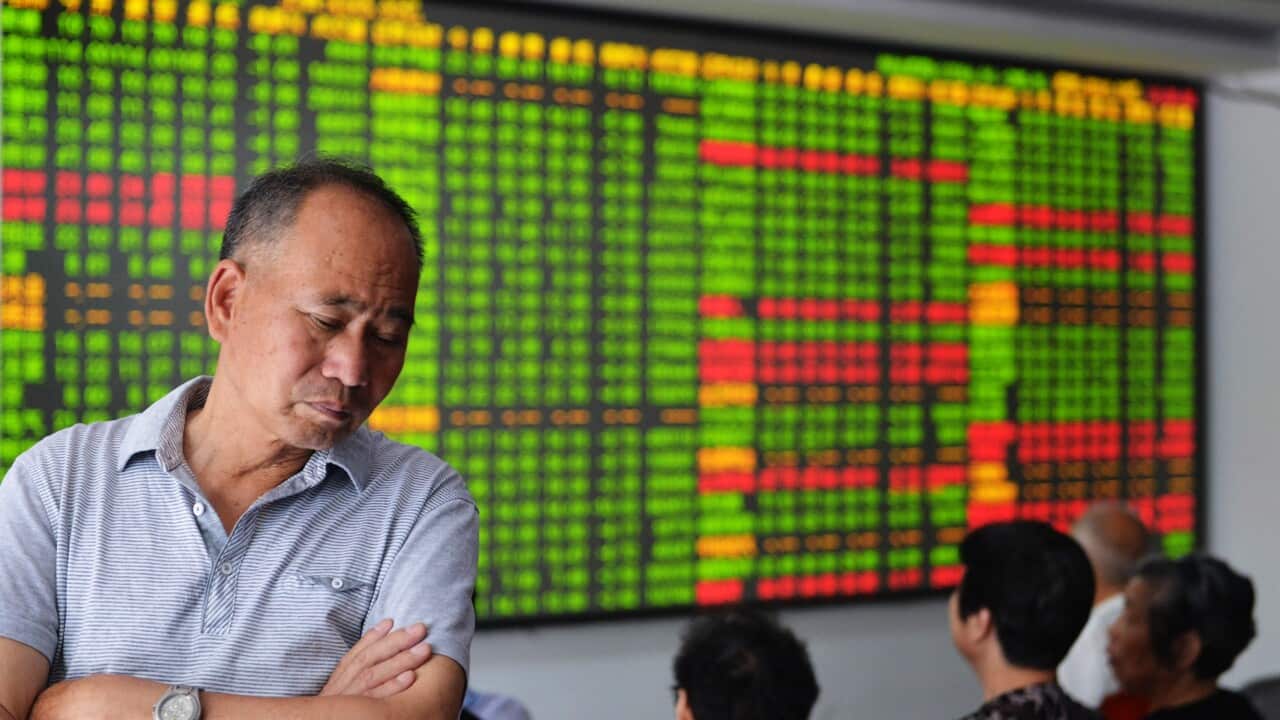
There will be losers in the Chinese share market crash but the effects on economies will be mild, one Australian stock broker says.
The steep decline on the Shanghai Stock Exchange has spooked investors all over the world with the country's benchmark, the Shanghai Composite Index, shedding close to a third since its recent peak in May.
Ken Howard from stockbroking and corporate finance firm Morgans said a strong rally preceded the crash in Chinese shares, with prices too high for those company’s earnings.
“It was fairy tale money in the first place,” Mr Howard said about the shares purchased with margin lending at such high price-earnings ratios.
Mr Howard said things were now returning to normal.
“This type of event will have a ripple type effect on the economy,” he said.
“It’s not going to seriously affect the world’s economy.”
Mr Howard said there would be winners and losers, but pointed out that not every major financial incident was followed by recession.
“This isn’t like a famine that’s interrupting the production of food,” Mr Howard said.
The Asian Financial Crisis in 1997 and the burst of the Dot Com bubble in 2000 were good examples of situations where people in the market lost money, but life continued afterwards, he said.
The recent losses on the index are dwarfed by the crash during the Global Financial Crisis.
An economist with the Commonwealth Bank of Australia says the stock market declines would not lead to financial instability in China.
Meanwhile, iron ore prices have fallen to their lowest in a decade.
Why did the Chinese market rally?
Margin lending, where people borrow to invest, has fuelled the recent boom in the Chinese share market.
Relaxed lending rules have allowed investors to take higher-leveraged margin positions in the Chinese market.
Margin lending allows investors to leverage their existing securities to increase their exposure to the market.
Gains and losses are amplified with margin lending.
A 'margin call' is issued by a bank or broker when the equity in a leveraged position falls below a certain level, requiring the investor to either sell shares or deposit more money to provide security for the loan.
Why is the market falling?
The Shanghai Stock Exchange made news in March when the median price to earnings ratio on the Shanghai Composite Index hit 44 and fears since then of an overheated share market have been well-reported.
Many companies were trading at more than 50 times their projected earnings, the Financial Times reported.
The father of value investing Benjamin Graham, who wrote the famous book The Intelligent Investor, said securities should not be purchased at more than 15 times their earnings.
Graham was the mentor of famous investor Warren Buffet, who later adopted his teacher's methods of value investing.
Many have said the Chinese market is overvalued.
The selloff in China has caused the government to react with restricting the sale of shares.
The media’s reporting on the crash has scared some people into selling their shares, and caused margin lenders to close their positions.
What effect will the crash have?
The falling Chinese market has fed into a crash in iron ore prices.
Iron ore prices had already been declining for years.
Iron ore is an important export for Australia and a major source of income for Australian mining companies.
Commonwealth Bank economist Wei Li said investor confidence would take some time to recover after the crash in China, but the situation would not likely affect the stability of China's financial sector.
He said the CBA believed just eight per cent of Chinese people were invested in the Chinese stock markets.
Market analyst Chris Weston from CFD trading company IG said the crash was affecting sentiment in Australia.
“I still feel we are a long way from the equity falls having a material impact on economics,” Mr Wheston said.
“Predominantly because only 20 per cent of the Chinese household portfolio is in equities, but had the falls been in deposits then things would look a lot worse."
Share


