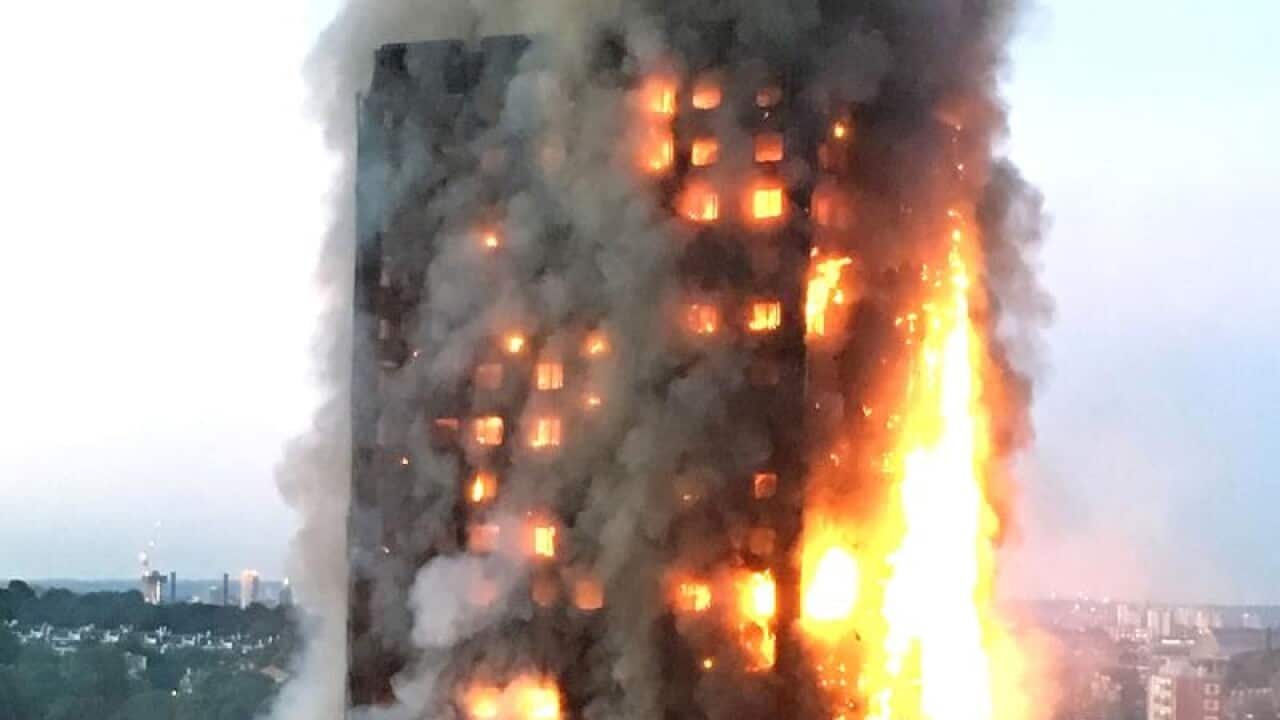
Cladding panels on London's Grenfell Tower were cut in such a way that the highly flammable core was "directly exposed" when the inferno reached the external facade, an inquiry has heard.
Professor Luke Bisby, a fire expert who analysed the spread of the blaze, told a hearing in the UK capital on Wednesday that the polyethylene core had a similar heat of combustion to petrol.
When exposed to flame, polyethylene would melt and could generate "flaming droplets", he said.
Footage from the night of the disaster showed fire raining down as the block in London's west was enveloped.
The professor explained: "Polyethylene is a highly flammable, synthetic thermoplastic polymer. Upon exposure to heat, polyethylene will melt and drip, possibly flowing while burning or generating flaming droplets."
News that makes sense
Your trusted source for staying up-to-date with the world around you. Get free daily news updates and analysis, straight to your inbox.
He continued: "You will no doubt have noted the commentary in the media comparing the polyethylene within the rainscreen cassette at Grenfell Tower with petrol or diesel; this is likely to be on the basis that the heats of combustion of petrol or diesel are similar to the PE used in Reynobond PE (aluminium composite material) products.
"It's perhaps worth reiterating here, however, that the heat of combustion is only one of the important parameters dictating how a material will burn."
The probe previously heard that the fire on June 14, 2017 escaped into the external face of the building after eating through the flammable material which lined the windows of Flat 16, on the fourth floor.
The window boards surrounding the frames were made of uPVC, the expert said - a material which promotes the spread of fire less than other polymers, but which will soften at a lower heat.
Prof Bisby continued: "This is significant, highly significant in my view, in the context of Grenfell Tower because, as I've already explained, uPVC window boards form the initial barrier for flames to prevent fire spread from the kitchen of Flat 16 into the cladding cavity beside the kitchen window.
"With regard to material and geometry, the refurbishment external cladding system at Grenfell Tower has an extremely complex geometry and incorporates a number of different materials and products.
"Many of the material and products installed within the cladding system are combustible - predominantly synthetic polymer materials."







