(Transcript from World News Radio)
Thailand's long-running political crisis has again resulted in an outbreak of violence around the capital Bangkok.
The protesters have staged more than three months of mass street rallies demanding the resignation of Prime Minister Yingluck Shinawatra.
But the latest anti-government protests have been fuelled by the news the country's anti-corruption body announced it was filing charges against the Prime Minister relating to a rice subsidy scheme.
Nikki Canning reports.
(Click on audio tab above to listen to this item)
Thailand's embattled Prime Minister is to be charged with neglect of duty relating to a controversial rice subsidy scheme.
The National Anti-Corruption Commission has accused her of improperly handling the scheme, saying her government proceeded with it despite advice from experts that it was potentially wasteful and prone to corruption.
The government has been months late in making payments to farmers for the rice they pledged to sell at above-market prices.
Farmers climbed over barbed wire fences and barriers to protest inside the Defence Ministry compound in north Bangkok where Ms Yingluck has set up temporary offices.
The Anti-Corruption Commission says the PM has been called to formally hear the charges later this month.
It add that if she is found guilty, she could be removed from office.
Addressing the nation, Ms Yingluck suggests the charges against her were politically-motivated.
"I express my regret and apology to the farmers (for rice subsidy program crisis), the farmers are being used (by anti-government movement), they are hostages in what has caused the government's inability to operate (pay subsidy to farmers) accordingly."
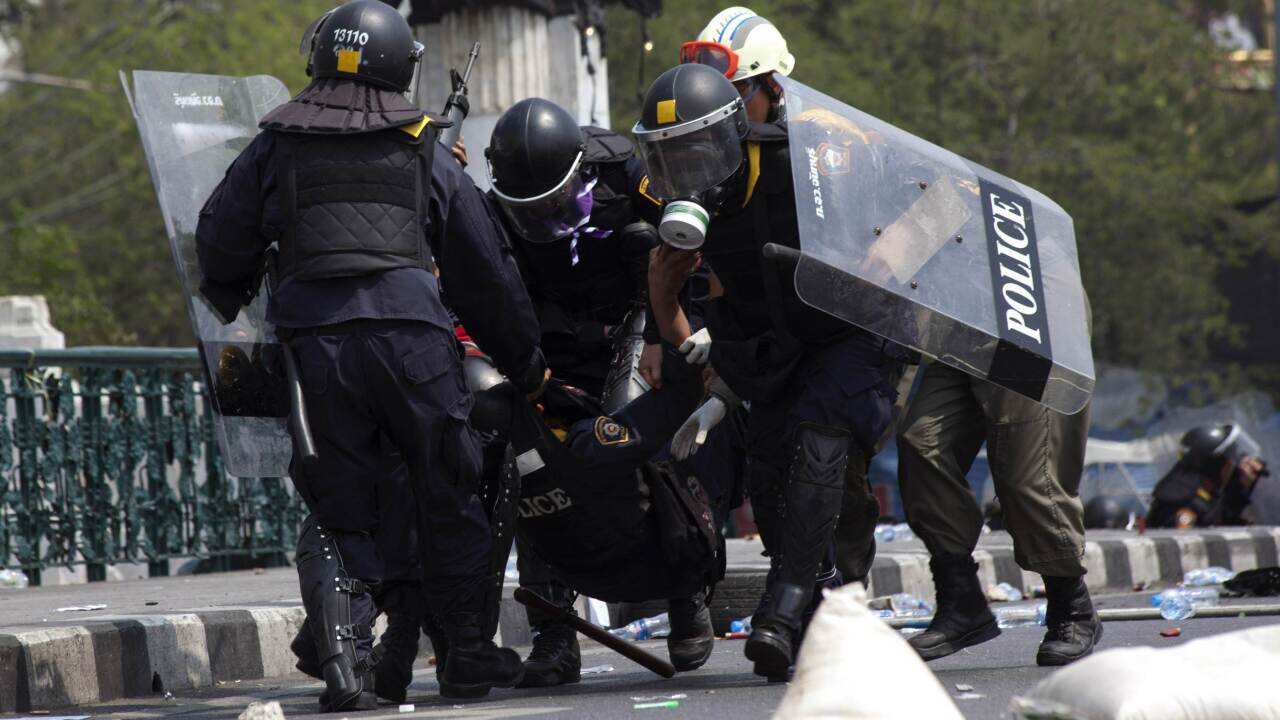
The announcement came hours after gunfire and explosions shook an area of Bangkok's historic district just a short walk away from major tourist attractions, as riot police moved to clear sites of protest rallies.
A policeman was shot dead and two civilians were killed and at least 60 other people were injured, including one foreigner.
Doctor Andrew Walker is the Deputy Dean of the College of Asia and the Pacific at the Australian National University.
He says the government's tactic to control anti-government action is vastly different to the bloody crackdown in 2010 against the so-called Red Shirt activists.
"On that occasion the army came out and dispersed the protesters with a very considerable display of force, leaving almost 100 dead. The army has made it clear they are not going to intervene to disperse these protesters so it'll be down to the police. I think the key issue now is whether or not this latest clash re-energises and mobilises the protesters and enables them to bring a lot of people back on to the streets of Bangkok. If that happens, it could be very difficult for the government to deal with. But if the numbers remain relatively low as they have been for the past few weeks then I think the government should be able to proceed to gradually clear most of these protesters out.
Anti-government protest leader Suthep Thaugsuban announced he will doggedly pursue the PM.
"The CMPO's (Centre for Maintaining Peace and Order) has ordered the authority to carry weapons in suppressing us. It is excessive and unnecessary in handling us. Because we were not armed. No matter where Yingluck is going to be, we will go there and fight every day, to expel her, every day. We will go every day and everywhere until she can't live in this country, because she is murderer."
Dr Andrew Walker from the Australian National University says he believes much of the current political unrest in Thailand is based on the weakness of the opposition movement.
"The main opposition party, the Democrat Party hasn't won an election since the early 1990s and don't show any sign of being able to win an election and it is that electoral weakness that is forcing them into these more desperate oppostional measures where they are taking to the streets and taking to the courts and pursuing and confronting the government in every way they can, except by challenging them at an election."
Thailand has been wracked by political unrest since 2006, when Ms Yingluck's brother, former Prime Minister Thaksin Shinawatra, was ousted by a military coup after being accused of corruption and abuse of power.
Since then, his supporters and opponents have vied for power, sometimes violently.
Prime Minister Yingluck Shinawatra took office in mid-2011 after a landslide election victory.





