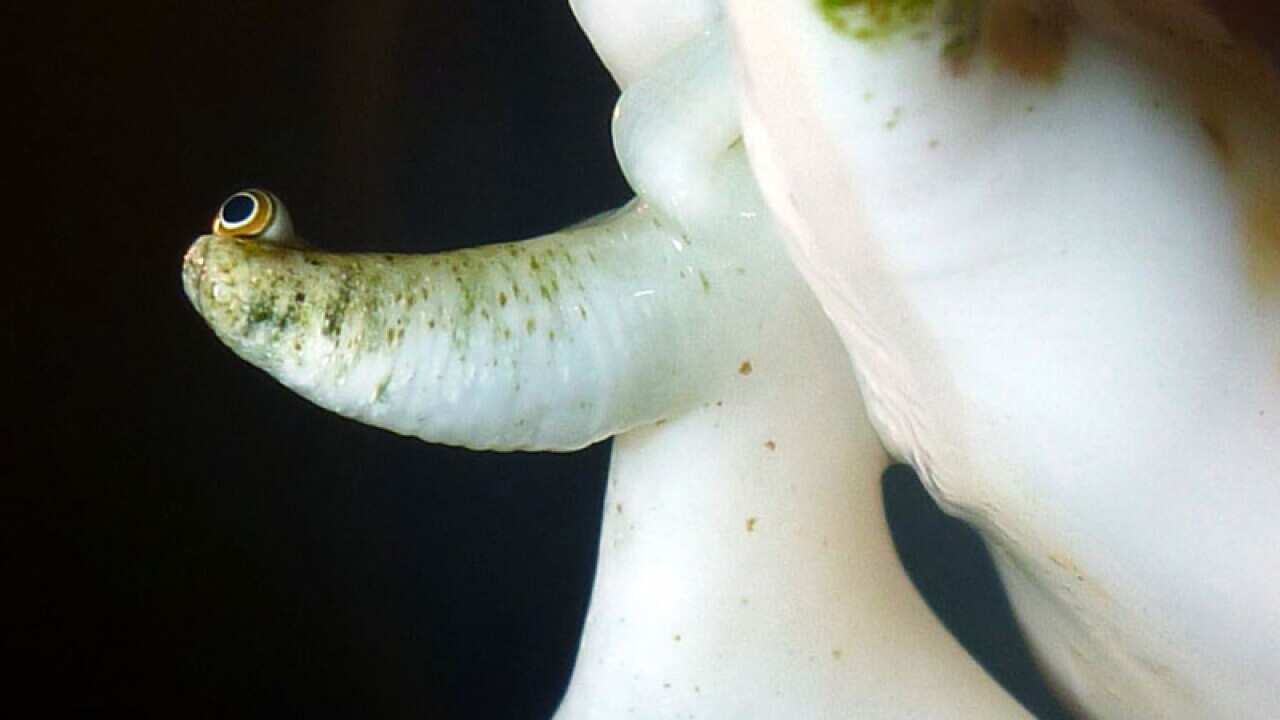
The effects of climate change could hinder sea snails' extraordinary ability to leap away from predators on one foot, Queensland researchers have found.
The study shows conch snails, found in sandy areas off coral reefs, find it difficult to make the quick decision to jump out of reach of prey when exposed to higher levels of carbon dioxide.
Lead researcher Dr Sue-Ann Watson of James Cook University says the chemical disrupts the snail's neurotransmitter receptor, causing it to have a delayed response.
The snail either stops jumping or takes longer to jump when exposed to the levels of carbon dioxide projected for the end of this century, the marine biologist says.
This leaves the three to four centimetre snail more vulnerable to the poisonous dart of its slow-moving nemesis, the cone shell.
News that makes sense
Your trusted source for staying up-to-date with the world around you. Get free daily news updates and analysis, straight to your inbox.
"Snails normally move slowly and crawl around on their one big foot," Dr Watson told AAP.
"But this snail uses its foot in a very special way as it has a strong foot and uses it to push up rapidly on the sand."
The conch snail normally jumps backwards and can leap the equivalent of its body height.
Dr Watson says the broader effects on the ocean's ecosystem could be quite profound.
"Altered behaviours between predators and prey have the potential to disrupt ocean food webs," she said.
Study co-author Professor Goran Nilsson, from the University of Oslo, says results of the study suggest carbon dioxide emissions directly alter the behaviour of many marine animals, including seafood.
The study appears in Proceedings of the Royal Society B: Biological Sciences.







