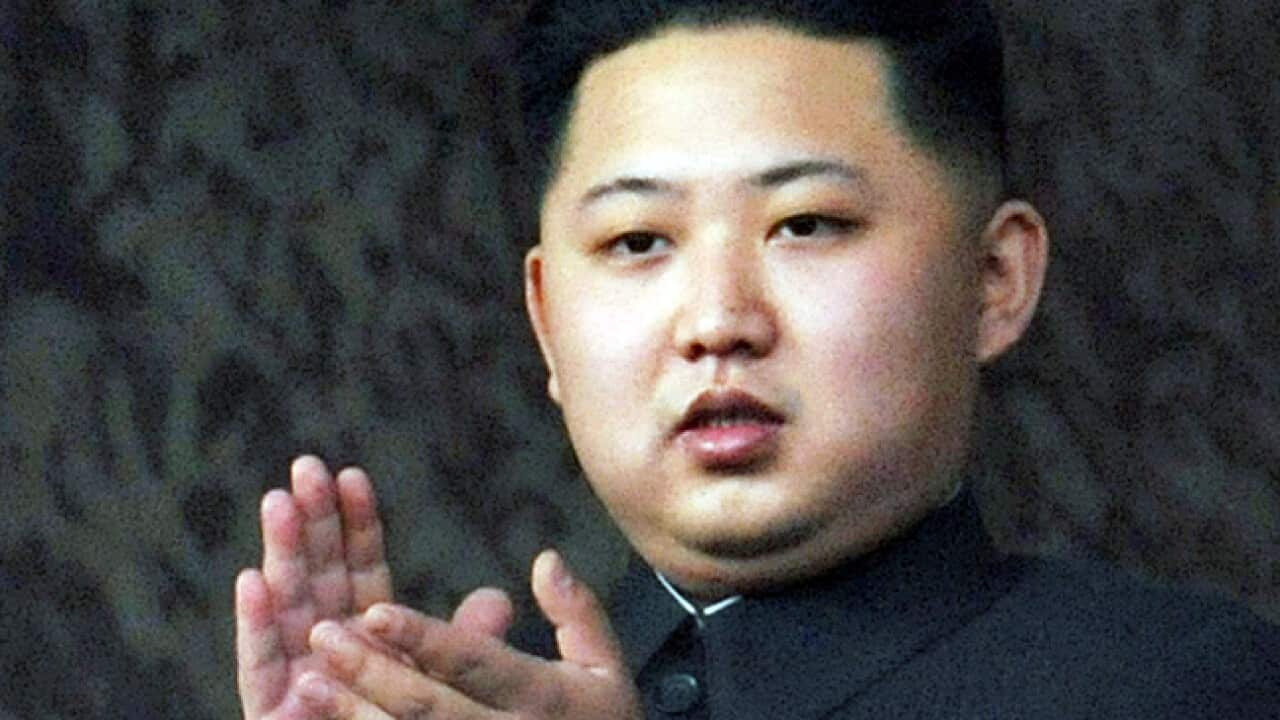
US Secretary of State Hillary Clinton called for a 'peaceful and stable' transition in North Korea as the impoverished country with a nuclear program plunged further into uncertainty, raising risks for the region.
"We both share a common interest in a peaceful and stable transition in North Korea as well as ensuring regional peace and stability," Clinton said after talks with Japan's Foreign Minister Koichiro Gemba.
"We reiterate our hope for improved relations with the people of North Korea and remain deeply concerned about their well-being," she said.
Clinton said that the United States has also been in "close touch" with fellow South Korea along with China and Russia, which were all involved in now-moribund denuclearization talks with North Korea.
Gemba -- whose visit was scheduled before the shock announcement of Kim's death -- agreed with the US stance on North Korea and urged renewed efforts over the cases of Japanese abducted by the communist regime.
"We share the recognition that it is important to make sure that the latest events would not negatively affect the peace and stability on the Korean peninsula," Gemba said.
"Due to the most recent developments, we are seeing an increasing level of interest in and attention to how the process of dealing with the abduction issue develops in Japan," he said.
"I expressed my gratitude to the consistent support extended by the United States for raising the abduction issue every time during the US-North Korea dialogue," he said.
Kim Jong-Il admitted during a landmark 2002 summit with then-prime minister Junichiro Koizumi that North Korea had abducted 13 Japanese civilians in the 1970s and 1980s to train the regime's spies in Japanese language and culture.
North Korea allowed five to return home along with their spouses and offspring but said that others were dead. The abductions have become a major issue for Japan, which believes that victims remain alive and under wraps.
DEATH GIVES REGION 'THE JITTERS'
It was the scenario strategists from Beijing to Washington fretted over: Kim Jong-il's sudden death befalls North Korea, before the isolated regime completed a power transfer to his young son and rejoined disarmament talks with the US.
With news of Kim's death on Monday, the impoverished country with a nuclear program plunged further into uncertainty, raising risks for the region.
Neighbours worry that political manoeuvring in Pyongyang could spill over into missile launches or other aggression, although analysts give such acts a low probability. Tens of thousands of American troops are stationed in South Korea and Japan in this heavily armed, jittery corner of the world. China wants to keep its socialist neighbour stable - and avoid a flood of refugees - but also free from American and South Korean influence.
"If you asked experts what could happen to bring the regime down, it would be the sudden death of Kim Jong-il. That has happened now," said Victor Cha, a former US National Security Council director for Asian affairs under president George Bush and now a senior adviser at the Center for Strategic and International Studies, an American think tank. "We're potentially at a watershed moment for the region."
Its politics opaque in normal times, Pyongyang is likely to slow decision-making, upending efforts to restart nuclear disarmament talks just as the US and North Korea seemed on the verge of resuming them.
After months of delicate discussions, Washington was poised to announce a donation of food aid this week followed by an agreement with Pyongyang to suspend a uranium enrichment program, people close to the negotiations had told AP.
Tentative reforms to lift its listless economy and better the lives of North Koreans - three million of whom or more than 10 per cent of the population are underfed, the UN says - may also be put on hold.
Kim's death caught North Korea's powerbrokers at a fragile time, in the midst of grooming his youngest son, Kim Jong-un, who is in his late 20s, to succeed him.
Though the elder Kim had a stroke in 2008, hastening plans to find a successor, his health had seemingly improved, allowing him to travel more frequently, resume a more public role and prepare for a longer power transition like the two-decade-long one he enjoyed under his father.
One test will be a long-planned celebration in April for the 100th anniversary of the birth of Kim's father and revolutionary North Korean founder, Kim Il-sung - an event meant to lend credibility to the bloodline succession. Feverish construction has been under way in Pyongyang while overseas critics of the regime have accused it of holding back food so that it can lavish its people with heftier supplies for the anniversary.
For now, North Korea watchers are focused on the-now abbreviated succession, looking for signs of whether the Workers Party and military will rally around Kim Jong-un or whether challenges will arise.
Domestic unrest may percolate, analysts said, as North Koreans tire of poverty and the mobile phones and internet connections that are a product of recent reforms leave them better informed about the outside world.
DELAYED PUBLIC ANNOUNCEMENT
The two-day gap between Kim's death on Saturday on a train and its public announcement on Monday underscored the government's nervousness, analysts said.
"The fact that they delayed for two days goes to show that the North Koreans are worried about instability," said Gong Keyu of Shanghai's Institute for International Studies.
Also possible are armed incursions against South Korea or Japan in a bid to rally North Koreans around the leadership. North Korea's shelling of a South Korean island last year was credited inside the North to Kim Jong-un, part of efforts to burnish his credentials as a fierce defender of the nation.
South Korea, North Korea's opponent from the 1950-53 civil war and target of recurring provocations, put its armed forces on alert and President Lee Myung-bak conferred with US President Barack Obama, who reaffirmed US support. Japanese Prime Minister Yoshihiko Noda held an emergency national security council with top cabinet members to urge heightened vigilance.
China worries that a North Korean meltdown could send North Koreans pouring over its border, creating a potential security mess and straining the far from robust economy of its northeast.
"This is the single largest militarily armed zone in the world. It has been thus for decades and right now we're at one of those critical junctures in post-1950 military history where we need to ensure that calm and restraint are exercised at an exceptionally difficult period of transition," Australian Foreign Minister Kevin Rudd said.
Given the possible complications, co-operation among Washington, Seoul and Beijing is vitally needed to prevent problems in North Korea from destabilising the region, the analysts said.
China rebuffed overtures by the US and South Korea after Kim's stroke in 2008 to discuss co-ordination if there is a regime collapse.
Among the scenarios Washington wanted to explore: how to keep their militaries from clashing accidentally if both move into North Korea and how to secure the uranium, plutonium and other materials in Pyongyang's nuclear program.
Beijing's influence over Pyongyang has grown in the past two years, its companies ramping up investment after North Korea exploded its second nuclear-test device and launched a long-range rocket, drawing UN sanctions.
Amid the uncertainty, analysts across the region also said Kim's death provided North Korea an opportunity to break from its past of misplaced economic policies, diplomatic isolation and military threats by embracing outside help and full-throttle market-driven reforms.
The younger Kim studied in Switzerland and is closer in age to a younger group of reformers who have helped introduce programs to bring in foreign investment and allow limited use of mobile phones and the internet, said Narushige Michishita, an expert at the National Graduate Institute for Policy Studies in Tokyo.
Those changes, however, are fuelling expectations among North Koreans for change and are likely to make the road ahead rougher for Kim, said Cui Yingjiu, a retired professor of Korean language at Peking University in Beijing and a former classmate of Kim Jong-il's in Pyongyang in the 1960s.
"The old way of thinking is changing. The time for dictators has passed," he said. "They see the changes in China. They're only thinking about money now."
Share


