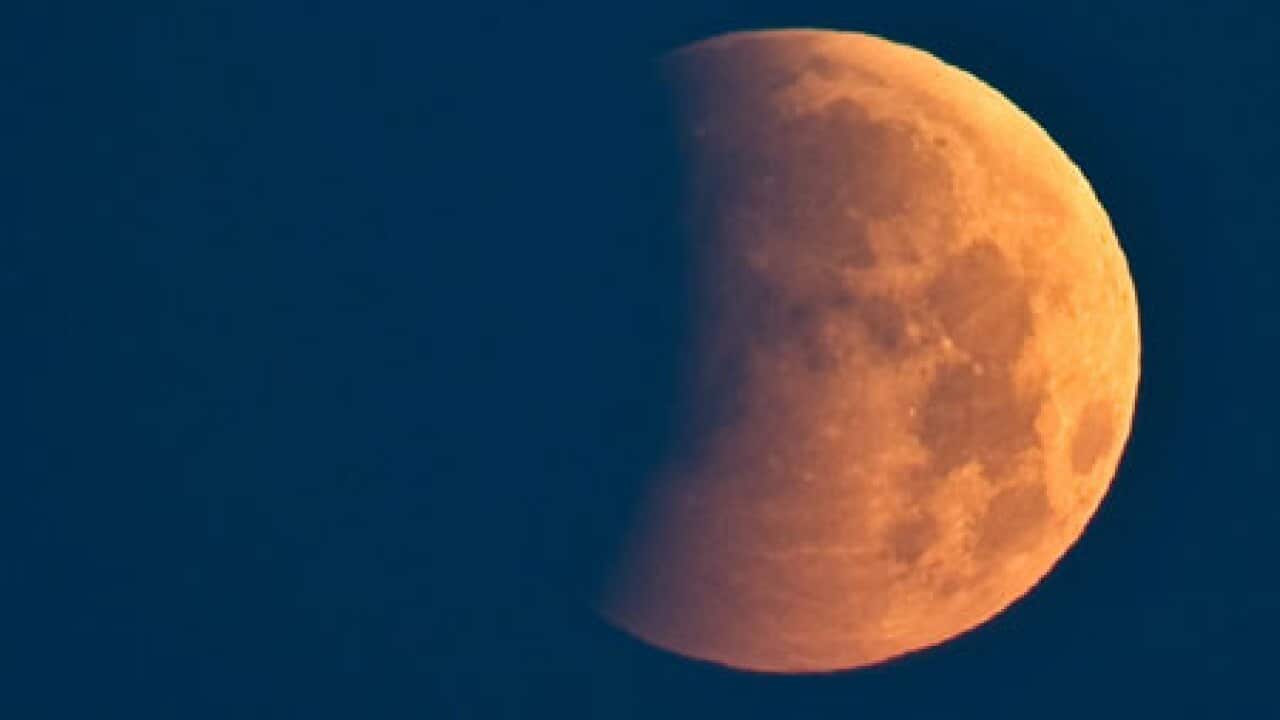
Clouds have prevented sky-gazers in Brisbane from seeing a rare lunar eclipse which astronomers said would leave the Moon red.
Brisbane was tipped to get the best view, with the city expected to see the full lunar eclipse for 13 minutes at moon rise about 6:40pm AEST.
Cloud cover, however, allowed only a partial glimpse of the Moon when it was to be at its most colourful.
Residents in Sydney and Canberra were due to see 45 minutes of partial eclipse after 8:00pm (AEDT)
And Darwin, Melbourne and Hobart were get around 20 minutes of partial eclipse when the Moon rises there.
News that makes sense
Your trusted source for staying up-to-date with the world around you. Get free daily news updates and analysis, straight to your inbox.
In the northern hemisphere, coinciding eerily with the northern hemisphere's mid-winter solstice -- for the first time in almost four centuries -- the eclipse showed the Sun, the Earth and its satellite as they directly aligned, with the Moon swinging into the cone of shadow cast by its mother planet.
Despite being in shadow, the Moon did not become invisible, though, as there is still residual light that is deflected towards it by our atmosphere.
Most of this refracted light is in the red part of the spectrum and as a result the Moon, seen from Earth, turns a reddish, coppery or orange hue, sometimes even brownish.
Two factors affect an eclipse's colour and brightness, said the US astronomy magazine Sky & Telescope.
"The first is simply how deeply the Moon goes into the umbra. The center of the umbra is much darker than its edges," it says.
"The other factor is the state of Earth's atmosphere along the sunrise-sunset line. If the air is very clear, the eclipse is bright. But if a major volcanic eruption has polluted the stratosphere with thin haze, the eclipse will be dark red, ashen gray, or blood-black."
Lunar eclipses have long been associated with superstitions and signs of ill omen, especially in battle.
The defeat of the Persian king Darius III by Alexander the Great in the Battle of Gaugamela in 331 BC was foretold by soothsayers when the Moon turned blood-red a few days earlier.
And an eclipse is credited with saving the life of Christopher Columbus and his crew when they were stranded without supplies on the coast of Jamaica.
According to legend, Columbus, looking at an astronomical almanac compiled by a German mathematician, realised that a total eclipse of the Moon would occur on February 29, 1504.
He called the native leaders and warned them if they did not help, he would make the Moon disappear the following night.
The warning, of course, came true, prompting the terrified people to beg Columbus to restore the Moon -- which he did, in return for as much food as his men needed. He and the crew were rescued on June 29, 1504.
The last total lunar eclipse took place on February 21 2008. Next year, says Espenak, will see two: on June 15 and December 10.
A solar eclipse happens when the Moon swings between the Earth and the Sun.







