
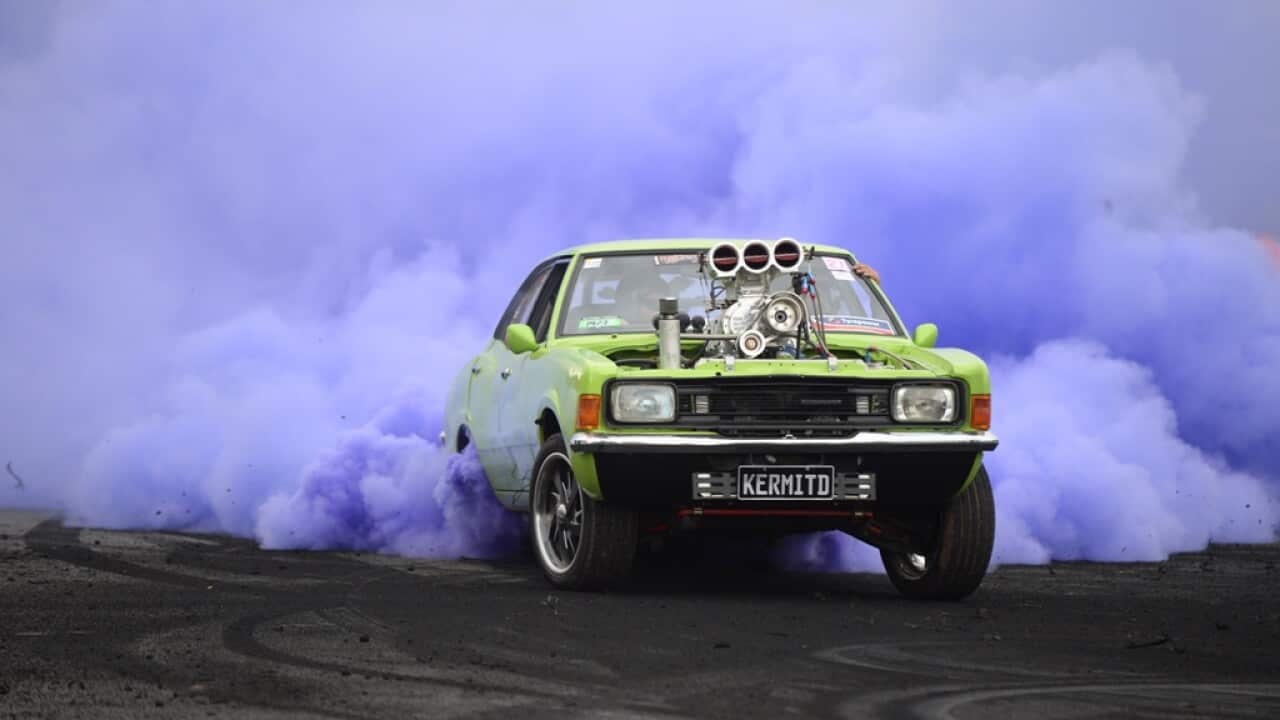
The Summernats festival is on again this weekend. Held at Canberra’s Exhibition Park, locals are split between the cheering enthusiasts and the complaining haters. There is a third group of people who have simply never been to the event, but who might be interested: the ‘Summernats curious’.
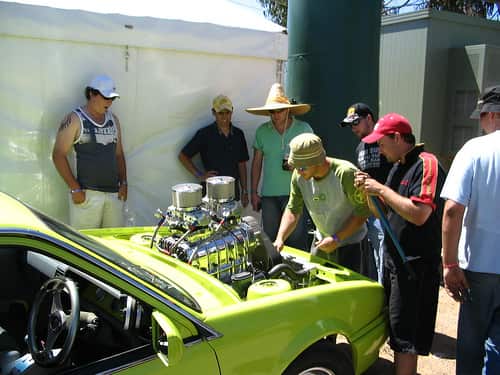
Even though they don’t quite understand the overwhelming sensory overload their respective hearts beat a little faster when a heavily worked V8-powered family sedan glides past. The Summernats video used to be called “Boobs, Blowers, and Burnouts” and this captures the three core elements of the event. But how can you move beyond the bumper sticker logic? A few key phrases are introduced below and then explained in more detail:
1.) “Go Before Show”: There is a historical tension in the scene of modified-car culture between those who build their cars to go fast and those that are designed to ‘turn heads’.
2.) “I’d Rather be Blown than Stroked”: A ‘blower’ is the colloquial term for device enabling mechanical forced induction. Mercedes have blowers. Turbocharging is another kind of forced induction and nitrous oxide injection is described as chemical supercharging. ‘Stroking’ involves increasing the engine capacity by lengthening the swept displacement in each combustion chamber. Holden stroked the old five litre V8 to 5.7L for the mid-1990s HSVs.
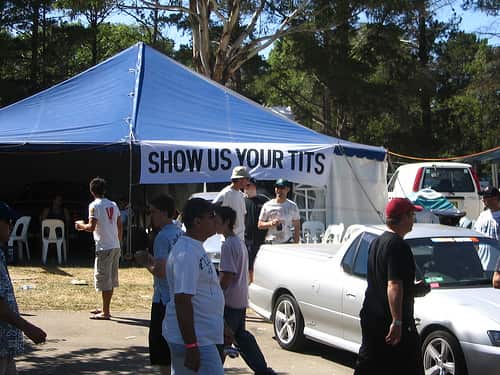
3.) “Show Us Your Tits”: A misogynist catcall shouted by members of a male-dominated crowd to women so as to encourage them to display their bare breasts for the appreciation of the crowd.
How to make sense of all this from an anthropological perspective?
For a long time the Summernats festival was the only event of its kind that brought together ‘Go’ and ‘Show’; that is, it combined the static display type car show with the dynamic driving events (Go to Whoa, Burnout Comp, etc.). To be crowned Summernats Grand Champion means that your vehicle must be judged in the ‘show and shine’ and be tested in the driving events.
Both styles of event are a demonstration of the work that has gone into a vehicle. An enthusiast ‘reads’ a modified car in terms of the challenges that the modifier has overcome to build it. A simple way for the Summernats curious to begin appreciating these cars is to try to imagine how much time has gone into modifying them and think about the time required to acquire the skill and so on.
Enthusiasts will not simply discuss the technical dimensions of the ‘build’. The technical language of automotive engineering and design is transformed into the subcultural argot of enthusiasts often through a kind of eroticisation. Here the technical discourse gains a different kind of consistency where a technical detail expresses a value judgement as a sign of appreciation. Think of the way wine enthusiasts describe the taste of wine, but now imagine that it isn’t almost entirely subjective like wine tasting and it is based on objective technical details. Adjectives and adjectival phrases are raised to a higher ironic power in subcultural argot (i.e. ‘sick’, ‘fully sick’, etc.) for the purposes of pure affirmation.
The Summernats festival emerged from the Street Machine Nationals in the 1980s. Promoter Chic Henry opened up the event beyond a target market of other enthusiasts to include the general public. The general public did not have the same level of ‘know how’ as enthusiasts, hence the character of the event shifted from one organised around the appreciation of technical details to a kind of party atmosphere. It is in this context that the performative modified vehicles garnered my attention than the traditional and somewhat more modest vehicles.
Modified vehicles serve to mediate relations between men: modified-car culture as a kind of secret men’s business. The massification of the culture was based on the spectacle of modified cars first, then the way they embodied the technical accomplishment of modification second. It meant the average Summernats punter was there for a ‘good time’ or ‘party’. One unfortunate consequence of the change in the event is that modified vehicles were insufficient for mediating relations between men, not because of the vehicles but because the participants did not have an adequate appreciation of them. Instead, women became a totem for warding off the charge of homoeroticism that inevitably occurs when hundreds of ‘partying’ men get together. The call of “show us your tits” has basically become a proxy for relations of homosocial desire at any male-dominated event.
Glen Fuller is an academic, cultural critic and an expert in irony.