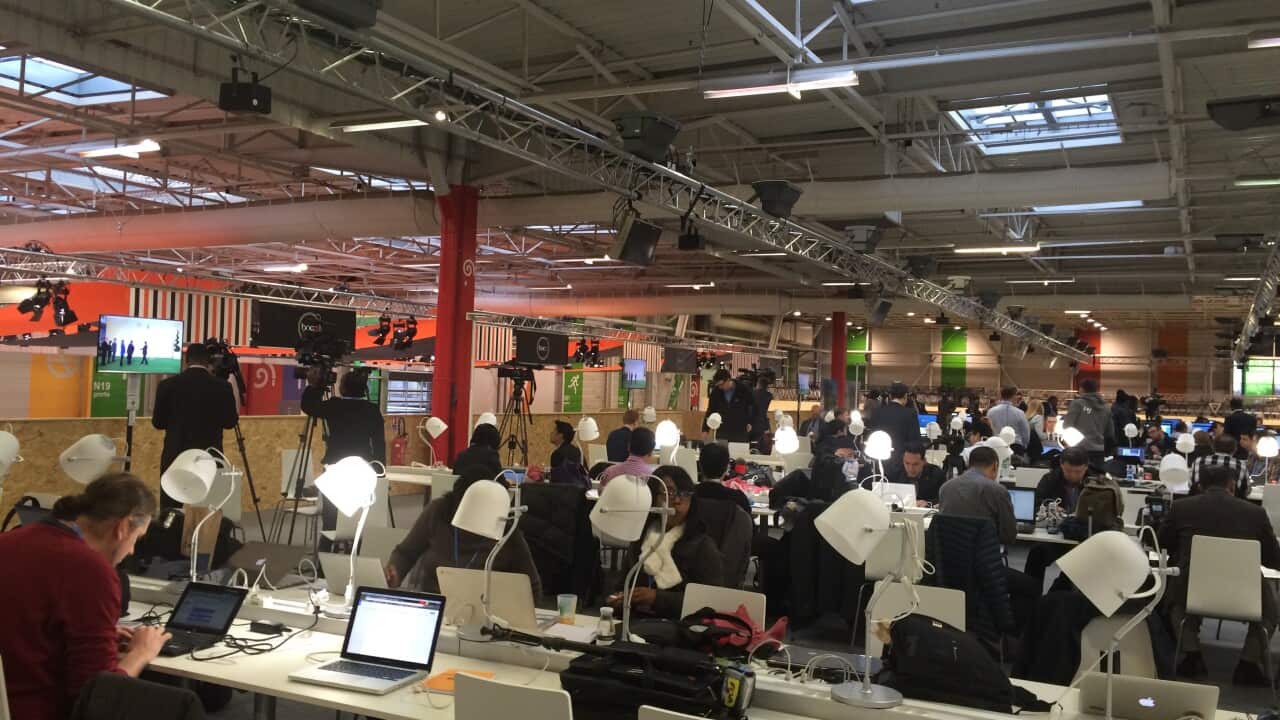
With more than 147 world leaders in the one place, the first day of COP21 was always going to be a logistical nightmare. And they are just a small contingent among the 40,000 attendees expected.
Most people here are hopeful there will be an outcome that will benefit their community. But there are high expectations of the Paris talks, and many points to cover, including mitigation and adaptation, particularly for island states who are most at risk of rising sea levels.
News that makes sense
Your trusted source for staying up-to-date with the world around you. Get free daily news updates and analysis, straight to your inbox.
There is a risk talks will become stale and conflicts may arise. French foreign minister Laurent Fabius urged all nations to break the cycle of rivalry that has hampered efforts in the past.
"Personally, I'm confident you will be able to achieve a good result. However the management of time will be a crucial point. Every day we have to make progress. No subject must be left aside. Therefore, I count on you to negotiate and build compromises as soon as negotiations are taken up again. Your energy, competence and experience should be fully focused on finding solutions."
UN Secretary-General Ban Ki-Moon had a clear message: the world must come together.
"Like the rhythms depicted on the Eiffel Tower, our hearts beat as one."
"This is the start of two weeks during which leaders forge a global response to climate change. Beating climate change is central to building a more equitable and peaceful future for all on a healthy planet," said Mr Ban.
"Leaders bear responsibility for the success of the negotiations."
The UN Secretary-General was buoyant there would be an outcome.
"I see all the stars are aligning in one direction. We are here as individuals, but we share one common goal."
Most heads of state and government are only here for the first day, with the aim to get concrete action underway from the beginning of the event.
Once they leave, their negotiators step in and that's when the framework starts getting built.
In the meantime they must take into consideration the views of those nations who face the worst impacts of climate change, including low-lying countries like Kiribati, where President Anote Tong championed calls for a moratorium on new coal mines, which has been supported by 11 other Pacific nations.
One key political outcome will be how to support and engage poorer nations in solutions. The agreements will need to be fair to ensure prosperity for all.
The Climate Institute's Erwin Jackson told SBS News the world has been working towards a climate change outcome for years now.
"We've done a lot in building clean energy investment, this process can help accelerate that so we can start driving clean energy innovation even faster."
"They're negotiating an agreement to transition from fossil fuels into clean energy," Mr Jackson explained.
"That means, the negotiations are tough, because it's not just about transitioning economies, it's about moving away from traditional industries."
"We are going to see lots of noise and lots of tough negotiations, and hopefully by the end of the two weeks, we'll get a reasonable outcome as a result."
It's also hoped the outcome will help the average person understand what they can do at an individual level to keep their carbon footprint minimal.
One of the key objectives of the Leaders Day will be to give negotiators the flexibilty they need to form an agreeable outcome for all.
"The real test is not whether we can develop technologies in test tubes, it's how we actually get them out into the real world, and spend the billions of dollars of investment that's going to be required."
Behind the recycled walls of the COP21 conference is a myriad of activities
The 18-hectare Le Bourget site is buzzing with activity.
It's open 24 hours to allow negotiations to run for as long as they need.
Each nation has various stalls set up by organisers who want to raise the plight of their affected communities. There's a large number of farming and agricultural groups, as well as charities and NGOs for food security and health, indigenous people's representatives and youth groups, among others.
Each nation has its own space open to all, from where they push for their own agendas and policies.
The US Centre for example has some sophisticated graphics which show satellite analysis of the Earth's land, ocean and atmosphere, atmospheric storms, air chemistry, ocean temperatures, sea level rise and snow and ice cover.
The media centre has stalls for television networks, and rows of plug-in desks for about 3,000 news crews from around the world.
Dotted outside are poles with flags of every attending nation, animal sculptures (inlcuding a kangaroo!), even a bright red Eiffel Tower made from steel garden chairs. There are food stalls and lots of coffee - and that's where the lines are longest.
There are also novel little factoids and info stations, including a charging station - which effectively doubles as a gym. You sit on a makeshift bike and pedal to provide power to, for example, your phone. I tried it - it's a workout. You have to pedal hard and for a while. Next time I'll bring a towel and my runners!
So with day one officially underway, it's now time to see what the talks will begin to deliver.
Sarah Abo’s trip to Paris is supported by the World Meteorological Organisation.







