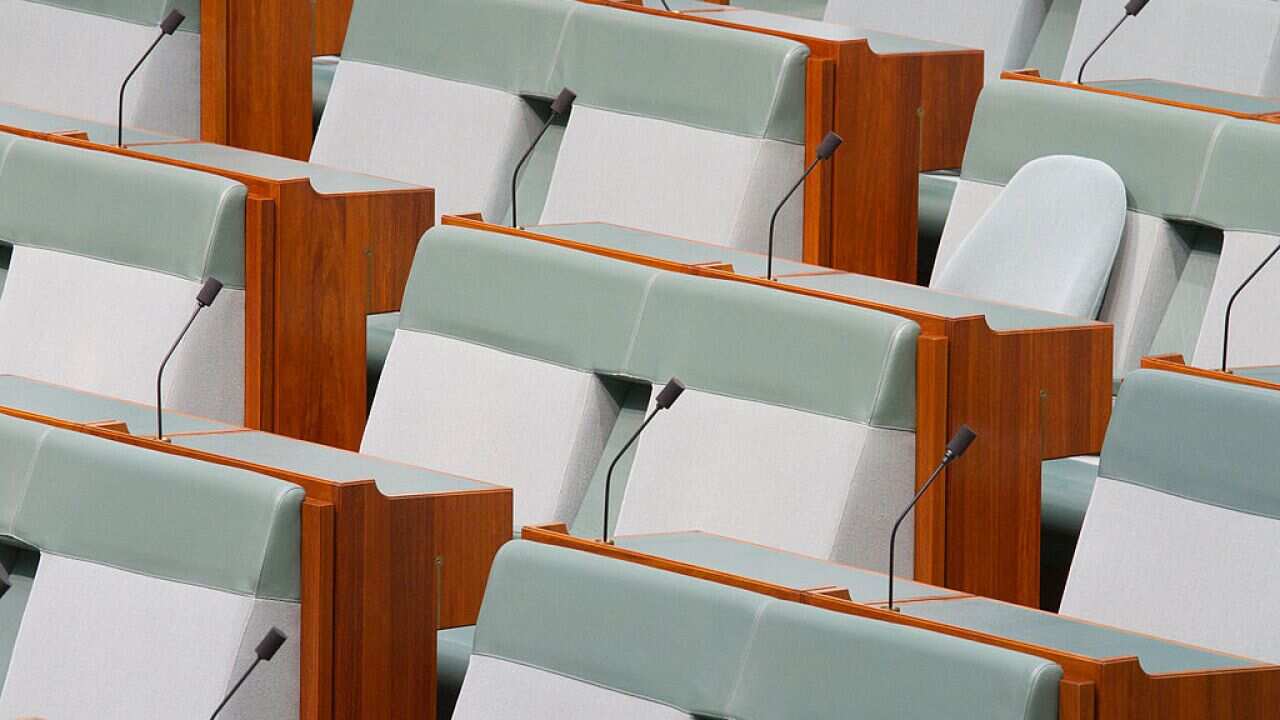
There were no queue-jumpers waiting in line to tour the Prime Minister’s Office at the Australian Parliament House Open Day last weekend.
2013 marks 25 years of Australia’s new Parliament House, and the public were invited to roam the halls, chambers, courtyards and even the grass-carpeted roof. Lured to the Hill by the promise of a Senate showbag, I soon found myself in line to see the PMO suites.
While waiting I thought about how strange it was that as an Australian I know exactly what the US President’s office looks like, but not our Prime Minister’s. The Oval Office is a symbol of democracy and governance in popular culture, and looms large in the global imagination. The Australian PM’s office has neither the pop cultural significance nor global weight - in fact I had no idea what it looked like.
As a patriot, it was my duty to find out.
The tour started in the Ministerial wing, on blue carpet extending throughout the cabinet area, as green carpet does through the House of Reps, and red through the Senate, and progressed into the bright sunshine of the Prime Minister’s Courtyard beyond.
It was here that it struck me.
There is far more cultural resonance, charisma and integrity to the design of Parliament House than the politicians who have inhabited it over the last two decades.
Every material and architectural element incorporated into the interior and exterior environment of Parliament House has been designed to resonate with Australian cultural heritage. The building is a composition of our culture and national identity as much as it is a site of government work.
The entire length of Parliament House north to south is a map of Australian history from indigenous cultures through to British settlement and the negotiations of our complex multicultural society. The Prime Minister’s courtyard is designed to replicate the sparse northern regions of Australia. There is very little vegetation, apart from the wisteria growing up pergolas on either side of the courtyard.
The Jarrah pergolas are built from wood salvaged from the Fremantle Woolstores in 1987 when they were being dismantled in preparation for hosting the America’s Cup.
The contrast between the character of the buildings and it’s inhabitants made stark to me that our upcoming election isn’t the presidential campaign that some imagine it to be. It’s a case of who we find less distasteful. Not a popularity contest, not a weighing up of the finer details of policy. Not a case of who we envision to guide our country with the skill and dignity of a natural leader. While our electoral systems differ, all democracies are ultimately voting on the ideas symbolised by our representatives, and ours are lacking.
Back in the late 80s, in the wake of our foray into the global spotlight, I imagine we had a clearer view of the natural charisma and promise of our democracy as represented by our shiny new Parliament House. But now, 25 years later, that vision has become murky.
Unless your vision for our country is focused on upholding that central tenet of democracy, queuing. Perhaps Australian politicians should take the PMO tour, to be reminded of the promise of hope, optimism and inclusion our country once had.
Anne Treasure is a recent survivor of the book industry.


