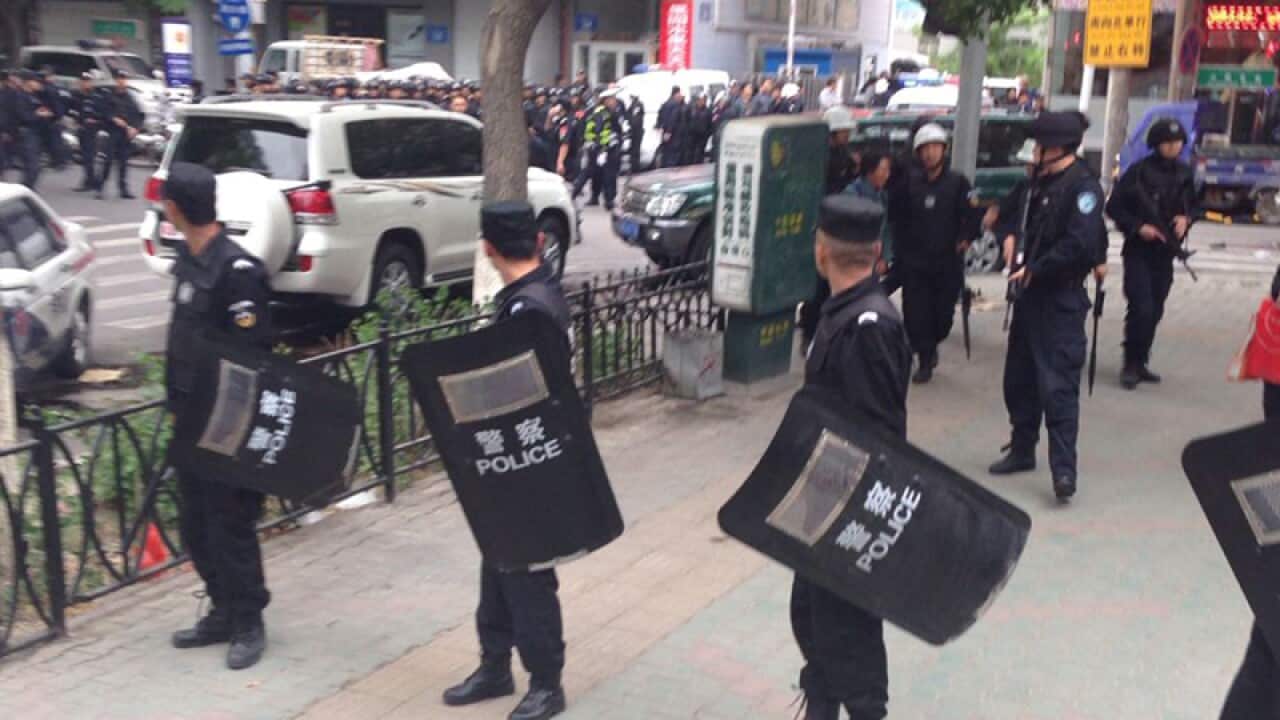
WASHINGTON — I'm a bit surprised that the explosion that killed dozens of people at an open-air market in the city of Urumqi's in China's Xinjiang province this week hasn't gotten more international notice. It may be because Thursday was a pretty busy international news day, or because of the sheer quantity of China-related news for the world to digest right now.
But I suspect its also because these incidents are becoming depressingly commonplace. Thursday's explosion follows recent deadly attacks on train stations in Guangzhou, Urumqi and Kunming, all of them blamed on Uighur extremists from Xinjiang.
This week's attack, however, is of another order of magnitude more serious. With at least 30 dead, it may be China's most serious terrorist attack in years and the use of explosives indicates an escalation in tactics over the other recent attacks, most of which were mass stabbings. The mysterious car attack on Tiananmen square, which took place while I was in Beijing last October, would have been a substantially more serious event if the perpetrators had used the tactics seen this week.
It's becoming increasingly clear that China is a country with a serious terrorism problem. Earlier this month, a report issued by Beijing University's Centre for International Strategy and Security Studies, highlighted the issue, warning that "Terror attacks in China have become more active than in previous years in both the number and seriousness of the attacks. The anti-terrorism condition facing China is grave."
A Xinhua article this month also highlighted the fact that "Separatists appear to be shifting their focus from symbols of the government - such as public security stations and police vehicles - to random, ordinary civilians, and operating in areas outside Xinjiang."
After the last attack in Urumqi, President Xi Jinping promised a "strike first" strategy against separatists in Xinjiang, where Uighur Muslims have longed agitated for independence and claimed discrimination by the authorities.
But with attacks expanding in both geographical scope and severity, it's becoming clear that Beijing's default strategy of cracking down hard on Xinjiang isn't working.
Keating is a staff writer at Slate focusing on international news, social science and related topics. He was previously an editor at Foreign Policy magazine.
Share


