By Michelle Smith, Deakin University
When floods and fires strike, news broadcasts frequently ensure that excerpts from CNN or Fox are shown. It doesn’t matter if the event is a naturally occurring catastrophe rather than any form of achievement, we need to see that other countries noticed us, especially the United States.
This need for external approval is related to Australian cultural cringe. When A.A. Phillips first used the term in 1950, he referred to the tendency to perceive Australian literature, music, theatre and art as inferior to British and European high culture.
Since then the need for overseas recognition in order to prove the worth of Australian creativity has extended to include all kinds of popular culture, including film and television.
In the past week, it has become national news that several American critics panned Chris Lilley’s current mockumentary series Ja’mie: Private School Girl after its debut on US television.
The AV Club gave praise to the work of Barry Humphries as Dame Edna Everage, but described Lilley as producing “sloppy, transphobic drag” in his performance as teenager Ja’mie King. Tim Goodman at The Hollywood Reporter complimented Lilley’s oeuvre in general, but found the new series “almost unbearable to watch”.
While the involvement of US network HBO in Ja’mie’s production gives a partial explanation for local interest in these negative American responses, cultural cringe is also a significant factor.
We can readily criticise one of the plethora of American television programs included in Australia TV schedules without it being seen as a reflection on American culture overall. Yet when one of our own productions achieves the rare feat of an international release, it is seen to bear the weight of representing us on the world stage.
Comedy induces far greater anxiety than any other genre. It reveals a great deal about a culture’s preoccupations, prejudices, and character—it tells viewers who we’re laughing with and who we ought to be laughing at.
We generally accept that there are national differences in comedy. For example, American humour, as reflected in its film and television, is seen to differ substantially from British humour.
Australians continually express cultural cringe about how our own comedic inflections, especially in programs such as Lilley’s, as well as Kath & Kim, give an impression that we are unsophisticated, racist, sexist and homophobic.
When news of Hey, Hey It’s Saturday’s “blackface” skit drew international attention in 2009 due to the outrage of guest Red Faces judge Harry Connick, Jr., the rightful embarrassment that this kind of humour would have otherwise gone largely unremarked about in Australia was palpable.
Lilley’s previous series Angry Boys also prompted debate in the US, especially given his use of blackface to portray rapper S.mouse. Australian site The Vine interviewed US hip hop artists to collect their largely condemnatory comments about the appropriateness of a white actor playing an African American character and the show’s use of racist terms.
Lilley’s adoption of blackface and “yellowface”, with character Ricky Wong in We Can Be Heroes, can be understood as more complicated than expressions of outright racism than these American responses identified.
As Lisa Bode shows, We Can Be Heroes made “ visible tensions and contradictions within contemporary Australian national identity, as well as the truth of white economic and cultural privilege within a dominant discourse of celebratory multiculturalism that seeks to mask it”. Though there is nothing to prevent racist or non-PC celebrations of some of Lilley’s characters, several of his series also work to expose the racism that lies at the core of supposedly upstanding and accepting Australians.
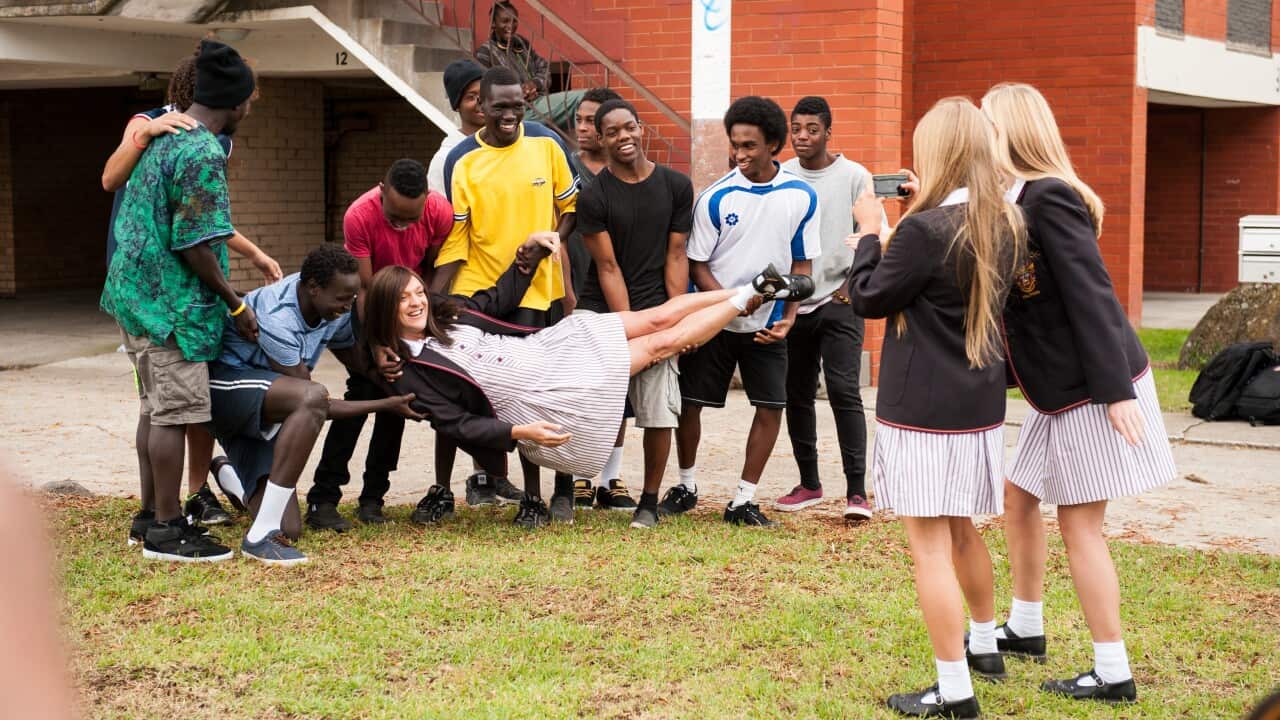
Kwami becomes Ja'mie’s “project”
Ja’mie is a prime example of this tendency in Lilley’s creations. She brings a Ugandan boy, Kwami, into her palatial family home for the sole purpose of appearing charitable in order to receive a prestigious school medal. Yet her performance of tolerance and racial equality is just that. She is mortified when he expresses affection for her, telling Kwami “no offence, but you are really povvo, you live in the western suburbs, and you’re black, and I am… this”.
While the politics of drag, blackface and yellowface are highly fraught, we should not base our anxieties about Lilley’s programs on international perceptions of what is and what is not funny.
Our television comedies often mirror unique aspects of Australia’s cultural make-up and shared history that are largely incomprehensible to those outside of it, in a way that US and British comedies are not unintelligible to us, with our large quota of foreign programming.
When some programs mysteriously find a niche despite their idiosyncrasies, as did a dubbed version of Hey Dad! in Germany, it’s a positive thing for our television industry. Yet we shouldn’t seek to iron out elements of Australian humour because of perceptions that our culture is inherently not good enough.
Michelle Smith does not work for, consult to, own shares in or receive funding from any company or organisation that would benefit from this article, and has no relevant affiliations.