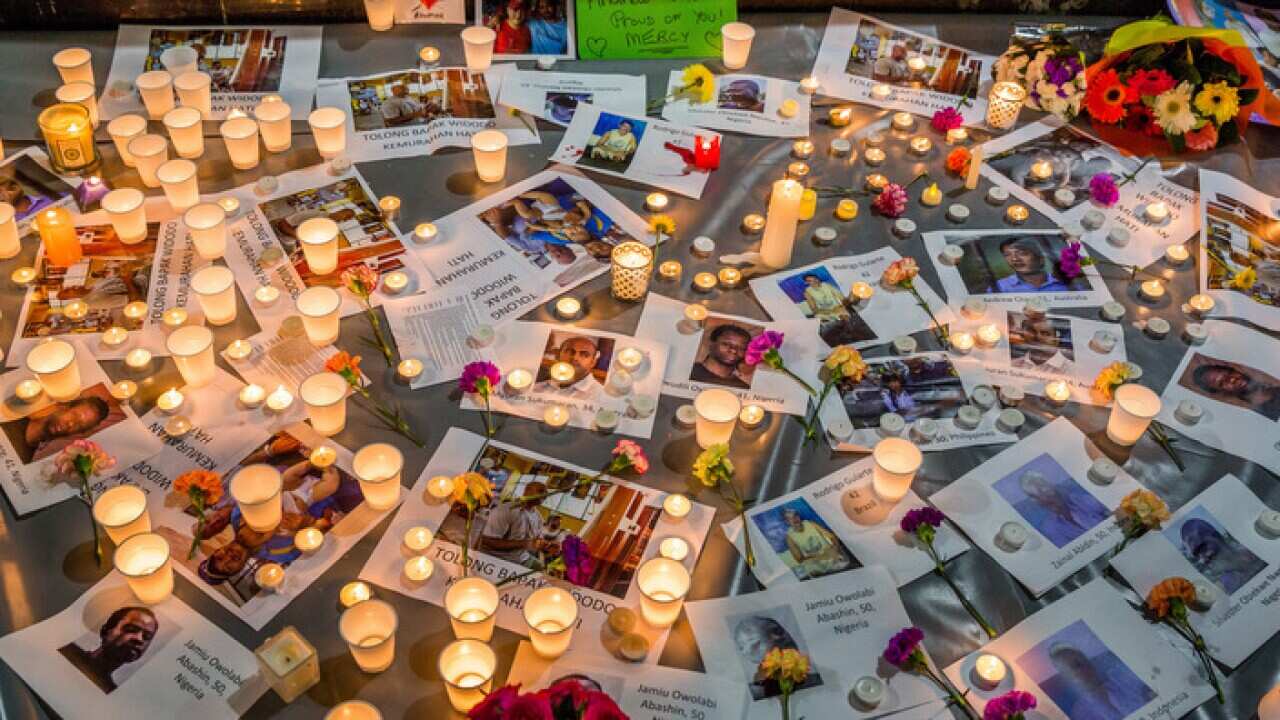
Ahead of the funerals for Andrew Chan and Myuran Sukumaran this week, many Australians are understandably deeply saddened. After weeks of petitions and vigils around the country, all their efforts came to nothing.
Many Indonesians feel the same way. Indonesian lawyer for Chan and Sukumaran, Todung Mulya Lubis, tweeted in response to news of their executions: "I failed. I lost. I am sorry." Lubis is a long-term human rights activist and internationally distinguished lawyer who traces his career to one of Indonesia’s most progressive legal organisations, the Legal Aid Institute in Jakarta.
Indonesians too are disillusioned by the government’s decision to go ahead with the execution. Some viewed Indonesian President Jokowi as the "human-rights president" as he pledged to deal with the legacy of past human rights abuses.
It is a view diminished by these executions. In the lead up, Indonesian civil society activists held protests and candlelight vigils, not only in Jakarta but also as far afield as Kupang in West Timor. They also urged people to tweet to the president and the Attorney General HM Prasetyo with the hashtag "let them live" up to the last hours before the executions.
"Indonesians too are disillusioned by the government’s decision to go ahead with the execution."
The plight of Filipino woman Mary Jane Veloso who alleged she had been duped by a trafficker promising her work in Malaysia captured Indonesian hearts, as some four million Indonesians work overseas as migrants.
A rift has now grown between campaigners and the president they thought would uphold human rights. Non-government organisations such as ELSAM and Kontras have advocated for the repeal of the death penalty for many years.
ELSAM argued that the death penalty was not an effective deterrent. It pointed out that Indonesia’s death penalty law was derived from colonial times - from Dutch law - and in a corrupt legal system such as Indonesia’s at present, such a penalty is dangerous.
Of late, discussions in Indonesia on the death penalty have been confined to cases of drug dealers and corrupt officials. But it is worth remembering that the death penalty in Indonesia has been used against government opponents, such as leftists convicted of subversion charges in the mid 1980s who opposed the rise of President Suharto’s New Order regime.
Some leftists arrested in 1965 were still on death row when the authoritarian regime collapsed in 1998. Since then there has been a long running, albeit small, campaign to abolish it, of which groups like the Legal Aid Institute in Jakarta has been a part.
While this may seem like a difficult task right now, Australians should consider how they could affect change on the question of the death penalty. The United States, China and Vietnam for example are also countries that execute prisoners regularly. We should now concentrate our energies to support those campaigning against the death penalty and for a new approach to the drug addiction issue in Indonesia.
Harm-reduction campaigns in Indonesia are underfunded and poorly understood for example. The Australian government through AusAID more than ten years ago held drugs information training courses under the Indonesia-Australia Specialised Training Program (IASTP) for Indonesian health practitioners.
"Of late, discussions in Indonesia on the death penalty have been confined to cases of drug dealers and corrupt officials."
As a training officer on that course, I saw that in the beginning, limiting supply by locking up drug dealers and users was the participants’ preferred method. The majority felt harm reduction would only lead to an increase in drug use. Over a period of three months, as they heard from many practitioners and visited clinics, drug rehabilitation centres and the Melbourne Assessment Prison, I witnessed a remarkable shift among the participants in their attitudes towards harm reduction and some were even drawn from the ranks of the military and police. AusAID no longer exists.
The experience of working on that education project underscores for me the need for us to continue to engage with Indonesia, particularly supporting the work of NGOs, health groups and civil society.
The Indonesian government may have proven intractable on the issue of the death penalty this time, but it is worth bearing in mind that the relationship between the two countries is broader than one of government to government. Indeed the campaign to save "our boys" has failed but there may be more that Australians can do for others on death row.
Dr Vannessa Hearman is lecturer in Indonesian Studies at the University of Sydney. She has worked in Australia, Indonesia and Timor Leste as a translator, interpreter and training officer.
Share


