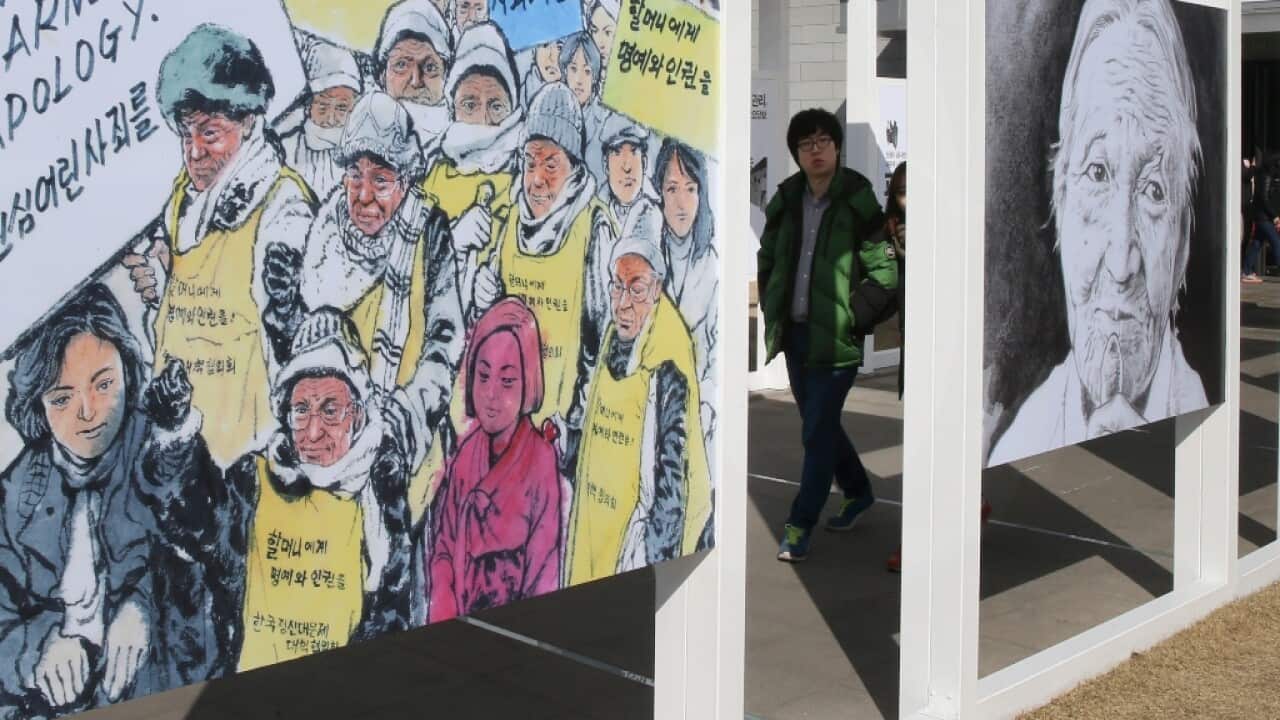
Proposals in Strathfield to erect a statue to the 'comfort women' - women recruited by the wartime Japanese military to brothels where they suffered sexual abuse and exploitation - have evoked intense and sometimes ugly passions. Local public officials and Australian media have been inundated with messages of protest, many of them coming from a group calling itself 'Japanese Women for Justice and Peace'.
But this is not an ethnic conflict of Japanese versus Chinese and Koreans. It is an issue of human rights, and should be discussed in the context of global efforts to stop violence against women in war.
There is abundant evidence that, from the late 1930s to 1945, Japanese imperial forces operated a network of military brothels to which tens of thousands of women from many occupied or colonized Asian countries (including Korea and China) were recruited. The recruitment was carried out in various ways, often by civilian brokers but sometimes by military or police. Some women were simply marched into the 'comfort stations' at gunpoint. Among those to suffer this fate were a small number of Dutch women held prisoner in Java. One of them, Jan Ruff-O'Herne, who later migrated to Australia, has been a courageous spokesperson for the victims.
In 1993, following protests from Korea and from human rights groups in Japan itself, Japanese chief cabinet secretary Yohei Kono issued the Kono Statement, which apologized for these wartime acts, and promised to engrave 'such issues in our memories through the study and teaching of history'. An Asian Women's Fund was set up, funded partly by the government and partly by private donations. This offered medical support and 'atonement money' to victims; but the response was criticized by some citizens' groups, particularly because the 'atonement money' came from private donations, and was not official government compensation. Many victims refused the payments.
News that makes sense
Your trusted source for staying up-to-date with the world around you. Get free daily news updates and analysis, straight to your inbox.
During the 1990s, Japanese history textbooks began to include mention of the 'comfort women', but following protests from nationalist groups in Japan, these references disappeared. A number of politicians have made statements attacking the Kono Statement. The issue came to a head in February when the Japanese government announced that it was planning to review the processes behind the statement. This was widely interpreted as meaning that the statement would be watered down. China and Korea protested, and even the US seemed concerned.
These politics are now being played out in Australia. The bizarrely named 'Japanese Women for Justice and Peace', which has spearheaded the letter-writing campaign against the proposed statue, is actually a Japanese nationalist lobby group. Its key players (many of them male) include far right politicians who ardently advocate Japanese military expansion. Right-wing Japanese newspapers such as the Sankei evoke fears by publishing claims of sinister links between the Strathfield proposal and the Chinese Communist Party. Some nationalists in China and South Korea, too, exploit the issue for their own political ends. These responses do nothing to help the victims or the people of Japan, Korea and China. It would be a tragedy if they were allowed to ferment frictions amongst East Asian community groups in Australia.
The Australian government and media should respond by urging the Japanese government live up to the promises of Kono Declaration: face the past, compensate the victims and educate its citizens about the truths of Japan's wartime history. The international community also needs to be more active in addressing problems of violence against women in war everywhere. The wartime Japanese 'comfort women' system was extraordinary in the number of women on whom it inflicted terrible suffering, but other countries too have been responsible for rapes and sexual exploitation of women in wartime. Australians need to be willing to reflect on our own record in war, and to ensure that our military training conveys values that prevent sexual violence in the military conflicts of today.
Tessa Morris-Suzuki is a historian of modern Japan and Australian Research Council Laureate Fellow at the Australian National University.







