
Touch is the first sense that we develop in the womb, and throughout life it continues to elicit strong emotional responses, and remains a powerful way to connect to other humans. Ebola is a disease that preys on touch—it is not airborne, and can only be transmitted through direct contact with the bodily fluids of an infected person. This means that the only way to stay safe in the regions affected by the current outbreak (the worst in history) is to touch no one.
In Liberia, one of the countries most affected by the outbreak, this means people are estranging themselves from a key part of their culture. As the New York Times reported this weekend, in Liberia, “closeness is expressed through physical contact.” The traditional greeting is a double-cheek kiss—not possible anymore when even a few drops of saliva could expose you to the virus. Washington Post reporter Lenny Bernstein noted during his visit to the country the prevalence of a new, warier greeting: the “Liberian handshake,” bumping fully-clothed elbows.
Still, some people can’t resist comforting their loved ones. The Times story tells of a man who tried his best not to touch his mother, who was vomiting blood in her bed:
But as she grew worse, unable to keep anything down, he gave her milk, and tried to soothe her. His skin touched hers. His mother died the next day. Just after his mother’s funeral, Mr. Dunbar’s own forehead got hot with fever. For 15 days, he stayed at John F. Kennedy Hospital in Monrovia, fighting the disease. It was a fight he eventually won. But when he got out of the hospital, he found out that four of his sisters, his brother, his father, his aunt, his uncle and his two nephews had died. His entire family, wiped out in days. On Friday, Mr. Dunbar said he would do nothing different. “That’s my ma,” he said, “that she the one born me.”
People who are isolated and experience little physical contact are known as “touch hungry.” These people are often members of marginalized or stigmatized populations—the homeless, for example. Ebola patients are certainly isolated, immediate quarantine being the best strategy to stop the spread of the disease, and in addition to being torn away from friends and family, they are hosts to a virus whose very name makes people fearful.
“Any time you’re feeling alone, there’s a sense of hunkering down, which increases stress and fear,” says Ann Connor, an associate professor at Emory University’s School of Nursing, who has studied what she calls “intentional comfort touch.”
Touch can be a way to combat some of the fear and stress that are inherent with visiting the hospital—one study showed that patients who had their hands held during cataract surgery experienced less anxiety and had lower levels of the stress hormone adrenaline. With an average Ebola survival rate of 50 percent, the stress and fear of coming down with the disease is surely unfathomable, but hand-holding—without the barrier of gloves, at least—is not on the table.
For nurses, doctors, and other healthcare workers, Connor explains that it’s less about what they’re doing than how they’re doing it. She offers the example of getting blood pressure taken, and the difference between just “slapping on” the cuff, and doing it in a more deliberate way.
“There’s a way you can put that cuff around the person’s arm, and place the stethoscope and your other hand, that conveys more comfort,” she says. “Those are ways you can bring back people’s dignity and sense of connection.”
Connor believes this is possible, even with the intense protective gear healthcare workers have to wear while treating Ebola patients. Crystal Johnson, a nurse at Emory University Hospital in Atlanta who has worked with three Ebola patients in the U.S., including Dr. Kent Brantly and Nancy Writebol, both of whom recovered from the disease, describes the gear she has to wear.
“We wear disposable undergarments, scrubs, and socks, and we have a set of shoes that we only use during this time,” she says. “Full Tyvek, with booties, a helmet with a hood, and also an apron. Double gloves. And tape up everything.”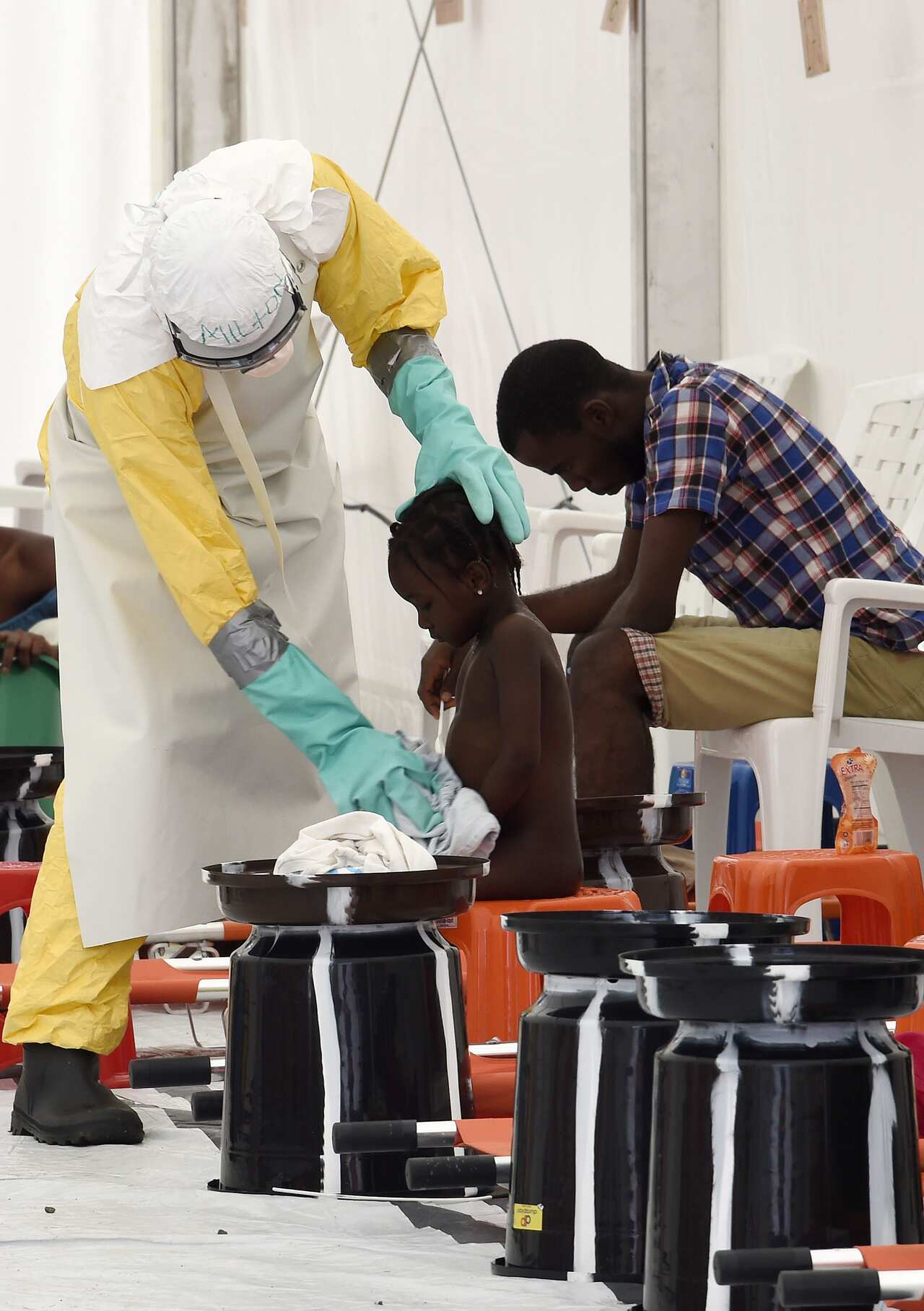 But nurses can still perform procedures in the caring, deliberate way Connor describes while wearing all this, and Johnson says that touching through the gear still makes a big difference.
A MSF worker attends to a girl at the medical centre where people infected with the Ebola virus are treated in Monrovia in September (AAP).
"Nancy said she didn't feel like she was an alien anymore, because we were able to touch, even though it was through the gloves."
“No one would come near [the patients],” she says. “Once they get here, we’re with them. We don’t leave their side. Nancy said it best, she said she didn’t feel like she was an alien anymore, because we were able to touch, [even though] it was through the gloves and everything.”
In her review of the literature on intentional comfort touch, Connor finds that it’s beneficial for nurses as well, who feel more valuable and satisfied, and less powerless when they are able to soothe patients through touch.
“We are their companions for a long time, because they sometimes aren’t able to talk with or touch their family members,” Johnson says. “We become really close from the start.”
The problem is that in West Africa, where there’s already a shortage of healthcare workers, where many healthcare workers have died, where there have been nearly 7500 cases, nearly 3500 deaths and counting, health workers may just not have the time or mental bandwidth to take a deliberate moment to intentionally comfort one patient. There’s just too much to do.
“There’s a way you can put that cuff around the person’s arm, and place the stethoscope and your other hand, that conveys more comfort,” she says. “Those are ways you can bring back people’s dignity and sense of connection.”
“When there’s a crisis, you feel somewhat powerless as a nurse,” Connor says. Healthcare workers may then have a more “instrumental touch”—quick, brusque, utilitarian, “because they feel out of control themselves.”
That’s not to say people can’t adjust, and pull through even the worst situations. “Humans have an enormous capacity for adaptation,” Connor says. And there’s been some adaptation already—the elbow bumps, and all. But Connor is reluctant to speculate when it comes to West Africa. The most affected countries—Guinea, Sierra Leone, and Liberia—have all suffered recent civil wars, and all the stresses that linger on for years afterward. And now, Ebola.
“I’m not sure how much adaptation they have left,” Connor says. “It’s almost like they’re being hit while they’re already down."
This article was originally published on The Atlantic. Click here to view the original. © All rights reserved. Distributed by Tribune Content Agency.
Share


