There’s always a bit of a disturbance in the force when the Greens do leadership changes.
The media don’t like the way it is done, and you generally see a stack of tweets and then articles that will refer to transparency and democracy, but are essentially complaints that “these are not the leadership challenges we are looking for”.
No leaks, no secret back-grounding of journalists for a few weeks, months (years, if you are Kevin Rudd supporters). Not even a clearly made-up leaked internal poll.
The Greens thus far have found not a great deal of need for the media in leadership challenges. Rather oddly, this has some suggesting they don’t use the media at all.
Clearly they do.
The Greens will favour journalists for drops, and obviously have a media strategy – just one that doesn’t necessitate the need to provide the press gallery with too much gossip.
When you’ve only got 11 members in your party room it gets pretty hard to leak against your leader without being obvious.
But the Greens are also very much a political party. It suits their interests to down-play this aspect, but in that they’re no different to the other parties. Kevin Rudd, for example, spent a good deal of his time in 2007 trying to convince voters he was above politics. The Liberal Party as well, once they got into power, suddenly found distaste for all things political, and wished a desire for bi-partisanship.
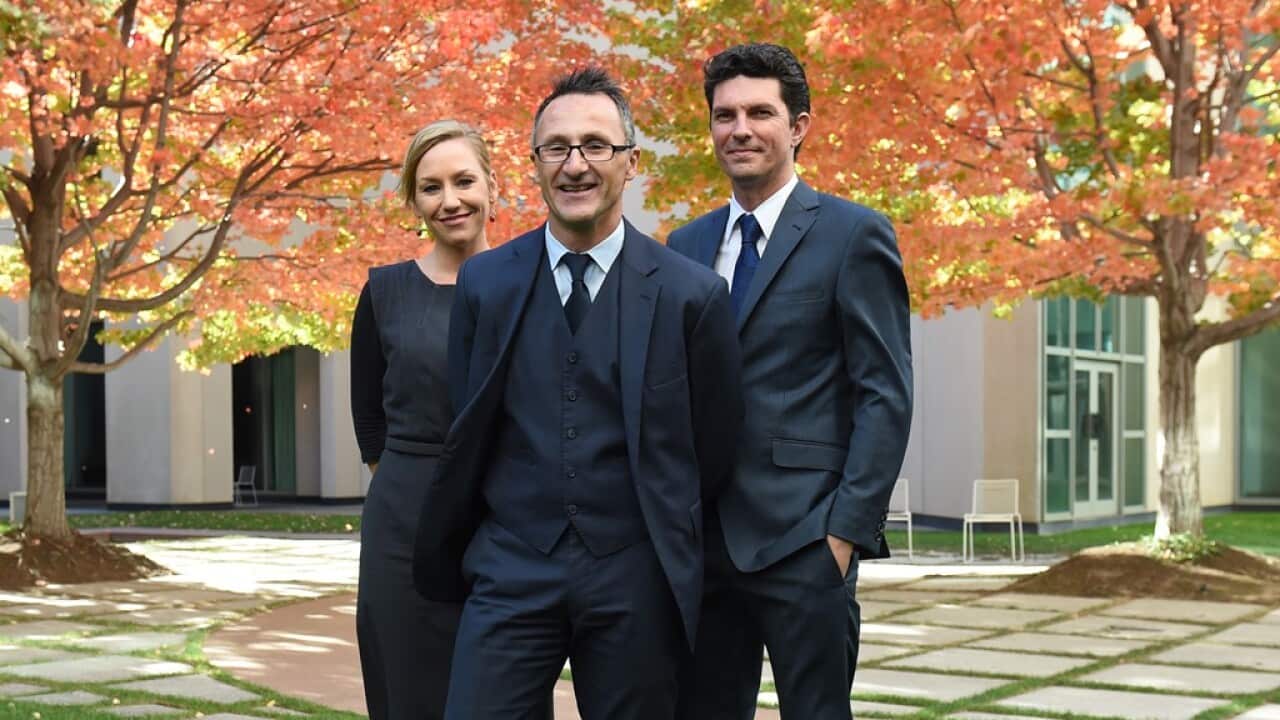
It looks pretty clear that while Christine Milne was not pushed, she very much ensured her leaving was timed so that she was replaced by the people she wanted – Richard Di Natale, Scott Ludlum and Larissa Waters.
Whether or not this is underhanded will amuse the gallery for a while, but few others.
Voters will look more at what Mr Di Natale has to say and what he does.
Recommended reading
Who is Richard Di Natale?
His initial performance on ABC’s 7:30 suggests he is a leader who will do very well – a leader who doesn’t need to consult his notes to discover what he believes in, and one who doesn’t reduce each point to a sound bite.
His vision clearly is on reframing the Greens as more middle of the road. But this does not necessarily mean any great change of policies. Those in the media who struggle to write about the Greens without having to invoke the Australian Democrats in some laboured analogy would have you believe that Di Natale needs to somehow make the Greens more like the ALP in order to increase its vote.
Rather than change into the ALP, Di Natale in his initial press conferences and interviews seems to be trying to convince voters that it’s the ALP that has changed, and if you want progressive policies, the Greens are where you should be.
Such lines infuriate ALP members and supporters – but they’re going to have to get used to them. They might also start working on a better response than whining that as a “party of government” life is harder for them. Saying “only the impotent are pure” is a nice one liner, but not if your party seems to be ever aiming for the “least worst” result.
But while any reframing may see some policy changes – such as negotiating over the fuel indexation – it more is about changing the messaging of the party.
Di Natale is nicely poised to do this. Like the former Greens leader Bob Brown, Di Natale is a doctor, but the two have quite different public personas. Brown came to prominence through his advocacy against the Franklin dam; Di Natale brings with him no such public perception as a protestor.
The new Greens leadership group does also represent a generational change – Di Natale wasn’t even a teenager when Bob Brown was fighting on the Franklin River. So while the environment will remain the core issue of the Greens, Di Natale does not bring with him the baggage of having to convince voters that climate change is the only thing he cares about.
In his first press conference and in his interview on ABC 730, health was clearly the issue he wants as one voters should think of when they think of the Greens.
Three years ago when Christine Milne became leader much of the commentary was about whether the Greens could survive without their well-known and admired leader. Many predicted (and hoped for) their electoral destruction.
That didn’t happen, and now instead the talk is of whether Di Natale can grow the Greens vote, rather than save it, and what he needs to do to achieve that aim.
The difficulty for a party such as the Greens is to persuade voters there is more to them than their eponymous one. Critics are ever on the watch for them to sell-out, or “go mainstream”. Di Natale’s initial approach looks to be to convince voters that the Greens already are the mainstream.
Share


