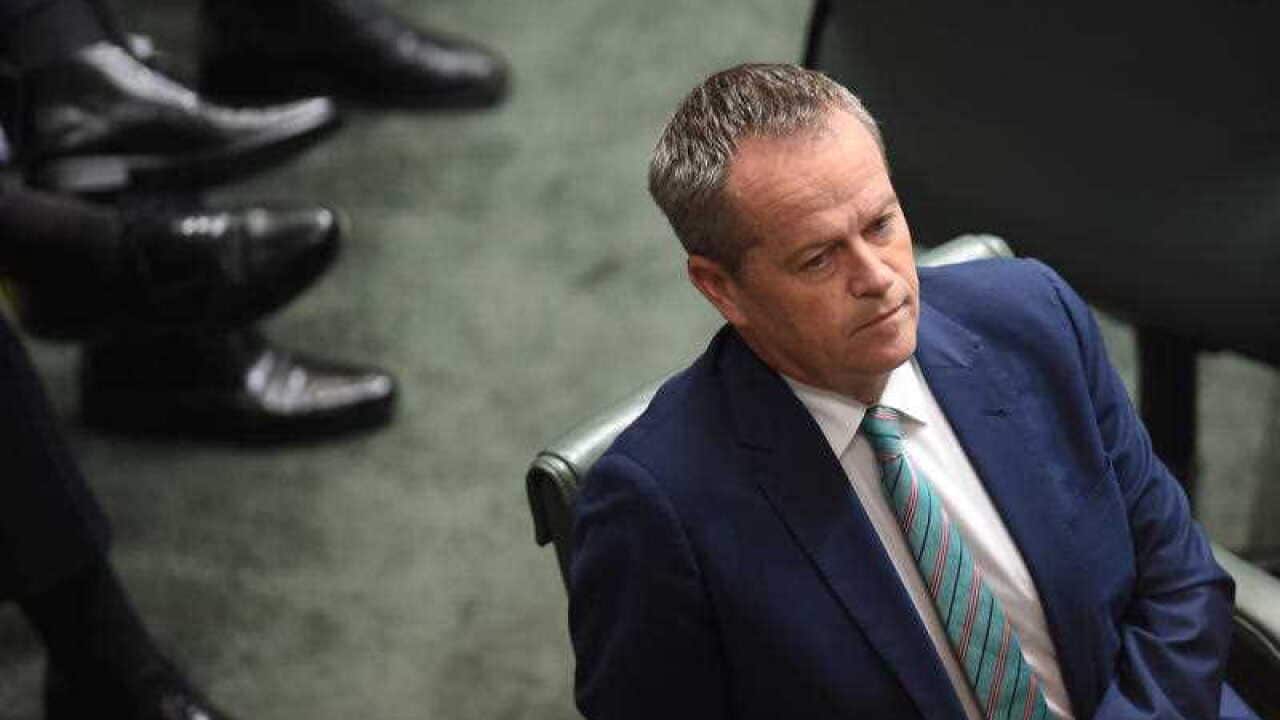
As we get close to the end of the parliamentary year, the rather odd thing is how little pressure is on Bill Shorten’s leadership. Usually the end of a parliamentary sitting period where a leader is suffering in the popularity stakes brings with it talk of the “killing season”.
And Bill Shorten is woefully unpopular.
There are probably more taxi drivers who are satisfied with Uber than voters who are satisfied with Shorten.
The latest polls have his satisfaction rating at just 26 per cent. There are probably more taxi drivers who are satisfied with Uber than voters who are satisfied with Shorten. His dissatisfaction rating is 57 per cent. For some context, when Turnbull was rolled by Abbott back in December 2009 (in the last sitting week) his satisfaction rating was 36 per cent and his dissatisfaction rating was “just” 50 per cent - yes, boys and girls, there was a time our glorious PM was not the most popular politician ever.
Indeed prior to the Abbott, Rudd, Gillard trifecta, wherein voters came to hate pretty much everyone in politics, having a negative net satisfaction rating was essentially a death knell for any opposition leader.
News that makes sense
Your trusted source for staying up-to-date with the world around you. Get free daily news updates and analysis, straight to your inbox.
It marked the end for Kim Beazley, for Brendan Nelson, for Malcolm Turnbull.
And yet there are no whispers about the end of Shorten, no backgrounding, no prominent and pointed appearances by likely challengers. It’s all a bit odd, given there would be few in the ALP who think Shorten has anything other than no chance of winning the next election.
Now yes the ALP has new rules which make it harder to dump a leader, but it is not impossible. It would seem the ALP has decided that sticking with Shorten is the pill it must swallow after the years of destabilisation.
It is sad for him, but Shorten right now looks destined to be forever the man who would have been PM had the Liberal Party been dumb enough to stick with Tony Abbott.
And it’s not like Turnbull is kicking goals everywhere. Yes his speech on our response to terrorism was strong, but news this week emerged in Fairfax papers of a possible blowout in the budget of the NBN, which he was in charge of as Minister for Communications. The issue regarding the need to replace the Optus cable TV and broadband network may be somewhat overblown, but it certainly is the case that no one would suggest the NBN has been a shining beacon of success under the Abbott/Turnbull governments.
This week there was also the case of an asylum seeker boat which arrived at Christmas Island, but which has now “disappeared” after being towed away by the navy.
And there is also the case of Turnbull’s continuing to support Mal Brough, whom he appointed as Special Minster of State, despite Mr Brough’s home being searched by the AFP over allegations of his involvement in obtaining the diaries of former speaker Peter Slipper.
But right now in this honeymoon, coming up to holidays, period there will be little to dent the PM’s approval rating, and so all the ALP can do is keep putting out policy and hope the wheel turns.
This week the policy announcement was to raise the excise on cigarettes by 12.5 per cent each year for 4 years from December 2016.
It was quickly attacked as lazy, and targeting the poor. What is interesting is that it is an old policy of Turnbull’s.
In his budget reply in 2009, Turnbull told parliament that the Rudd government should increase “the amount of excise collected on tobacco by 12.5 per cent, or about 3c extra per cigarette”.
He suggested that “there is a tough choice for a weak Prime Minister: either raise $1.9 billion by making health more expensive and putting more pressure on the public hospital system or raise it by adding about 3c more to the price of a cigarette and taking pressure off the public health system. You see, budgets are indeed about priorities”.
At the time the response to Turnbull’s policy was fairly muted – it hardly seemed the big ideas one would associate with Turnbull.
For Shorten it is not particularly great that he is now replicating a policy from Turnbull during a time when he was woefully unsuccessful. But even worse is that Shorten looks to be selling it as a tax measure rather than a health policy. Rather oddly he has contrasted it to the possibility (the remote possibility, if we are honest) of the Turnbull government putting a GST on fresh food.
Now sure there are reasons to attack changing the GST, but if your alternative is a tax on cigarettes, which by its very definition is designed to be short-term (as you hope it will reduce the number of people paying the tax), then you come across looking pretty light weight on the issue of long-term economic policy.
A health policy should not be sold as an economic/budgetary one – especially when voters already largely see a cigarette excise increase as just a tax grab. And doing such is hardly likely to have anyone becoming less dissatisfied with Shorten.
In the past Shorten would likely have been dumped by now; he is fortunate the fallout from the era of destabilisation, which he helped bring about, has meant the ALP looks set to stick with him no matter how few voters are prepared to do the same.
Greg Jericho is an economics and politics blogger and writes for The Guardian and The Drum.







