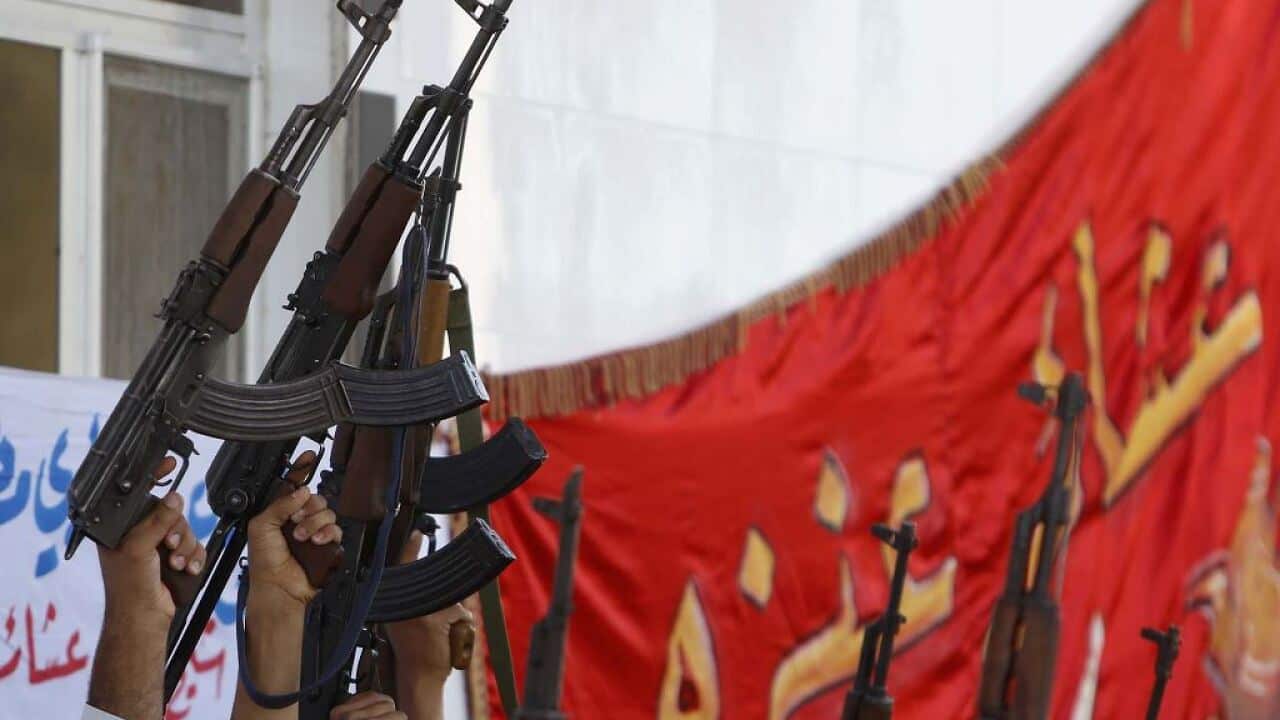
When a bunch of extremists seem about to take control of one of the Middle East’s largest countries, you’d think we’d have better things to do then argue about what they’re called. But the world’s media seem stubbornly divided about what name to give the jihadist movement currently overwhelming Iraq.
To some news outlets—including the big news agencies Reuters, the Associated Press, and Agence France-Presse, as well as al-Jazeera—it’s the “Islamic State in Iraq and the Levant,” or ISIL. To others—among them the New York Times—it’s the “Islamic State in Iraq and Syria” (or in some cases “Greater Syria”), or ISIS. Quite a few places write “…the Levant,” but then bizarrely abbreviate it to ISIS (we’re looking at you, Financial Times and Guardian).
Nor is the confusion restricted to English-language media. In French the reigning phrase appears to be l’Etat Islamique en Irak et au Levant (EIIL). But in Spain, El Pais has chosen El Estado Islámico en Irak y el Levante (EIIL), while its rival newspaper El Mundo has gone with Estado Islámico de Irak y Siria, and uses the English acronym ISIS. In Germany, Deutsche Welle uses ISIS in both its English and German versions, but writes out “…the Levant” on its English site and “…und Syrien” on its German one; meanwhile, Der Spiegel, Die Zeit and the Frankfurter Allgemeine have gone with ISIS while Die Welt plumps for ISIL. The BBC Russian service, like much of the Russian media, uses the Russian equivalent of ISIL—whereas the BBC in English spells out “Levant” but then uses ISIS.
It's all a sham
The group’s name in Arabic is al dawla al islamiyye f’il iraq w’al sham. The last word, sham, is the problematic one. It is used, in the phrase bilad al sham, to refer variously to: the contemporary Levant, a somewhat amorphous region sometimes understood to include Iraq, and sometimes not; to the historical region called al sham in classical Arabic but known to the ancient Greeks and other civilizationsas “Syria” or a variant thereof, which is roughly contiguous with the Levant; and to a Syrian nationalist dream of a “Greater Syria,” a region of similar extent that includes Iraq. Sham is also a contemporary nickname for Damascus, the Syrian capital; but modern-day Syria is called suriya.
No wonder people are confused. So how to resolve the issue?
Some outlets (the New Yorker among them) have skirted it by calling the group the “Islamic State in Iraq and al-Sham,” which conveniently abbreviates to ISIS. That might be the most honest approach. But it’s also the least informative. DAIISH (or DIISH or DAISH), an acronym of the Arabic name, might be better (media do sometimes use foreign-language acronyms like KGB), but it seems unlikely to become popular.
At Quartz we’ve chosen to render sham as “Levant” over “Syria,” on the grounds that while scholars of Middle Eastern history might recognize “Syria” to have a broader meaning, most of our readers will take it to mean modern-day Syria, i.e., suriya, not sham. And then, if you’re using “Levant,” you might as well as abbreviate it logically—so, ISIL.
There’s another, more practical reason. If you search Google for ISIS, you’ll also find a mobile-payments system; a pharmaceutical company; a zoological database used for species conservation; a respected history-of-science journal; a couple of university student information systems; a nuclear non-proliferation think-tank; the shadowy spy agency in a bawdy animated comedy series; and, needless to say, the Egyptian goddess of nature and magic. And that’s just on the first page of results. But there is only one ISIL.
This article was originally published on Quartz. Click here to view the original. © All rights reserved. Distributed by Tribune Content Agency.
Share


