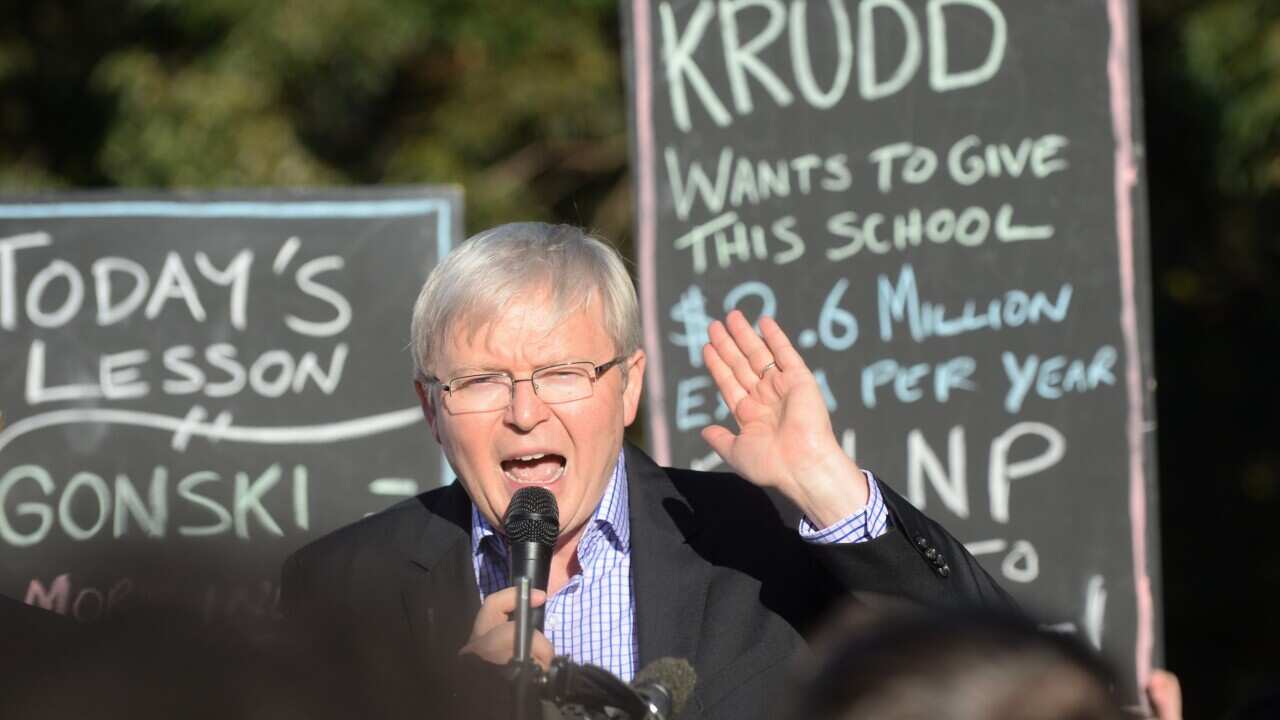
It's fewer than three weeks until the election and we have a government that seems to be founding the bulk of its re-election campaign on the credibility of the opposition’s costings - or lack thereof.
It's not altogether unsurprising, given that Labor sacked Rudd, backed Gillard, sacked Gillard and backed Rudd again in the space of three years.
With such an unstable leadership and a lack of clear policy direction, the government has been unable to run on its record. So devoid of substance is Kevin Rudd’s re-election platform, he's had to resort to scare campaigns.
Take for example his claims surrounding the GST and the price of Vegemite, or his ludicrous suggestion that the Coalition intends to privatise public hospitals lest the alleged ‘$70 billion black hole’ remains unfilled - which, incidentally, has been debunked by Politifact and ABC researchers.
Kevin Rudd continues to allege that the Coalition will ‘cut to the bone’, while the debate on the ABC’s Q&A program last night was dominated by Chris Bowen’s demands for Joe Hockey to release the Coalition’s costings.
Of course, the Coalition is withholding its costings from the public. No-one can credibly argue otherwise. Many of the explanations from Tony Abbott, Joe Hockey and other shadow cabinet members sound absurd. But there are obvious tactical reasons for not releasing the cumulative costings too early – the government is desperately looking for new reasons to demonise the Opposition and it would love a few weeks of hard negative advertising that distorts whatever costings it does release.
In the game of election campaign tactics, there is no advantage whatsoever for the Coalition to hand the government a free kick. The Coalition will no doubt wait until the legislated election media blackout that begins at midnight, Wednesday 4 September before releasing any costings document.
One might argue that voters should have not a scintilla of concern for political tactics. However, in circumstances where the government has the entire public service at its disposal to weigh up, discuss, test, model and recommend various policies for three years at a time, the government has a significant advantage over the Opposition. The Opposition merely has the shadow cabinet and ordinary internal party policy processes to devise policy and has nowhere near the same capacity or resources to conduct the testing and modelling ordinarily available to the government.
While the Opposition is permitted to submit its policies to the treasury for analysis, it is almost invariably leaving itself susceptible to an avalanche of government criticism, accusations of mythical black holes and the like. At the 2010 election, there were leaks from treasury pertaining to its analysis of the Opposition’s promises, which did not worry Wayne Swan at the time, putting in question the integrity of treasury and the Charter of Budget Honesty process. While the newly created Parliamentary Budget Office somewhat ameliorates the situation by removing the partisan risks of submitting policies direct to treasury, it is not perfect - it was forced to admit that it couldn’t cost the Coalition’s broadband policy due to it not having the requisite expertise.
The problem for the government is twofold: not only does it like having it both ways, but it also has one of the poorest fiscal records in recent history. It submitted its own costings only 24 hours to polling day in 2010. It's also amassed more than $180 billion in net debt in the last six years. Even accounting for the oft-mentioned GFC, it’s hard to argue that this government doesn’t have a spending problem. None of the estimates provided by treasury have been particularly accurate either, with a near doubling of the projected deficit for 2013-14 in the three month period between the May budget and the PEFO. That is simply astonishing.
We should see the costings debate for what it really is: a distraction strategy to mask the fact that the wheels are falling off for the government. A slew of recent polls have shown that Kevin Rudd’s popularity, satisfaction ratings and trustworthiness are all tanking.
There can be no doubt that Labor's calls for costings and the constant warnings of ‘cuts cuts cuts’ will become even more hysterical. But I also have to wonder whether Labor honestly thinks average Australians honestly sit at the kitchen table with their calculators conducting a mathematical comparison between the costings of the government and the Opposition.
The fact that it’s getting so little mileage out of this scare campaign in the polls suggests the people are fed up with the sanctimony.
Robert Candelori is a law student at the University of NSW and a member of the Liberal Party.


