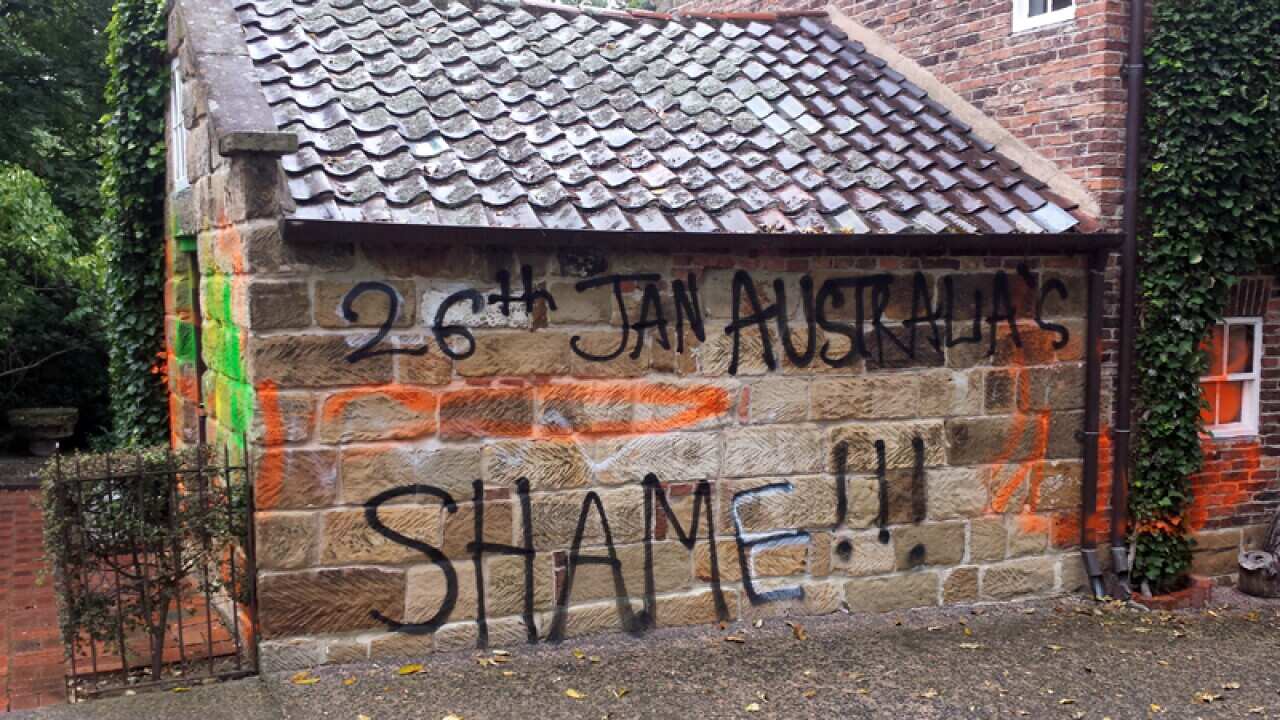
While the History Wars have recently been reignited in education, in public life there is an ongoing and relentless fight over history and cultural identity. Last year, in the days following 'Australia Day', Captain Cook's Cottage was the target of politically-motivated vandalism.
The anarchist group who took responsibility, disaccords, called the cottage an 'absurd shrine to genocide.'
This year, days before 'Australia Day' or 'Invasion Day', the oldest building in Australia was again vandalised. '26th Jan Australia's shame' read spray paint on the 259-year-old bricks of the east-facing exterior. Fluoro green, yellow, and orange paint decorated the desecration and the smashed-in window sent a more than transparent message.
The protesters didn't have to send their memorandum of disagreement in this vile way, though. Defacing a historically significant site is simply un-Australian, in every sense of the word. It's a cowardly, blatantly destructive, and inherently violent form of protest which doesn't belong in a conversation about the importance of history. What's more, their manner of protest brings disparagement upon any and all who might agree with their sentiments but not their methods.
Yes, one could rightly argue the metaphorical resonances implicit within the acts of desecrating a site of Western heritage and how it echoes the destruction and despoliation of Indigenous heritage. But why do these protesters lack the creativity to send their message in a less destructive, violent way?
News that makes sense
Your trusted source for staying up-to-date with the world around you. Get free daily news updates and analysis, straight to your inbox.
I suspect they don't lack the creativity to do so, just the maturity or will. There are so many other wonderful, artistic ways they could have chosen to send their message which wouldn't have involved the same sort of destruction and illegality as the act they chose. Just look at the gravitas one might achieve by sitting on a New York City sidewalk with a sewing machine. Replacing the Union Jack that flies above the cottage with an Indigenous flag or erecting a display detailing the atrocities committed against Indigenous people, are just simple examples of other possible actions available to the protesters. Possible actions they chose not to take, mind you.
There's just one problem with the more civilised options for these protestors: they won't get the same shock value. Granted, in a way, it seems like that's the only thing that matters to them; 'let the consequences be what they may, so long as we get our ideas heard'. I'd put it on par with a toddler's tantrum; 'let everyone's ear drums explode, I want that cookie'. It's not unlike the tactics of radio shock-jocks, though perhaps they could cite moral superiority in that at least on radio they haven't yet being physically destructive (even if they might have inspired others to commit violence).
So to be both shocking and non-violent, I argue, is the key to the ethical media-attention-grab. It's not wrong to want to share your message - whatever it is - so long as you do it in a way that is non-violent and non-destructive. While coming up with the perfect protest might be difficult, it doesn't excuse the use of violence or destruction to make your political point. Indeed, if you want your political points taken seriously, it is best that you do not discredit yourself in the process of articulating them.
Tom Burns is a Melbourne-based writer who studies bioethics and neuroscience.







