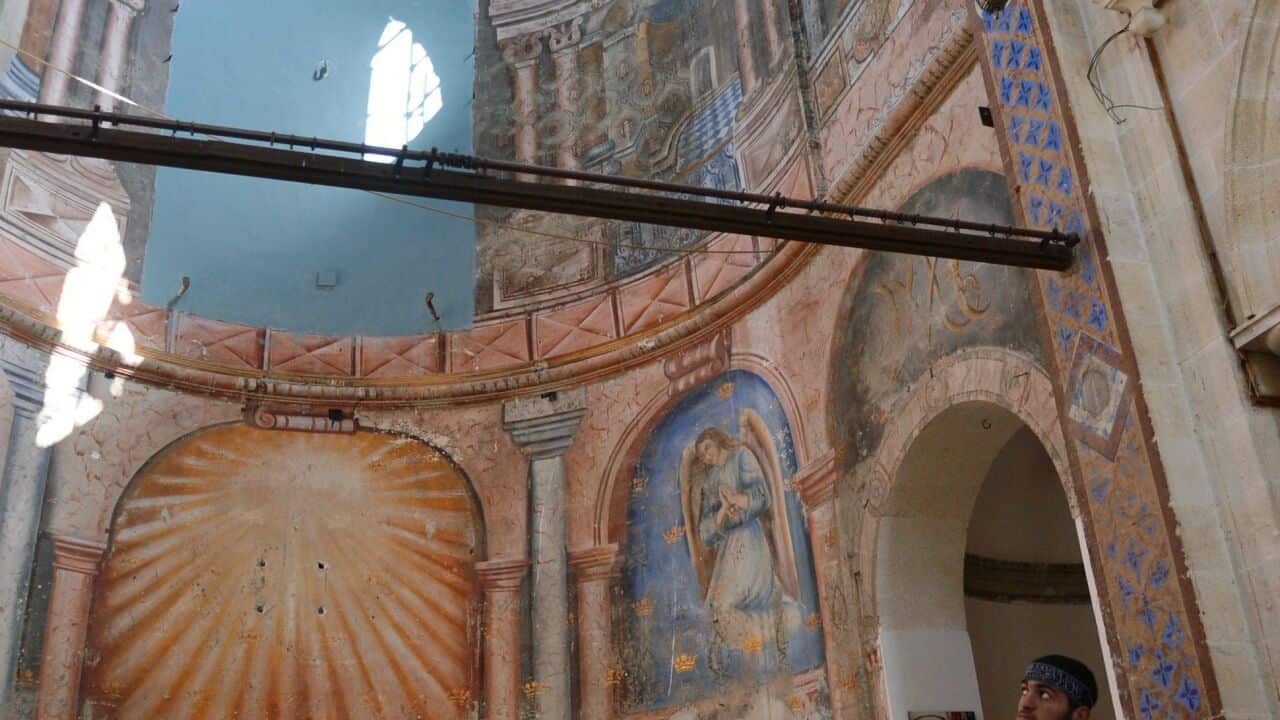
The report relied on high-resolution satellite photos to chronicle damage to mosques, Roman buildings, and a Byzantine castle.
The Geospatial Technologies and Human Rights Project of the American Association for the Advancement of Science wrote the assessment with help from the Penn Cultural Heritage Center at the University of Pennsylvania's Museum of Archaeology and Anthropology, the Smithsonian Institution, and the Syrian Heritage Task Force.
The Cultural Heritage Center has a two-year grant to study how historic material is used in conflicts, said Richard Leventhal, the center's executive director.
Heritage, he said, helps determine who we think we are. Destroying heritage is not only about razing buildings and gaining land, but "also the destruction of people's identity."
Earlier this summer, Brian Daniels, director of research and programs for the Penn center, went to southern Turkey near the Syrian border to train 20 Syrians who want to protect the sites. They were taught how to protect museum collections during emergencies and were given supplies to secure pottery and library books, some of which are now being kept in private homes.
Daniels said he was "just incredibly floored" by the bravery of the Syrians. "They are aware their lives are at extreme risk," he said. "They feel that it is their responsibility, their duty, to try to save these things that are most precious about Syria's history."
He likened their actions to what most of us would do if our homes caught on fire. First, we'd make sure everyone was safe. Then we'd try to save the family pictures. "These people's jobs are to try to save the family photos for the country," he said.
The report does not assign blame for the damage. Daniels said that both the Islamic State insurgents and the Assad regime are responsible for an "incredible amount" of destruction. The Islamic State damage is clearly intentional. One of their targets, he said, is Christian graves. Islamic State "has been destroying these things left, right and center," Daniels said. Experts are not as sure about the regime's role although it is the only combatant capable of aerial assault.
The United Nations Organization for Education, Science and Culture maintains a list of more than 1,000 World Heritage sites representing great cultural or natural significance. In the United States, there are 22 of them. Most are national parks.
Syria's are buildings or towns. They include the Ancient City of Damascus, the Ancient City of Bosra, the Site of Palmyra, the Ancient City of Aleppo, two castles _ the Crac des Chevaliers and Qal'at Salah El-Din _ and the Ancient Villages of Northern Syria, which are also known as the Dead Cities.
Of the six sites, the historic section of Damascus, which is Syria's capital and one of the oldest cities in the world, has been "largely protected from the violence that has heavily impacted neighborhoods surrounding the city," the report said.
Aleppo has not been so lucky. In northwestern Syria, it served as a commercial hub from the second millennium BC and reached its peak in the 16th and 17th centuries. It has seen heavy fighting during the civil war. One of its best-known sites, the Great Mosque, has been damaged, as have many other historic buildings, according to the report.
At other sites, the report found evidence of new construction, looting, and intermingling of military equipment and ancient buildings.
The next step is to better establish a timeline for the damage at each site. The ultimate goal, the report said, is to "enable U.S. policymakers and other humanitarian agencies working in conflict zones to design more effective interventions."
The report, Daniels said, may also give the Syrian preservationists "a better sense of what they're up against and where they can better direct their resources and energy."
By Stacey Burling
The Philadelphia Inquirer
© 2014 Tribune Content Agency News Service
Share


