
You know, I’m pretty famous. And by “pretty”, I mean “not at all”. But I’m still probably more famous than you, who have probably never even met anyone off Home and Away. Sure, if you could measure fame by military rank, so that the Pope is a four-star general and David Wenham is a second lieutenant, I’m probably only a lance-corporal; but I have reached that bare minimum level where you can claim to be “famous”: the level where people you’ve never met feel comfortable being breathtakingly rude to you.
It’s going on right now: you yourself, as you read this, are probably already planning your diatribe for the comments. No doubt when I read them (and I always read the comments, as a sort of inoculation exercise), I will find a variety of brisk, witty variations on the usual themes: I’m an idiot, I’m a wanker, I’m a hack, I’m a fat guy in a hat and therefore incapable of knowing things about stuff.
It’s not that I’m thin-skinned. I mean, I am thin-skinned, but that’s beside the point. I realise that being called names in the comments is the price I pay for having the bald-faced temerity to write words and show them to other people. It’s a trade-off: in exchange for the gift of a professional writing career, I must accept the irrational hatred of large numbers of strangers. I get it. What I don’t get it what’s in it for you. What need does it fulfil, to be able to impotently bellow into the void, “I DON’T LIKE THIS”? Is it relaxing? Do you consider it a constructive use of your energy? Is it that sharing personal tastes with friends and family is not enough: to feel significant in this spacious universe, you must keep the Never Heard Of You community up to date at all times?
Look, I’m all for slagging off the famous. I am quite happy to have a chat about what a knob Jamie Oliver is. But that’s just it: I’m chatting about him. Not to him. Even writing it here, he won’t know unless he is googling himself, and if he is: Jamie, man, take a good look at yourself.
But you see, don’t you? I’m not writing him a letter, ringing him up, or visiting his house to tell him he’s a knob. And that, I think, is fair enough. Anyone with any sort of public profile knows full well they won’t be universally beloved – nobody in history ever has been. And they know they’ll be talked about. If they want to hunt down what’s being said about them, that’s their look-out.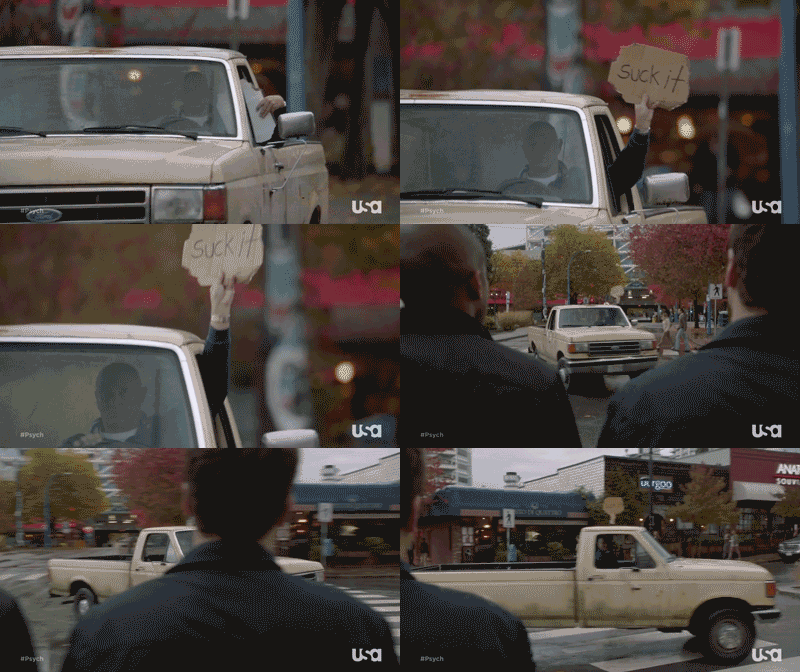 But in the age of social media, the distinction between “about” and “to” has been erased. And I know this because of the bizarre number of people who are irresistibly compelled to tweet things like “@benpobjie Honestly I find you very unfunny” or “@benpobjie I have no idea why anyone reads your rubbish” or “@benpobjie You’re a fat c--- why don’t you kill yourself?” Now, do you see the subtle difference between telling your friend that Ben Pobjie is a fat c--- who should kill himself, and telling me the same thing? That’s right – the second one is just bloody rude. I don’t even know you: why on earth would I want your pungent opinion? What sort of person finds it enjoyable to go about telling others they hate them? What sort of weird boat gets floated by this activity?
Conduct on the Internet should be more like IRL conduct, which is not like this.
The key is, of course, this is happening online, where we all kid ourselves that the people aren’t actually people. It’s just Twitter, right? That’s what people do on Twitter. It’s not like the exchange of language between human beings in one medium is in any way similar to the exchange of language between human beings in another. Surely there could be nothing wrong with telling someone to kill themselves electronically? That’s just banter.
I am so sorry to disabuse you, but hard truths need to be learned. People are still people, even on the internet, and rudeness is still rudeness, even when typed. So here is a handy rule of thumb, for when you’re tweeting, Facebooking or emailing me, or any of those infinitely more famous people who cop infinitely more abuse: if you wouldn’t be willing to walk up to me on the street and say it to my face, don’t say it to me anywhere.
If you would be willing to walk up to me on the street and say it to my face, you’re probably an even worse person, but I’m guessing that won’t bother you too much anyway.
Share


