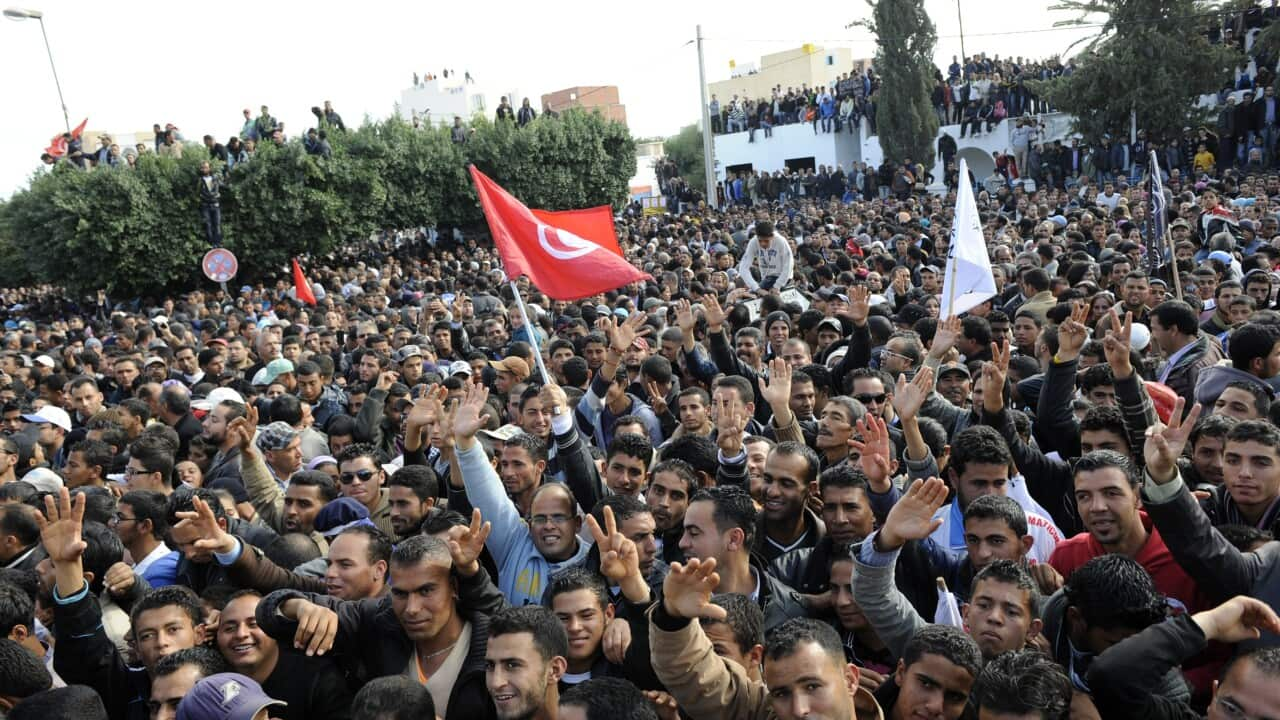
At a meeting at the Wall Street Journal this week, Martin E Dempsey, chairman of the Joint Chiefs of Staff, noted that the United States' ability to exercise influence in the Middle East had significantly diminished over the course of the Arab Spring. He noted in particular that there are fewer and fewer good options left for dealing with the conflict in Syria.
According to coverage of the event in The Times, he also predicted that it would take a generation or more for the Middle East to recover from the turmoil that the Arab Spring has triggered across the region over the past few years.
This is clearly a sobering assessment for anyone who still harboured any hope that the Arab Spring would live up to the expectations of the people that started the uprisings in the first place. There has been no significant improvement in people’s living conditions, political tensions and repression persist and levels of violence are on the up.
Syria, Egypt and Libya are the most obvious, and most widely reported failures but things have not been going smoothly in Yemen either, with increasingly vicious sectarian fighting in the North. In Tunisia, tense negotiations between rival political factions also continue.
At the same time, instability has been exported around the region and beyond. Lebanon is perhaps the country most adversely affected from the ongoing crisis in Syria. Alongside Iraq, it is also a case that exemplifies the growing sectarian nature of the violence across the region.
Beyond the immediate area, it is particularly the fall-out from the collapse of authority in Libya that remains a worry. Not only did the events in Libya trigger the crisis in Mali, but instability there now also creates opportunities for extremists from further afield, including training grounds for members of the Nigerian Boko Haram terrorist organisation.
Various branches of al-Qaeda – AQAP in Yemen, AQIM across the Sahel and Maghreb and local off-shoots in Iraq and Syria – have clearly benefited from the chaos of the Arab Spring.
Apart from the seemingly unstoppable proliferation of violence, the fragility of the states across the region is also evident in the spread of Polio in Syria. The outbreak has, in turn, been genetically linked to Egypt and Pakistan, with closely related virus strains also detected in Israel and the Palestinian Territories.
Add to that the impact of the Arab Spring on children, the economic costs of the so-called revolutions, and the manifest lack of will and ability on the part of the international community to manage this crisis and mitigate its consequences, and General Dempsey’s assessment of recovery being a generational challenge is hardly an overstatement.
There is no doubt either that the instability engendered by the Arab Spring will continue to pose serious security challenges well beyond the region – from induced migration, to public health risks, to increased transnational organised crime, and to a renewed proliferation of jihadist terrorist violence.
The question that nobody seems to be able to answer, though, is how these risks can be managed effectively so that the symptoms are not only fought but but their root causes addressed.
Stefan Wolff does not work for, consult to, own shares in or receive funding from any company or organisation that would benefit from this article, and has no relevant affiliations.
Share


