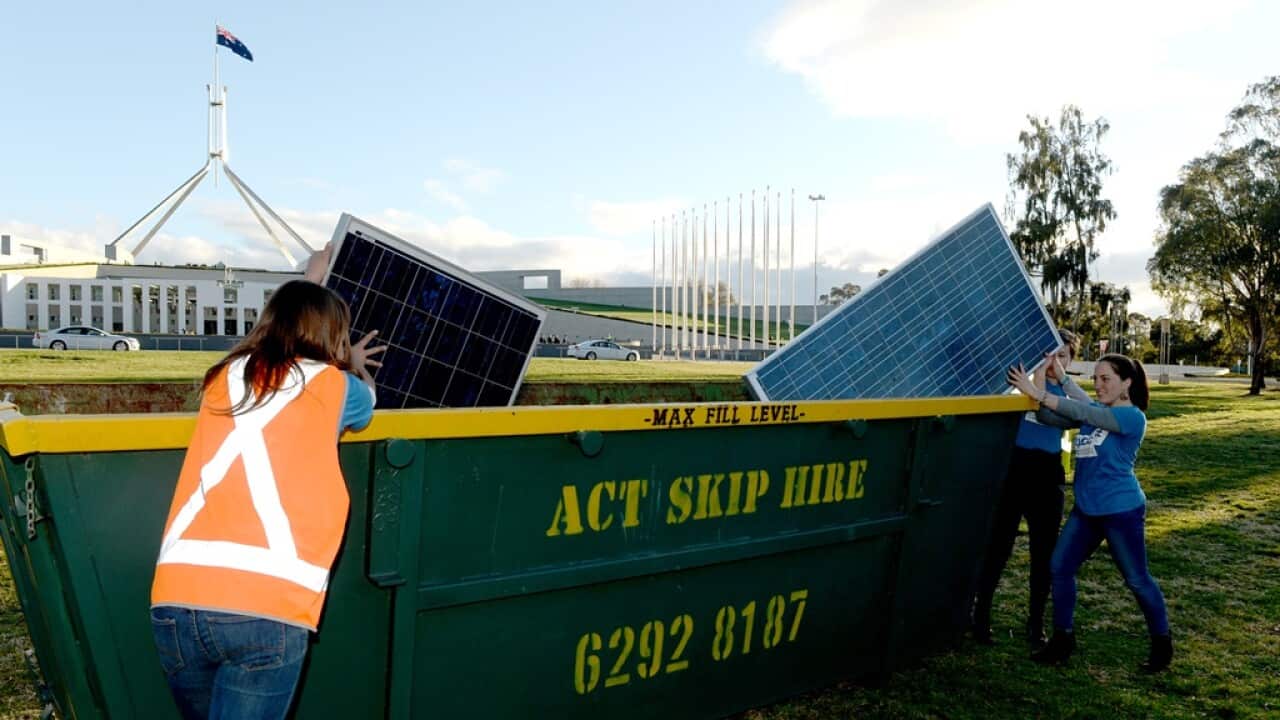
Question Time last week was dominated by the government wishing to talk about national security, but the real political moment of the week occurred a couple hours after Tony Abbott had called to an end to the back and forth on Thursday.
The Renewable Energy Target (RET) Review was released around 3:40pm on Thursday afternoon and it was every bit as illogical as you would expect, given the panel conducting the review was chaired by Dick Warburton, a man who told The Australian that he was “a sceptic that man-made carbon dioxide is creating global warming.”
In essence, the report finds that the RET is working very well – indeed, better than expected – and is having a minimal impact on prices. Moreover, it could even lead to lower electricity prices after 2020.
Thus, clearly it needs to be completely gutted.
The report is a love letter for the coal industry. It argues that because demand for electricity is decreasing, coal and other non-renewable energy generators need to be protected from would-be new entrants – i.e. renewable energy entrants not new non-renewable ones.
News that makes sense
Your trusted source for staying up-to-date with the world around you. Get free daily news updates and analysis, straight to your inbox.
It therefore recommends the scheme be stopped for any new entrants, which if the government agreed, would in a stroke kill any new investment in the industry and put at risk the returns on investments already made on the presumption the RET would not be changed.
The ALP and the Greens are resoundingly in favour of keeping the RET as it is, and currently the Palmer United Party opposes any changes as well, meaning the government would not be able to legislate any changes without much negotiation.
If it wants to use logic to help negotiate with cross bench senators, it won’t get much help from the review.
Among its ludicrous reasoning is that the impact of the RET over time might make “incumbent generators” (i.e. coal fired ones) less profitable such that they might spend less money on “maintenance”.
As Deputy Editor for the SMH, Ben Cubby tweeted rather sardonically:
Laughably, the report suggests in its Executive Summary that the “RET is a high cost approach to reducing emissions because it does not directly target emissions and it only focuses on electricity generation”. Bizarrely, however, the report itself notes that the purpose of the RET is to just focus on electricity generation. It’s like criticising a child care subsidy because it failed to increase the number of students graduating with PhDs.
Idiotically, the report demonstrates the high cost of direct-action style climate change policies, but then recommends “the Government should emphasise alternative, lower cost approaches to reducing emissions in the Australian economy.”
Maybe someone needs to give Dick Warburton a nudge and let him know the carbon price has been removed.
The report even notes in an appendix that “144 countries have renewable energy targets. Of those, 138 countries have policy measures in place to support those targets being met.” So we’re not exactly going it alone on the path to renewable energy (although we would be if the government proceeded with its recommendations).
The response from the government thus far has not been promising.
The Environment Minister Greg Hunt in an interview on Sky News effectively conceded the government would at the very least alter the RET to ensure that by 2020 we only have 20% of our energy supplied by renewable sources rather than 26% as is predicted under the current arrangements. But just doing that will effectively stop any new investment and hand the coal industry a large windfall.
“The report is a love letter for the coal industry. It argues that because demand for electricity is decreasing, coal and other non-renewable energy generators need to be protected from would-be new entrants – i.e. renewable energy entrants not new non-renewable ones.”
Hunt’s ability and willingness since to stand up for his portfolio over the past year has been laughable, and his initial response to the review seems little different. He even falsely suggested in his Sky News interview that the review was legislated to occur by the previous ALP government. The legislation did require a review of the RET to be done, but it was to be done by the Climate Change Authority – the same authority that the Abbott government has tried to abolish .
It’s hard not to think Greg Hunt is in his job purely for window dressing. He was the bloke in the Liberal Party who seemed to actually agree with the science on climate change, and so Tony Abbot found him useful to placate that small section of would-be LNP voters who cared about the issue.
He kept his role as environment spokesperson in opposition and as Minister in government. The only price to pay was to trash everything he had previously advocated. It’s a price he has willingly – nay, eagerly – paid.
And thus far he has been the most redundant minister in the government.
Early last week there were reports in the AFR that Tony Abbott had pressured the Warburton panel to come up with recommendations to axe the RET. Despite it involving his portfolio Hunt was absent for most of the week, only popping up on Friday to childishly slam the CEO of the Australian Solar Council for daring to suggest that Hunt had been sidelined in Cabinet decisions on the RET.
Now Hunt can show us whether he has or hasn’t been. He would like everyone to think he is a great advocate for renewable energy; now it is time to put up.
After presiding over the end of the carbon price, abolishing the Climate Commission, supporting the abolition of the Climate Change Authority and the Clean Energy Finance Corporation, and approving the dumping of dredge soil in the Great Barrier Marine Park, Hunt’s response on the RET review will either mark him as a Minister who has finally found a spine, or will see him marked as perhaps the emptiest suit in the history of Australian politics.
Greg Jericho is an economics and politics blogger and writes for The Guardian and The Drum.







