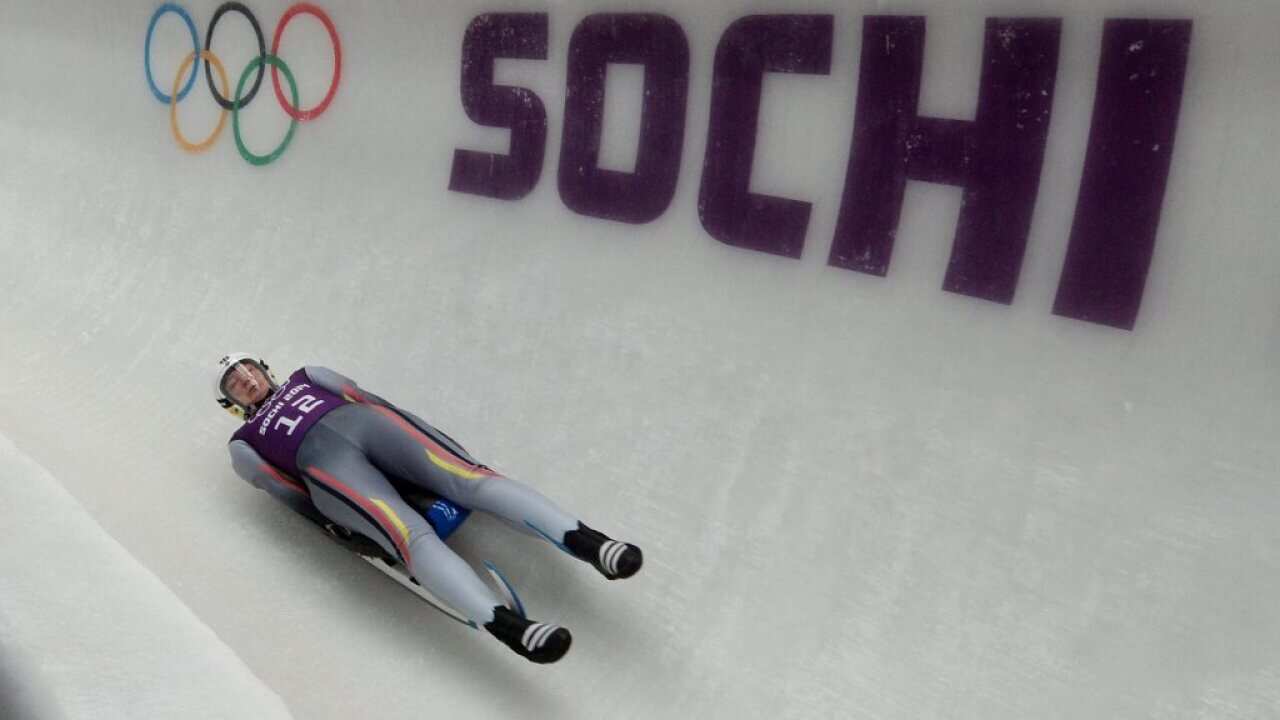
Sports television is rarely commented upon in terms of its aesthetic qualities. Like a lot of the non-fiction content that passes across our screens—with the possible exception of current affairs programs, whose characteristic tropes and tics have been roundly and deservedly satirised—it is kind of an invisible form, unseen and unremarked upon precisely because of its ubiquity. Sports television is so much a part of the audiovisual backdrop to our lives that it is easy to forget that each shot has been framed with intent and spliced with purpose and that the genre has its own set of tropes and tics as well.
While the vast majority of sporting events are covered with the same predictable shots, with an increasing tendency towards overly-elaborate digital inserts and overlays that subtract more than they add, the advent of the Winter Olympics every four years—much more so than their summer equivalent, for some reason—always serves to remind me that there is nevertheless a great deal of aesthetic pleasure to be taken from sports television.
I'm not talking about the obvious aesthetic pleasure that comes from watching a great sportsman or woman in action, mind you, though that certainly plays a role in the enjoyment. I am talking about the less obvious pleasures provided or else mediated by the medium itself: the pleasure, not of the athlete, in other words, but of the televisual image of the athlete. I realise that my emphasis on such a pleasure will put die-hards off-side. David Foster Wallace, in his famous piece about Roger Federer, once wrote that 'TV tennis is to live tennis pretty much as video porn is to the felt reality of human love.' But I think there is enough pleasure involved—enough purely cinematic pleasure—to make the watching of such events on television a similarly rewarding experience.
Slow motion is the most obvious of these. Recently, during the Australian Open, slow motion footage was employed between points and super-slow motion in various montages, often for no more profound a reason than to satisfy our deep-seated wonder at the players' bodies that full-court, real-time footage cannot. Slow motion confirms for us the immanent anatomical majesty of the competitors while also bringing to our attention otherwise-unseen details—the jelly-like rippling of a calf muscle as a player's foot hits the court, say—that simultaneously render these bodies alien and strange.
News that makes sense
Your trusted source for staying up-to-date with the world around you. Get free daily news updates and analysis, straight to your inbox.
This is scientific and fantastic, analytical and chimerical, combining what, from the very beginning, have been the two competing but ultimately complimentary sides of cinema's brain: the Lumière brothers' realism and Georges Méliès' illusionism. (To be fair, the distinction doesn't always hold up.) Taking the analytical impulse that gave us Muybridge's galloping horse or Etienne-Jules Marey's chronophotography and combining it with the artifice of the early cinema of attractions, slow-motion sports photography realises, however unconsciously, the dual nature of the moving image as both magical and scientific—indeed, as magical precisely because scientific—and fulfils what many of cinema's earliest practitioners considered to be the new technology's greatest promise.
The scientific-magical quality of slow-motion photography is readily apparent in the footage coming out of Sochi, too. But here it serves another purpose as well. The use of slow motion is in part about abstracting the athletes' bodies from their narrative context—the world of competition and medals, not to mention politics and scandal—and resituating them in one in which all that matters is the fabulous plasticity of the human machine as it twists and turns and flies and moves through the whites and blues of snow and sky.
In this we can see echoes of Leni Riefenstahl's Olympia, her chronicle of the 1936 Olympic Games, the most artful of her Nazi propaganda films and the project that more than any other ensured the union of slow motion and sports photography forever. The penultimate sequence of the film is also its most famous and uses the technique, paired with clever framing, to transform the high-diving competition at the Berlin Games into a highly erotic modernist dance.
For Riefenstahl, slow motion not only abstracted the athlete's bodies from the realm of competition, but idealised and even mythologised them, too, lifting them to another plane entirely. It turned them into gods. It is thus telling that Jesse Owens, who dashed Hitler's dreams of racial superiority on the rocks of his otherworldly ability, is the only non-Axis competitor to appear in slow motion in the film. While it would perhaps be going too far to call this move subversive on Riefenstahl's part, it is nevertheless to her credit, particularly as Goebbels had let it be known that Hitler didn't want to see Owens in the picture at all, let alone have him presented as equal to the Aryan supermen, which is ultimately the effect that the slow motion had and continues to have to this day.
Then there's the coverage of the figure skating, which has its own set of aesthetic considerations, the most important of which is related to shot size. Typically, each routine is shot using a series of simple medium-wide shots. Close-ups (of hands, of skates, of grimacing faces) only ever follow the conclusion of a run (and usually appear, coincidentally, in slow motion). During a run, by contrast, the prevailing composition is one in which the whole of the skater's body is visible at all times. There are occasional cuts between cameras, of course, but for the most part the shot size remains the same.
Such an observation may, on the face of it, seem like medium-wide shots themselves: kind of bland. But this shot size has been chosen for a reason and plays an important role in our perception of the routines. What is so integral to our experience of the figure skating—and its spectacularly painful-looking falls and failed landings—is the camera's insistence on the validity of the action taking place before us on the ice. The reality of the routines—the integrity of the 'pro-filmic event,' as ethnographic filmmakers call it—is never thrown into question by dubious cuts or inserts. Unlike in a Hollywood sports movie, where the reality of even a staged sporting event is questionable—can Matt Damon really play rugby?—the fact that the figure skater's body can be seen, whole and uninterrupted by a frameline, confirms the reality of the event before us and justifies our wonder at the feats that comprise it.
In this way, television coverage of the figure skating shares some important features with the golden age of Hollywood musicals, and also helps to identify some of what we might perceive to be the modern musical's shortcomings. Personally, what the figure skating routines remind me of most is the 'Make 'Em Laugh' sequence from Singin' in the Rain. This has nothing to do with comedy and everything to do with that aforementioned integrity. What makes the Russian skater Evgeni Plushenko so wonderful to watch is the fact that we can see, at all times, that this is indeed his aging, injured body on the ice, achieving what it's achieving not in fragmented, sporadic bursts, but in one long take. This is what makes Donald O'Connor's increasingly madcap antics in the 'Make 'Em Laugh' sequence so impressive and painful to watch as well.
It's also what's missing from something like Rob Marshall's Oscar-winning Chicago, in which Richard Gere's tap-dancing number is profoundly compromised, not necessarily because it isn't him doing the dancing (it apparently is), but rather because the constant intercutting between his feet, his face and a simultaneous scene taking place in a courtroom cannot but induce that element of doubt. It is very easy to make a bad dancer look good when one's dance studio is the editor's cutting room, very easy to take countless takes of individual movements and splice them into a flawless routine. It is harder by far to execute such a routine in a single-take medium-wide shot, especially when one is expected to execute a bunch of quads or run up a wall and do a backflip. (Once asked at a Q&A with students how he'd pulled this off, O'Connor deadpanned: 'Experience.') If we hold our breath for Plushenko and O'Connor but cock an eyebrow at Gere, this is why. As Jean-Luc Godard once famously said: 'Cinema is truth twenty-four times a second, and every cut is a lie.'
Plushenko is not everybody's cup of tea, of course. He is by most accounts a bit of a narcissist (or a bit of a badass, depending on your view of things) and there are reasons to believe that he essentially strong-armed his way into Sochi when Russia's national champion, Maksim Kovtun, should have been given his turn at bat. But I have been following his Olympic career since he won gold in Turin in 2006, when I was a freshly-minted film school graduate with two weeks to kill in front of sports I didn't give a damn about, and I was pleased when he was given the opportunity to end his Olympic career in front of a home crowd.
This is the last time the 31-year-old will compete at an Olympics—or indeed, most likely, at any such meet—and he has already marked the occasion by winning gold in the team event. This ties him with Sweden's Gillis Grafström as the most decorated figure skater in Olympic history. With his back a constant source of pain—he's a Frankenstein's monster, in some respects, full of bolts—he's unlikely to surpass that record when he competes in the individual men's event this week. But I urge you to watch him anyway. Plushenko is one of the sport's greatest athletes, as well as one of its greatest showmen, and he's almost certain to go out with a bang. And if he doesn't, well, it's okay. We'll always have his 'Sex Bomb' routine:
Matthew Clayfield is a freelance foreign correspondent who covered the 2012 Russian presidential election from Moscow.
UPDATE: Evegni Plushenko has pulled out of the men's individual competition for medical reasons.







